
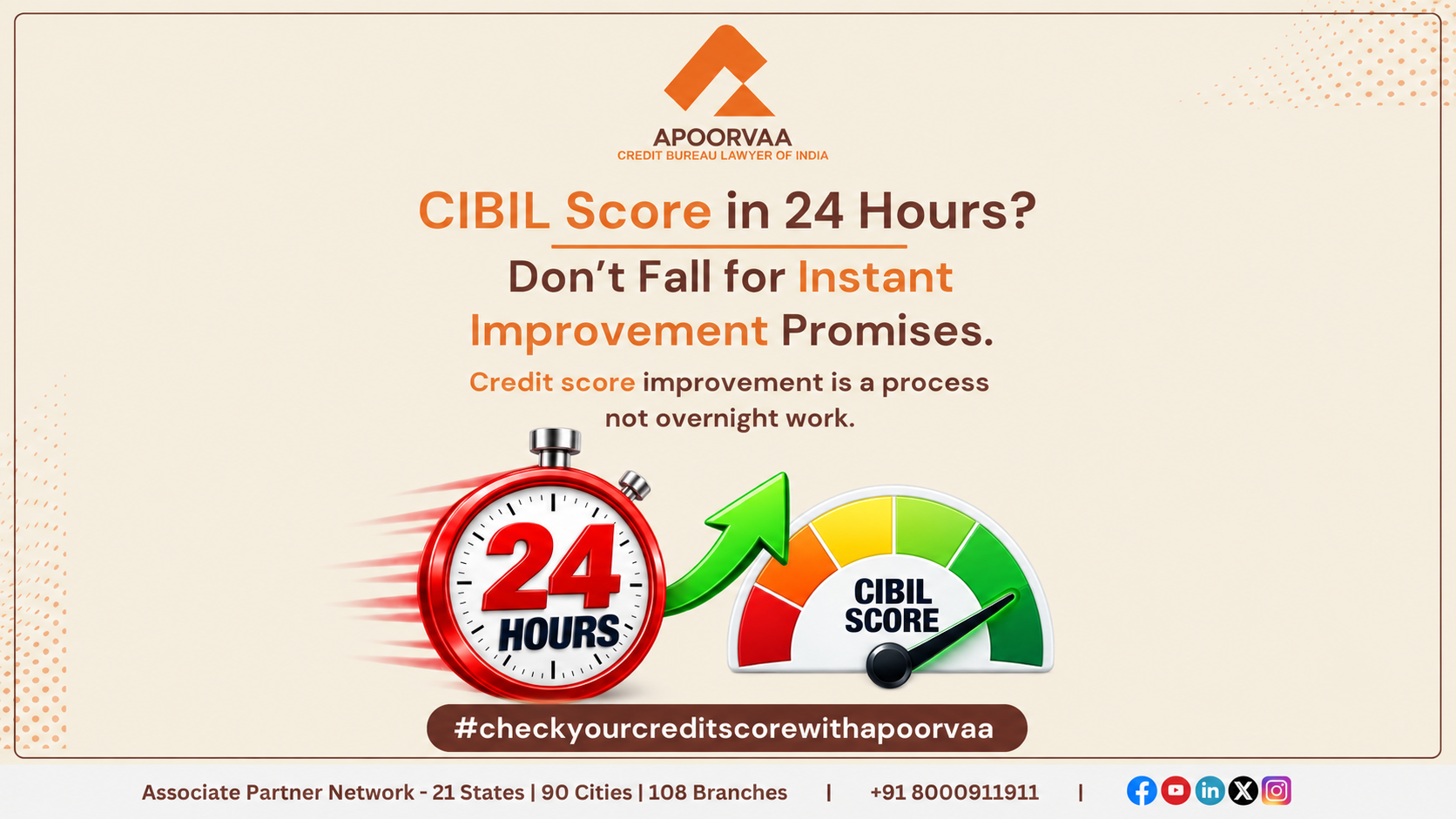
“Improve your CIBIL Score in 24 hours.”
“Increase your credit score within 7 days.”
“Guaranteed CIBIL improvement in 15 days.”
Search online and you may encounter promises like these.
For someone casually researching credit scores, they may simply look like attractive advertisements.
But for a customer whose home loan, business loan, vehicle loan or other financial requirement is urgently waiting, such claims can become extremely persuasive.
The customer may already be under pressure.
A lender may have raised concerns about the credit profile. The customer may have discovered a low CIBIL Score or negative information in the credit report.
Then somebody offers what appears to be the perfect solution:
“Don’t worry. Your CIBIL Score can be improved immediately.”
This is where customers need to understand an important reality:
CIBIL Score improvement is not simply an overnight activity.
A CIBIL Score is calculated using information from a person’s credit profile. TransUnion CIBIL identifies payment history, credit utilisation, age of credit and enquiries among the main factors affecting a score.
Therefore, before trusting promises of 24-hour, 7-day or guaranteed CIBIL Score improvement, it is important to understand what is actually affecting the credit profile.
Why “CIBIL Score Improvement in 24 Hours” Gets Attention
The phrase works because it addresses urgency.
Most customers don’t start searching for CIBIL-related services without a reason.
Usually, something has triggered the search:
- a loan application has not progressed,
- a lender has raised a credit concern,
- the customer has discovered a low score,
- an old account is affecting the credit profile,
- unexpected information has appeared in the report,
- or an important financial requirement is approaching.
At that point, the customer isn’t simply thinking:
“I want a better credit score.”
They may actually be thinking:
“I need this loan urgently.”
That distinction matters.
Because the more urgent the financial requirement becomes, the more attractive an instant solution appears.
But financial urgency does not change how a credit profile works.
A customer’s urgency cannot create years of positive repayment history overnight.
It cannot automatically change genuine historical information.
And it cannot turn every credit-report problem into a guaranteed 24-hour solution.
First Understand What a CIBIL Score Represents
Before discussing CIBIL Score improvement, it is important to understand the score itself.
A CIBIL Score ranges between 300 and 900 and represents a numerical summary of an individual’s credit history.
The underlying CIBIL Report contains much more than the score.
It can include information relating to:
- active and closed credit accounts,
- repayment history,
- balances,
- credit enquiries,
- personal information,
- and other credit-related information supplied by lenders.
CIBIL explains that its score is mainly calculated using payment history, credit utilisation, age of credit and enquiries.
This means the three-digit score should not be viewed as an independently editable number.
The score is an outcome of the underlying credit profile.
That single concept explains why customers should be cautious about instant-score promises.
Two Customers With the Same CIBIL Score May Have Different Problems
Suppose two customers both have a CIBIL Score of 650.
At first glance, their situations appear identical.
But look deeper.
Customer A
May have recent repayment delays.
Customer B
May have very high credit-card utilisation.
Or consider other customers.
One may have several recent credit enquiries.
Another may have a relatively short credit history.
Another may have an old settled account.
Another may believe an account or balance appearing in the report is inaccurate.
Another may have an otherwise healthy credit profile but one particular reporting concern.
The number may be the same.
The reason behind the number may be completely different.
Therefore, offering every customer the same “CIBIL improvement package” without understanding the underlying profile can oversimplify a complex issue.
CIBIL Score Improvement Should Begin With the Cause
At Apoorvaa, one principle is particularly important when evaluating credit-report concerns:
Don’t focus only on the score. Understand what is affecting the credit profile.
This changes the entire conversation.
Instead of asking only:
“How quickly can my CIBIL Score increase?”
the more useful question becomes:
“Why is my credit profile currently showing this score?”
The answer may involve credit behaviour.
It may involve historical account information.
It may involve a genuine reporting concern.
Or several factors may be operating together.
Until the underlying situation is understood, promising a particular score within a particular number of days can create unrealistic expectations.
CIBIL Score Improvement and CIBIL Rectification Are Not the Same
This is one of the most important distinctions customers should understand.
The terms CIBIL Score improvement and CIBIL Rectification are often used interchangeably.
But they should not automatically be treated as the same service.
CIBIL Score Improvement
This relates broadly to how a customer’s credit score develops based on the overall credit profile and credit behaviour.
CIBIL Rectification
This becomes relevant where there is a genuine concern relating to information appearing in the credit report that may require examination and appropriate correction.
Consider two customers.
The first customer’s credit report is accurate, but their credit history includes repeated payment delays and high utilisation.
The second customer believes certain information appearing in the report does not accurately reflect the underlying account circumstances.
These are not identical cases.
A low score does not automatically mean the credit report is wrong.
And equally:
A credit-report problem should not automatically be dismissed simply because the customer has a low score.
Correct assessment matters.
Negative Credit Information Is Not Automatically Incorrect Information
This is another area where unrealistic expectations can arise.
A customer sees words such as:
Overdue
Settled
Written-off
or other negative account information.
The immediate reaction may be:
“This is reducing my score. Please remove it.”
But there is a fundamental difference between:
information that is negative
and
information that is inaccurate.
If an account status genuinely reflects what occurred with the credit facility, the fact that it negatively affects the credit profile does not automatically make it an error.
On the other hand, where reported information genuinely appears inconsistent or inaccurate, that may require appropriate examination.
This distinction is at the heart of responsible CIBIL Rectification.
Why Genuine Credit History Cannot Simply Be “Deleted”
Some advertisements can create an impression that almost any negative information can be removed from a credit report after paying a fee.
Customers should be cautious about such expectations.
TransUnion CIBIL states that it is not authorised to delete or modify records in a Credit Information Report without written confirmation from the respective credit institution.
That is an important fact.
CIBIL is not simply editing a customer’s report because the customer wants a negative entry removed.
The underlying information matters.
The reporting institution matters.
And the accuracy of that information matters.
Therefore:
Genuine CIBIL Rectification should not be confused with guaranteed deletion of genuine credit history.
Payment History Can Affect CIBIL Score Improvement
Payment behaviour is one of the important factors affecting a CIBIL Score.
CIBIL states that late payments, missed payments and delinquencies can negatively affect the score.
Consider a customer with several active loans.
If EMIs have repeatedly been delayed, that repayment behaviour forms part of the customer’s credit history.
A “24-hour score package” cannot manufacture a completely different repayment history.
This is why responsible credit behaviour remains important even when professional assistance is being sought for a genuine credit-report concern.
Rectification cannot substitute for responsible repayment behaviour.
Credit Utilisation Can Also Influence the Score
Consider a credit card with a limit of ₹1,00,000.
Suppose the customer consistently uses ₹90,000–₹1,00,000 of the available limit.
That represents very high utilisation of available revolving credit.
CIBIL identifies higher credit utilisation as something that may make a borrower appear over-extended and negatively affect the credit profile.
So if the customer asks:
“Can you increase my score in 24 hours?”
the better starting point is understanding the broader credit behaviour rather than focusing only on the number.
Age of Credit Cannot Be Manufactured Overnight
Credit history develops with time.
Someone who has responsibly managed credit accounts over many years naturally has a different credit profile from someone who has only recently entered the formal credit system.
CIBIL identifies the age of credit as one of the factors affecting the score.
This creates another simple reality:
You cannot manufacture years of credit history in 24 hours.
Some aspects of credit health inherently develop over time.
Multiple Credit Enquiries Can Matter
Loan urgency can sometimes create another problem.
Imagine this sequence:
A customer applies with Bank A.
The application doesn’t progress.
The customer immediately applies with Bank B.
Then Bank C.
Then an NBFC.
Then another lender.
The customer thinks:
“If I apply everywhere, somebody will approve the loan.”
But lender enquiries become part of the credit report, and CIBIL says frequent applications over a short period may negatively affect the score.
This is why repeatedly applying for new credit without understanding why an earlier application faced difficulty may not solve the underlying issue.
What If There Is Actually an Error in the CIBIL Report?
This is where CIBIL Rectification becomes particularly relevant.
A customer may find information that appears inconsistent with their understanding of the account.
The concern may involve account information, balances, overdue information, ownership or another reported field.
Such circumstances should be distinguished from ordinary score improvement.
CIBIL provides a dispute framework for reported inaccuracies, but CIBIL also states that it cannot make changes to reported information without confirmation from the relevant credit institution.
Therefore, even genuine correction should not automatically be translated into:
“Your score will increase by 100 points tomorrow.”
These are two separate outcomes.
Report Correction Does Not Equal a Guaranteed Score Increase
Suppose a genuine reporting concern is corrected.
What happens next?
The first achievement is that the credit report more accurately reflects the confirmed information.
But customers sometimes expect:
“One correction means my score must increase by 50 points.”
or:
“Once this account is corrected, my score must become 800.”
That assumption should be avoided.
Why?
Because the credit profile may contain many other factors.
There may still be:
- other active accounts,
- repayment history,
- utilisation,
- enquiries,
- account age,
- previous credit behaviour,
- and other information influencing the overall profile.
Correcting genuine inaccurate information and guaranteeing a particular score increase are two different things.
What Does “Updated Instantly” Actually Mean?
This deserves special attention because customers can easily misunderstand the terminology.
CIBIL explains that once corrected data is received from the concerned Credit Institution, its records are updated accordingly.
A customer may hear something like this and conclude:
“So CIBIL Score can be fixed instantly.”
That is not the same statement.
There is an important difference between:
an authorised correction being reflected in the credit records
and
someone guaranteeing that your final score will reach a predetermined number immediately.
This distinction matters when evaluating advertisements promising “instant CIBIL improvement.”
Why 24 Hours, 7 Days and 15 Days Are Dangerous Expectations
The problem is not merely the number of days.
The bigger problem is the word:
Guaranteed.
Every credit profile is different.
If the customer’s situation has not even been properly understood, how can the final score and timeline already be guaranteed?
A customer should therefore be cautious when they hear statements such as:
“Any CIBIL problem solved in 24 hours.”
“Guaranteed 750+ score.”
“300 to 800 CIBIL Score in 7 days.”
“All negative entries removed.”
“Loan guaranteed after CIBIL improvement.”
These claims can create expectations that may not reflect the actual credit circumstances.
Why Customers With Urgent Loans Need to Be Most Careful
Someone casually checking their credit report has time to think.
Someone whose loan is waiting may not.
Imagine:
Property documentation is ready.
A business requires urgent working capital.
A vehicle purchase is waiting.
A financial commitment has already been made.
Then the lender raises a credit concern.
At that moment, the customer doesn’t want education.
They want a solution.
And that emotional pressure makes:
“CIBIL fixed in 24 hours”
extremely powerful.
But this is exactly when unrealistic commitments can cause the greatest harm.
A customer may lose money.
More importantly, they may also lose valuable time while depending on a promise that was never realistic for their credit profile.
CIBIL Score Improvement Does Not Guarantee Loan Approval
Another common misunderstanding is:
“Once my CIBIL Score improves, my loan will definitely be approved.”
That should not be assumed.
A credit score can be an important part of a lender’s assessment, but lending decisions can involve other factors as well.
CIBIL itself describes the score as playing an important role when lenders evaluate loan or credit-card applications; it does not itself make the lender’s approval decision.
Depending on the loan, lenders may evaluate factors such as income, repayment capacity, existing obligations, business financials, security, internal credit policy and the overall application.
Therefore:
CIBIL improvement and loan approval are connected—but they are not the same promise.
Where Professional CIBIL Rectification Actually Matters
After reading about unrealistic promises, customers should not conclude that professional CIBIL Rectification has no role.
It can have an important role.
But that role begins with the credit-report problem, not with an arbitrary guaranteed score.
Where a genuine credit-report concern exists, the circumstances may require proper understanding of:
- what is appearing in the credit profile,
- what type of account or reporting issue is involved,
- whether the information appears consistent with the underlying circumstances,
- and whether the matter represents a genuine rectification concern.
Different credit-report problems can have different causes.
This is precisely why expertise matters.
A genuine credit-report concern deserves assessment—not a shortcut promise.
Why Apoorvaa Does Not Begin With a Guaranteed Score
At Apoorvaa – Credit Bureau Lawyer of India, our work focuses on genuine personal and business credit-bureau concerns.
Our starting question is not:
“What score do you want?”
It is:
“What is actually affecting your credit profile?”
Because until the underlying situation is understood, promising a particular score or timeline would create the wrong expectation.
Some customers may have genuine credit-report concerns.
Some may primarily need better credit behaviour.
Some situations may involve both.
And some negative information may correctly reflect the customer’s historical credit behaviour.
Professional credit rectification begins with understanding the difference.
CIBIL Score Improvement Is Not About Making Negative History Disappear
One of the biggest misunderstandings surrounding CIBIL Score improvement is the belief that every negative item in a credit report can simply be removed.
A customer may see:
- overdue,
- settled,
- written-off,
- delayed payment history,
- high outstanding balances,
- or other negative information,
and immediately think:
“If this is affecting my score, somebody should delete it.”
But negative information and inaccurate information are not the same thing.
If information genuinely reflects the history of a credit account, the fact that it affects the customer’s score does not automatically make it incorrect.
This distinction becomes extremely important when evaluating claims of instant CIBIL Rectification.
The purpose of genuine rectification is accuracy—not artificial removal of genuine credit history.
Can a Settled Account Be Removed to Improve CIBIL Score?
The word “settled” frequently creates concern.
A customer may have negotiated an account in the past and later discover that its status is affecting the credit profile.
At this stage, advertisements promising instant removal can appear attractive.
But customers should first understand that a settled status may represent an actual historical event relating to the account.
Therefore, the right question is not simply:
“Who can delete the settlement fastest?”
The more important question is:
“Does the information appearing in my credit report accurately represent the account circumstances?”
If genuine information is being reported, it should not automatically be treated as an error merely because it is negative.
Where there is a genuine inconsistency in reporting, however, the situation is different and may require professional assessment.
What About Written-Off Accounts?
The same principle applies to written-off accounts.
Customers sometimes approach CIBIL-related services believing:
“Written-off is negative. Remove it and my score will increase.”
But a written-off status can relate to the historical treatment of a credit facility.
Its presence alone does not establish that the information is inaccurate.
This is where responsible CIBIL Rectification differs significantly from unrealistic score-improvement promises.
Professional assessment should determine whether there is a genuine reporting concern—not begin with a promise to remove whatever appears negative.
Can Overdue Amounts Simply Be Deleted?
Another common concern involves an overdue amount appearing in the credit report.
Suppose the report shows an overdue balance.
Before assuming it should disappear, the underlying circumstances matter.
Is the amount genuinely outstanding?
Has the account already been dealt with but the report appears inconsistent?
Is the customer misunderstanding what the reported field represents?
Is there another reporting issue requiring examination?
These situations are not identical.
This is why a provider who promises:
“Every overdue entry will be removed immediately.”
before understanding the account circumstances may be creating an unrealistic expectation.
Paying a Fee Cannot Automatically Rewrite Credit History
Customers sometimes believe that a higher professional fee should produce a larger score increase.
For example:
“If I pay ₹20,000, how many points will my score increase?”
This is the wrong way to evaluate a professional credit-related service.
A service fee does not purchase credit-score points.
Similarly:
₹5,000 does not buy 50 points.
₹10,000 does not buy 100 points.
₹25,000 does not guarantee a 750+ score.
The score continues to depend on the underlying credit profile.
Where professional assistance is required, the value should lie in understanding and addressing genuine credit-report concerns—not selling points on a score.
CIBIL Score improvement should never be presented as a score-purchasing transaction.
Why “Guaranteed 750+ CIBIL Score” Needs Caution
A customer sees an advertisement:
“Guaranteed 750+ CIBIL Score.”
The first reaction may be excitement.
But consider what would be required to make such a guarantee responsibly.
The customer’s:
- complete credit history,
- active accounts,
- repayment behaviour,
- utilisation,
- recent enquiries,
- historical account statuses,
- and any genuine reporting concerns
would all need to be understood.
Even then, the future score is not simply a number chosen by the service provider.
This is why customers should distinguish between:
professional assistance with a genuine credit-report problem
and
a marketing promise of a predetermined score.
Why “300 to 800 CIBIL Score” Is an Extraordinary Claim
A particularly attractive online claim is:
“Increase your CIBIL Score from 300 to 800.”
Sometimes an extremely short timeline is attached:
24 hours.
7 days.
15 days.
The larger the promised jump and the shorter the promised period, the more carefully the customer should evaluate what is actually being offered.
A credit score reflects the broader credit profile.
If someone has years of problematic repayment behaviour, that history cannot simply be replaced with years of responsible behaviour overnight.
Similarly, if the customer’s report contains genuine negative history, paying a service provider does not automatically convert that history into positive credit behaviour.
Extraordinary credit-score promises deserve careful questions—not immediate payment.
Why Instant Promises Can Be Especially Risky During a Loan Requirement
The greatest concern is not merely that a customer may pay unnecessary fees.
There may be another cost:
Time.
Imagine a business owner who urgently requires working capital.
A service provider says:
“Give us seven days. Your CIBIL Score will be fixed and then your loan will happen.”
The business owner waits.
Seven days pass.
Then another explanation is given.
More time passes.
Meanwhile, the actual financial requirement remains unresolved.
For customers facing urgent finance requirements, unrealistic timelines can therefore create both financial and opportunity costs.
The urgency of your loan should never become the reason you stop questioning an unrealistic CIBIL promise.
CIBIL Rectification and Credit Behaviour May Need Different Attention
Consider two customers.
Customer 1
The credit report accurately reflects repeated repayment delays.
Customer 2
The customer identifies information that appears inconsistent with the actual account circumstances.
Both may have a low CIBIL Score.
But they do not necessarily have the same problem.
The first situation may primarily involve the consequences of historical credit behaviour.
The second may involve a genuine CIBIL Rectification concern.
This is why Apoorvaa does not treat every low-score enquiry as an identical rectification case.
Every low CIBIL Score is not automatically a CIBIL Rectification case.
That distinction protects customers from unrealistic expectations.
What Customers Should Understand Before Choosing a CIBIL Service
A customer does not need to become an expert in credit-bureau systems.
But before choosing professional assistance, there are a few things worth understanding.
- Understand What Service Is Actually Being Offered
Is the provider offering:
credit education,
credit-report assessment,
professional assistance for a genuine reporting concern,
or simply:
“guaranteed score improvement”?
Those are not necessarily the same service.
- Don’t Judge Only by the Fastest Timeline
A provider saying 24 hours may sound more attractive than someone explaining that the circumstances need to be understood first.
But the fastest promise is not automatically the most reliable solution.
In credit matters, an accurate understanding of the problem can be more valuable than an impressive timeline.
- Don’t Judge Only by the Lowest Fee
Suppose one provider charges ₹2,000 and promises an instant result.
Another professional service charges more but first evaluates whether there is actually a genuine rectification concern.
The comparison should not simply become:
“Who is cheaper?”
The more important consideration is:
“What exactly am I paying for, and is the promised outcome realistic?”
Professional expertise should be evaluated on the quality and relevance of the service—not merely the lowest quotation.
- Understand the Difference Between Correction and Score Guarantee
If genuinely inaccurate information is corrected, that can improve the accuracy of the credit report.
But it does not automatically mean:
“My score will increase by exactly 100 points.”
A customer should be cautious if these two outcomes are presented as though they are identical.
- Be Careful With Guaranteed Loan Approval
Some customers ultimately want CIBIL improvement because they need a loan.
That makes a combined promise especially attractive:
“We will improve your CIBIL and guarantee your loan.”
But loan approval remains a lender’s decision.
Credit profile is important, but lenders can consider multiple eligibility, financial and policy factors.
CIBIL Rectification should not be sold as guaranteed loan sanction.
Seven Warning Signs Around Instant CIBIL Score Improvement
Customers should pay closer attention when they encounter claims such as:
- “100% Guaranteed CIBIL Score Improvement”
A predetermined future score should not simply be guaranteed.
- “CIBIL Score Increased in 24 Hours”
Ask what exactly will change and why that timeline applies to your individual profile.
- “300 to 800 Score Guaranteed”
An exact dramatic increase deserves careful scrutiny.
- “All Negative Entries Will Be Deleted”
Negative information is not automatically inaccurate information.
- “No Need to Pay Genuine Bank Dues”
A professional service should not create an expectation that genuine financial obligations automatically disappear through credit rectification.
- “Loan Guaranteed After CIBIL Repair”
Credit-related assistance and loan sanction are separate matters.
- “Pay Immediately or You Will Lose the Opportunity”
Financial urgency should not prevent you from understanding what you are purchasing.
These warning signs do not mean every promotional statement automatically proves wrongdoing.
They mean:
Stop. Understand. Ask questions. Then decide.
Can CIBIL Rectification Help When the Problem Is Genuine?
Yes—where there is a genuine credit-report concern, professional assessment and assistance can be relevant.
But the purpose is not to promise an artificial score.
The purpose is to understand the reported information and determine the nature of the concern.
This is an important distinction in Apoorvaa’s approach.
At Apoorvaa – Credit Bureau Lawyer of India, we focus on genuine personal and business credit-bureau matters.
We do not begin by asking:
“How many points do you want?”
We begin with the credit-report concern.
Because before discussing a solution, the problem itself needs to be understood correctly.
Why Root-Cause Understanding Matters in CIBIL Rectification
A low CIBIL Score is an outcome.
The real issue may lie somewhere deeper in the credit profile.
This is why two customers with exactly the same score may require completely different professional observations.
Simply chasing the number can distract customers from the actual issue.
The score tells you there may be something worth understanding. The complete credit profile helps explain the context.
For genuine credit-report concerns, identifying the nature of the issue is therefore more important than beginning with a guaranteed score promise.
CIBIL Is Not the Only Credit Bureau in India
Another point customers often overlook is that CIBIL is only one part of India’s credit-information ecosystem.
India has four RBI-registered credit information companies:
- TransUnion CIBIL,
- Experian,
- Equifax,
- CRIF High Mark.
Different lenders may access credit information according to their systems and policies.
This means credit health should not always be viewed only through one CIBIL number.
A customer may focus entirely on:
“How do I increase my CIBIL Score?”
while overlooking the broader credit-bureau profile.
This is especially relevant where customers have complex personal or business credit histories.
Why Apoorvaa Focuses on Credit-Bureau Matters
The credit-bureau ecosystem involves more than a three-digit score.
A customer’s credit profile can contain information accumulated across multiple accounts, lenders and periods.
That information can affect important financial opportunities.
At Apoorvaa – Credit Bureau Lawyer of India, our focus is on professional assistance for genuine credit-bureau and CIBIL Rectification concerns.
Our objective is not to sell an overnight score promise.
It is to help customers understand whether the issue they are facing genuinely requires professional credit-bureau attention.
Because sometimes the customer needs rectification.
Sometimes the customer primarily needs better credit behaviour.
And sometimes the customer may be expecting removal of information that accurately reflects their historical credit conduct.
Knowing the difference is where professional expertise becomes valuable.
Frequently Asked Questions About CIBIL Score Improvement
Can CIBIL Score increase in 24 hours?
Customers should not assume that there is a universal process capable of increasing every person’s CIBIL Score to a desired level within 24 hours. The score depends on the underlying credit profile.
Can CIBIL Score improve in 7 or 15 days?
There is no single improvement timeline applicable to every customer. Credit histories, account information and the reasons affecting individual scores differ.
Can someone guarantee my CIBIL Score will become 750 or 800?
Customers should be cautious about predetermined score guarantees. A professional service provider does not simply select the score that the credit bureau will calculate.
Can all negative CIBIL entries be removed?
No such general assumption should be made. Negative information is not necessarily inaccurate information. Genuine reporting concerns and genuine negative credit history must be distinguished.
Can an incorrect entry in my CIBIL Report be rectified?
Where information genuinely appears inaccurate or inconsistent, it may require appropriate assessment and rectification. Any change to lender-reported information depends on the relevant facts and confirmation through the credit-reporting ecosystem.
Will rectification immediately increase my score?
Rectification of genuinely inaccurate information improves the accuracy of the credit profile. It should not automatically be translated into a guaranteed number of score points.
Can a settled or written-off account be removed to improve CIBIL?
The presence of a settled or written-off status does not itself prove that the reporting is inaccurate. The underlying account circumstances need to be considered.
Can CIBIL Rectification guarantee my loan?
No. Loan sanction remains the lender’s decision. A particular CIBIL Score or rectification outcome should not be presented as a guarantee of loan approval.
Is a low CIBIL Score always a rectification problem?
No. A low score may result from genuine credit behaviour, or there may be a reporting concern—or both. Understanding the cause is important.
The Most Important Question Is Not “How Fast?”
When customers contact a credit-related service, their first question is often:
“Kitne din mein score improve hoga?”
It is understandable.
But it may not be the most useful first question.
Instead ask:
“What is actually affecting my credit profile?”
Because once the underlying situation is understood, expectations can become more realistic.
The objective should not be to find the person who makes the fastest promise.
The objective should be to understand the credit problem correctly.
Final Thought
CIBIL Score improvement is a process—not overnight work.
Payment history develops over time.
Credit utilisation reflects borrowing behaviour.
Credit history develops over time.
Enquiries become part of the credit profile.
And where genuine reporting concerns exist, they require proper understanding rather than unrealistic promises.
So when you encounter:
“CIBIL Score improve in 24 hours.”
“Guaranteed 800 score.”
“All negative entries removed in 7 days.”
don’t allow urgency alone to influence your decision.
A realistic assessment may not sound as exciting as an instant promise—but it can be far more valuable.
Your credit report represents important financial information.
Understand it properly.
Protect your credit health.
And where a genuine credit-report concern exists, seek relevant professional assistance rather than relying on shortcuts.
Professional Assistance for CIBIL Rectification
If you have a genuine concern regarding information appearing in your personal or business credit report, understanding the nature of the problem is an important first step.
Apoorvaa – Credit Bureau Lawyer of India provides professional assistance for genuine CIBIL Rectification and credit-bureau concerns.
We focus on understanding the credit-report issue rather than promising an artificial score or guaranteed loan outcome.
📞 Free Credit Helpline: +91 8000 911 911
Credit Rectification does not guarantee deletion of genuine credit history, any particular CIBIL Score, loan eligibility or loan approval. Outcomes depend on the individual credit profile and reporting circumstances.
Related Credit Education