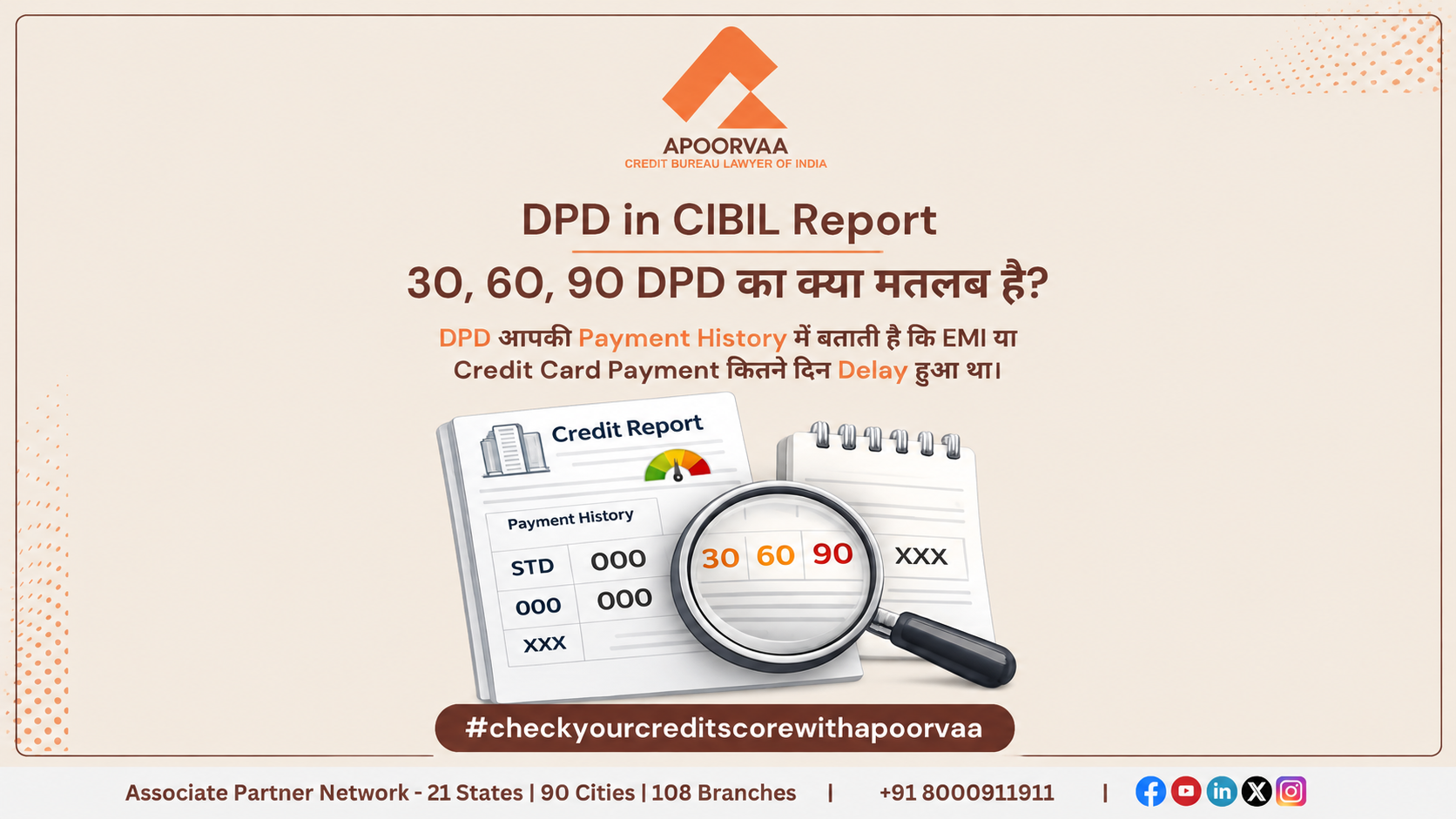
DPD in CIBIL Report is one of the most important areas to examine when trying to understand your credit history. While most borrowers concentrate on their three-digit CIBIL Score, lenders can also evaluate the detailed repayment information appearing behind that score.
When you open the payment-history section of a loan or credit-card account, you may see entries such as:
000 | 30 | 60 | 90 | STD | XXX | SMA | SUB | DBT | LSS
For an ordinary borrower, these numbers and codes can be confusing.
Many people immediately assume that anything other than 000 means their credit profile is permanently damaged.
Others are told:
“Pay the outstanding amount and every old DPD will disappear.”
Some borrowers repeatedly raise disputes hoping that genuine historical payment delays will become zero.
None of these approaches begins with the most important question:
What exactly does the payment history in your CIBIL Report say, and is that information accurate?
Before discussing DPD rectification, borrowers need to understand the difference between a genuine historical payment delay, current delinquency, account classification and incorrect credit reporting.
What Is DPD in a CIBIL Report?
DPD stands for Days Past Due.
It indicates the number of days for which a payment obligation was reported as overdue for a particular credit account during the relevant reporting period.
Suppose you have a home loan, vehicle loan, personal loan or credit card.
The lender expects payment according to the agreed repayment schedule. If the amount becomes overdue, the payment history can reflect the period of delinquency.
For example:
- 30 DPD indicates that the payment was reported approximately 30 days past due.
- 60 DPD indicates a longer overdue period.
- 90 DPD indicates a still longer period of delinquency.
- Other numerical values can also appear depending on the payment history reported for the account.
Therefore, DPD does not simply tell you:
“This account was bad.”
It provides a timeline of how the account was reported during different periods.
That timeline is important.
Why You Should Not Check DPD Without Checking the Month and Year
Suppose you find 90 DPD in your CIBIL Report.
Your first reaction may be:
“Will I get a loan with 90 DPD?”
But that question is incomplete.
You first need to know:
When was the 90 DPD reported?
A 90 DPD appearing against a recent active loan can present a very different credit situation from a 90 DPD reported many years ago on an account that was subsequently resolved.
For example:
Situation 1
A borrower had a credit-card payment delay several years ago. The account was subsequently resolved, and the borrower has maintained regular repayment behaviour across later credit facilities.
Situation 2
A borrower currently has a housing loan and the latest payment history shows repeated EMI delays. The borrower is now applying for an unsecured business loan.
Both borrowers may have numerical DPD in their credit reports.
However, their current repayment behaviour and overall credit profiles are different.
This is why proper credit-report analysis looks at:
- The DPD value.
- Month and year.
- Account concerned.
- Frequency of delinquency.
- Severity of delinquency.
- Whether the issue was subsequently resolved.
- Recent repayment behaviour.
- Current account status.
Simply seeing “90” is not enough to understand the complete situation.
Understanding the CIBIL Payment History Section
DPD is often discussed only in terms of 30, 60 and 90 days.
But borrowers can encounter several other codes in the same payment-history area.
Depending on the reported account information, these may include:
000, STD, XXX, SMA, SUB, DBT and LSS.
These entries do not all mean the same thing.
Some relate to payment delinquency, while others can indicate the reported classification/status of the credit facility.
Understanding these differences is essential before trying to rectify a CIBIL Report.
What Does 000 Mean in a CIBIL Report?
000 generally indicates that there were no days past due for that particular reporting period.
In simple terms, the account was not reported as overdue for that period.
Borrowers often want their entire payment history to display 000.
However, if a genuine payment delay occurred in the past, later repayment of the outstanding amount does not automatically mean that every historical period should be converted to 000.
That distinction becomes particularly important in credit-rectification cases.
What Does STD Mean in CIBIL?
STD means Standard.
It generally indicates that the account was classified as a standard asset for the relevant reporting period.
Borrowers sometimes see STD and assume it is a negative remark because it appears instead of 000.
That assumption is incorrect.
STD itself should not automatically be interpreted as a delinquency.
This is why borrowers should understand the meaning of a code before attempting to dispute it.
What Does XXX Mean in CIBIL?
XXX generally indicates that payment-history information was not reported or was unavailable for the particular period.
It should not automatically be interpreted as:
- A missed EMI.
- A default.
- 30 DPD.
- 60 DPD.
- 90 DPD.
If XXX appears in your report, examine the complete account history rather than treating the code itself as evidence of delinquency.
What Does 30 DPD Mean?
A 30 DPD entry indicates that the payment was reported approximately 30 days past due for that particular reporting period.
If you see 30 DPD, first check the corresponding month and year.
Then compare it with:
- EMI due date.
- Actual payment date.
- Bank statement.
- Loan statement.
- Payment receipt.
If the payment was genuinely delayed, the entry may accurately represent historical repayment behaviour.
If your records show that payment was made according to schedule, however, the reporting should be examined more closely.
What Does 60 DPD Mean?
60 DPD indicates a longer period of overdue payment.
Repeated progression from lower to higher DPD values may indicate that an account remained unresolved over successive reporting periods.
For example, a payment history showing a pattern such as:
30 → 60 → 90
requires a different analysis from a single isolated historical delay.
The complete account should therefore be reviewed instead of focusing on one number.
What Does 90 DPD Mean?
A 90 DPD entry indicates that the account was reported approximately 90 days past due during the relevant reporting period.
This is a significant delinquency indicator and deserves proper examination.
However, it still needs context.
A historical 90 DPD from years ago, followed by resolution of the account and subsequent disciplined credit behaviour, is different from a recently reported 90 DPD on an active loan.
Therefore, the better question is not merely:
“Is 90 DPD bad?”
It is:
“Why was 90 DPD reported, when did it occur, was it accurate, what happened to that account afterwards, and what does my current repayment history show?”
What Is SMA in a CIBIL Report?
SMA stands for Special Mention Account.
SMA is associated with accounts showing signs of repayment stress.
Under RBI’s prudential framework, overdue term-loan accounts can move through Special Mention Account categories before NPA classification. Broadly, these include:
- SMA-0: up to 30 days overdue.
- SMA-1: more than 30 days and up to 60 days overdue.
- SMA-2: more than 60 days and up to 90 days overdue.
The applicable treatment can depend on the nature of the credit facility and regulatory framework.
For borrowers, the important point is that SMA should not be interpreted in the same way as STD or XXX.
If SMA appears in a credit report, the concerned account and reporting period should be examined carefully.
What Does SUB Mean in CIBIL?
SUB means Sub-Standard.
This represents a more serious asset classification than a standard account.
Under the applicable RBI prudential framework, an account classified as an NPA can fall within the sub-standard category for the prescribed period.
Therefore, seeing SUB in payment history deserves closer attention.
A borrower should examine:
- Which account carries the classification.
- When it was reported.
- What outstanding liability existed at the time.
- Whether the account was subsequently resolved.
- How the account is presently being reported.
Simply paying an amount today does not automatically mean that every historical classification disappears.
What Does DBT Mean in CIBIL?
DBT means Doubtful.
A doubtful classification represents a further deterioration from the sub-standard category under the applicable asset-classification framework.
Therefore, DBT should not be treated merely as another unfamiliar abbreviation in a credit report.
If your report contains DBT, the complete account history requires careful examination.
The objective should be to understand why the account reached that classification and whether the information being reported corresponds with the lender’s records.
What Does LSS Mean in CIBIL?
LSS means Loss.
This is a serious asset classification.
A loss asset refers to an account where loss has been identified and the asset is regarded as substantially uncollectible under the applicable prudential framework, although some recovery value may still exist.
For a borrower, an LSS entry requires a detailed understanding of the underlying credit account.
It should never be treated as equivalent to 000, STD or XXX.
DPD Numbers and Asset Classification Codes Are Different
This is one of the most important points when reading a CIBIL Report.
A numerical value such as:
30 | 60 | 90
primarily communicates Days Past Due.
Codes such as:
STD | SUB | DBT | LSS
communicate information relating to the classification/status of the account.
SMA is associated with special-mention classification for stressed accounts under the applicable framework.
And XXX generally indicates unavailable/unreported payment-history information for that period.
Therefore, seeing all these entries within the payment-history section does not mean they should all be interpreted as different versions of DPD.
A proper credit-report analysis distinguishes between them.
Can DPD Be Rectified?
Yes—but the word “rectified” needs to be understood correctly.
There are two completely different situations.
Situation 1: The DPD Is Accurate
Suppose your EMI was genuinely delayed by 90 days.
The lender correctly reported 90 DPD.
Later, you paid the outstanding amount and resolved the liability.
In this situation, the current account information should appropriately reflect subsequent developments, but the fact that a genuine payment delay occurred historically does not automatically become incorrect merely because the account was later resolved.
Situation 2: The DPD Is Incorrect
Suppose the report shows 90 DPD, but your bank statements, payment receipts and lender records establish that the payment was made according to the agreed schedule.
Now the issue is different.
You are not asking for genuine negative history to be deleted.
You are identifying a possible credit-reporting error.
That distinction determines whether a genuine credit-rectification process may be required.
Credit Rectification Is About Accuracy, Not Artificially Cleaning History
This principle is central to understanding DPD.
Credit rectification should not mean:
“Remove every negative-looking entry from my report.”
It should mean:
“Identify whether the information reported about my credit accounts is accurate and take the appropriate action where it is not.”
An accurate historical delay should not be treated like a reporting error.
At the same time, an incorrect DPD should not simply be accepted because it appears in a bureau report.
The underlying account records, supporting documents and lender reporting must be examined.
That is where proper credit-report analysis becomes important.
How to Verify Whether DPD Is Incorrect
Before starting any DPD rectification process, establish whether the entry is actually wrong.
A negative-looking entry is not automatically an incorrect entry.
Suppose your CIBIL Report shows 60 DPD for a loan account in a particular month. Start by comparing that reporting period with your actual repayment records.
Check:
- EMI due date.
- Actual payment date.
- Amount due.
- Amount paid.
- Loan account statement.
- Bank statement from which the payment was made.
- Any communication received from the lender.
If the EMI was genuinely delayed, the reported DPD may correctly represent what happened.
However, if your documents establish that payment was made according to schedule but the report shows a delay, there may be a legitimate reporting discrepancy requiring further examination.
This verification should come before raising a dispute.
Documents Required for DPD Rectification
Documentation plays an important role when challenging inaccurate credit information.
Depending on the nature of the issue, useful documents may include:
- Loan account statements.
- Credit-card statements.
- Bank statements showing payment.
- EMI receipts.
- Payment acknowledgements.
- Emails exchanged with the lender.
- Loan closure letters.
- No Due Certificate, where applicable.
- Settlement documentation, where relevant.
- Previous correspondence regarding the disputed account.
The documents required will depend on what exactly is being challenged.
For example, if you are claiming that an EMI was paid on time, evidence showing the due date and actual payment date becomes particularly important.
Credit rectification should therefore be evidence-based rather than based simply on the borrower’s recollection of what happened.
Should You Contact CIBIL or the Bank for Wrong DPD?
This is another area where borrowers frequently become confused.
Credit information appearing in a bureau report originates from information furnished by credit institutions. Therefore, where a DPD or account classification appears incorrect, the concerned lender’s underlying records are extremely important.
A borrower may use the applicable credit-information dispute mechanism, but the reporting institution may need to verify the disputed information.
That is why simply raising the same dispute repeatedly without addressing the underlying lender records may not solve the issue.
A more structured approach is:
- Identify the incorrect entry.
- Collect supporting documents.
- Compare the credit report with the lender’s records.
- Communicate the discrepancy clearly.
- Use the appropriate dispute/correction process where required.
- Review the updated report after the process is completed.
If the lender confirms that its original reporting was correct, repeatedly raising identical disputes without new supporting evidence is unlikely to change genuine historical information.
Does a No Due Certificate Remove DPD?
Not automatically.
This distinction is extremely important in credit-rectification cases.
A No Due Certificate can establish that no amount remains payable under the account according to the circumstances in which the certificate was issued.
However, it does not automatically mean that genuine historical payment delays should disappear.
Suppose your repayment history was:
000 → 30 → 60 → 90
and you subsequently cleared the complete outstanding liability and obtained appropriate closure documentation.
The lender may update the account’s subsequent/current status appropriately.
But if the 30, 60 and 90 DPD entries accurately reflected payment delays during those earlier months, clearing the account later does not necessarily turn the historical sequence into:
000 → 000 → 000 → 000
The current liability and historical repayment behaviour are separate aspects of the credit account.
What Happens to SMA, SUB, DBT or LSS After Payment?
The same principle requires careful understanding when the payment history contains classifications such as SMA, SUB, DBT or LSS.
Resolving an account can affect its subsequent/current reporting as applicable, but borrowers should not automatically expect historical classifications to vanish merely because payment has now been made.
Instead, examine:
- What classification was reported.
- During which period it appeared.
- Why the account received that classification.
- Whether the underlying overdue was subsequently resolved.
- What the lender’s current records show.
- Whether the historical reporting itself was accurate.
If the classification accurately reflected the account’s condition during that period, subsequent resolution does not necessarily make the historical information incorrect.
If the classification itself was wrongly reported, however, supporting records become important for seeking appropriate correction.
Old DPD vs Recent DPD During Loan Approval
Borrowers frequently ask:
“I have 90 DPD. Will the bank reject my loan?”
There is no universal answer based only on that number.
Banks and financial institutions have their own credit policies, underwriting standards and risk-assessment processes.
A lender may consider the overall credit profile, including the recency, frequency and severity of delinquency.
For example, consider two cases.
Case A: Old DPD
A borrower delayed a credit-card payment many years ago. The account was subsequently resolved, and the borrower has maintained regular repayment behaviour since then.
Case B: Recent DPD
A borrower currently has a housing loan and the last few EMIs have repeatedly been delayed. The borrower is now applying for an unsecured business loan.
Both borrowers have payment delays in their credit history.
However, the second case reflects current repayment stress, while the first involves historical behaviour followed by subsequent repayment performance.
A lender may assess these profiles differently according to its internal credit policy.
Therefore, an old DPD should not automatically make a borrower conclude:
“I will never get another loan.”
At the same time, recent repeated DPD should not be ignored.
Can DPD Affect Your CIBIL Score?
Payment history is an important component of a borrower’s overall credit profile.
Repeated or serious payment delinquency can therefore be relevant to creditworthiness and may influence the overall credit assessment.
However, borrowers should avoid trying to calculate a fixed number of CIBIL Score points that will supposedly be lost because of one 30, 60 or 90 DPD.
A credit score is calculated using multiple elements of the credit profile, and the exact scoring methodology is proprietary.
The more practical approach is to concentrate on:
- Resolving current genuine overdues.
- Maintaining regular repayment behaviour.
- Correcting inaccurate information.
- Using credit responsibly.
- Avoiding unnecessary repeated loan enquiries.
- Reviewing the complete credit report periodically.
Common Mistakes Borrowers Make with DPD
One of the biggest mistakes is concentrating only on making the negative entry disappear.
Other common mistakes include:
Raising disputes against accurate history: A dispute should address inaccurate information, not simply information the borrower does not like.
Assuming payment automatically resets history: Clearing an outstanding amount does not necessarily convert genuine historical DPD into 000.
Ignoring current repayment problems: Trying to remove an old DPD while current EMIs are repeatedly bouncing misses the more immediate problem.
Looking only at the CIBIL Score: The detailed credit report often provides far more useful information about the underlying issue.
Trusting guaranteed DPD-removal promises: Whether an entry can legitimately be corrected depends on its accuracy and supporting records.
Applying repeatedly for loans: If the underlying credit issue has not been understood, approaching multiple lenders may not solve the problem.
What Should You Do After Finding DPD in Your CIBIL Report?
Follow a structured process:
Step 1 – Identify the account
Find exactly which loan or credit card contains the DPD or classification.
Step 2 – Identify the reporting period
Check the month and year.
Step 3 – Understand the entry
Determine whether it is numerical DPD, STD, XXX, SMA, SUB, DBT or LSS.
Step 4 – Compare it with lender records
Review statements, payment dates and supporting documents.
Step 5 – Determine whether it is accurate
Separate genuine historical delinquency from possible reporting errors.
Step 6 – Resolve current liabilities
If genuine dues remain outstanding, understand and appropriately address them.
Step 7 – Seek correction where justified
If the information is inaccurate, follow the appropriate lender and credit-information correction/dispute process with supporting evidence.
Step 8 – Maintain responsible repayment behaviour
Credit rectification should be accompanied by disciplined management of active credit facilities.
Frequently Asked Questions About DPD in CIBIL Report
Can 30 DPD be removed from CIBIL?
If 30 DPD accurately reflects a genuine payment delay, subsequent payment does not automatically make the historical information incorrect. If it was reported inaccurately, the records should be examined and appropriate correction pursued.
Can 90 DPD be corrected?
Yes, where the 90 DPD itself is factually inaccurate and supporting records establish the discrepancy. A genuine historical 90-day payment delay, however, should not be confused with a reporting error.
How long does DPD remain in a CIBIL Report?
The visibility of historical information is subject to the credit bureau’s applicable reporting and retention framework. Borrowers should avoid assuming that an entry can be deleted merely because a certain number of years have passed. More importantly, verify whether the information currently appearing is accurate.
Does clearing overdue payment improve CIBIL?
Resolving genuine overdue obligations is an important step towards improving the overall credit position. However, credit scores are influenced by multiple factors, and borrowers should not expect an immediate or guaranteed increase by a specific number of points.
Can a bank reject a loan because of DPD?
Banks make lending decisions according to their own credit policies and risk assessment. DPD may form part of that assessment, but its significance can depend on factors such as recency, severity, frequency, subsequent repayment behaviour and the applicant’s overall profile.
Is STD bad in a CIBIL Report?
STD generally means Standard and should not automatically be interpreted as negative delinquency.
Is XXX a default?
Not necessarily. XXX generally indicates that payment-history information was not reported or available for that period. It should not automatically be interpreted as a missed payment.
Can SMA, SUB, DBT or LSS be rectified?
If such a classification was incorrectly reported, the underlying records should be examined and appropriate correction pursued with supporting evidence. If it accurately reflected the account classification during that period, subsequent resolution does not automatically make the historical classification incorrect.
Final Thoughts
DPD in CIBIL Report should never be analysed by looking at one number in isolation.
A 30, 60 or 90 DPD tells you about reported payment delinquency during a particular period. STD, SMA, SUB, DBT and LSS provide different information relating to the reported condition or classification of an account, while XXX has a different meaning again.
The most important question is not:
“How do I delete this negative entry?”
It is:
“Is this information accurate, why was it reported, what is the present position of the account, and what action is actually required?”
If the historical DPD is genuine, paying the outstanding amount later does not necessarily erase the fact that a delay occurred.
If the information is incorrect, however, borrowers have every reason to examine the discrepancy, collect appropriate documents and follow the prescribed correction process.
And when the DPD is old, don’t automatically assume that one historical delay permanently destroys future loan eligibility. Equally, don’t ignore recent repeated delinquency simply because the CIBIL Score still appears acceptable.
A healthy credit profile begins with an accurate credit report, proper resolution of genuine liabilities and disciplined repayment behaviour—not shortcuts or artificial deletion of genuine history.
Need Professional Help with DPD or Your Credit Report?
Finding 30, 60, 90 DPD, SMA, SUB, DBT, LSS or another negative entry in your CIBIL Report does not automatically tell you what needs to be done.
The first requirement is proper Credit Report analysis.
You need to determine whether the entry represents genuine historical repayment behaviour, an unresolved lender issue, an incorrect classification or another credit-reporting discrepancy.
At Apoorvaa – Credit Bureau Lawyer of India, we specialise in Credit Rectification and detailed Credit Report analysis for individuals and businesses.
We help borrowers understand the negative entries appearing in their credit reports, examine available lender and payment records, identify genuine reporting concerns and guide them through the appropriate and lawful rectification process wherever correction is justified.
If a DPD or negative account is affecting your CIBIL Score, Credit Report or loan eligibility, don’t repeatedly raise disputes or rely on someone promising guaranteed deletion.
Get the complete Credit Report analysed first. Once the actual reason is identified, the correct Credit Rectification process can begin.
This is especially important before applying repeatedly for new loans, because understanding and addressing the underlying credit issue can save both time and unnecessary loan enquiries.