
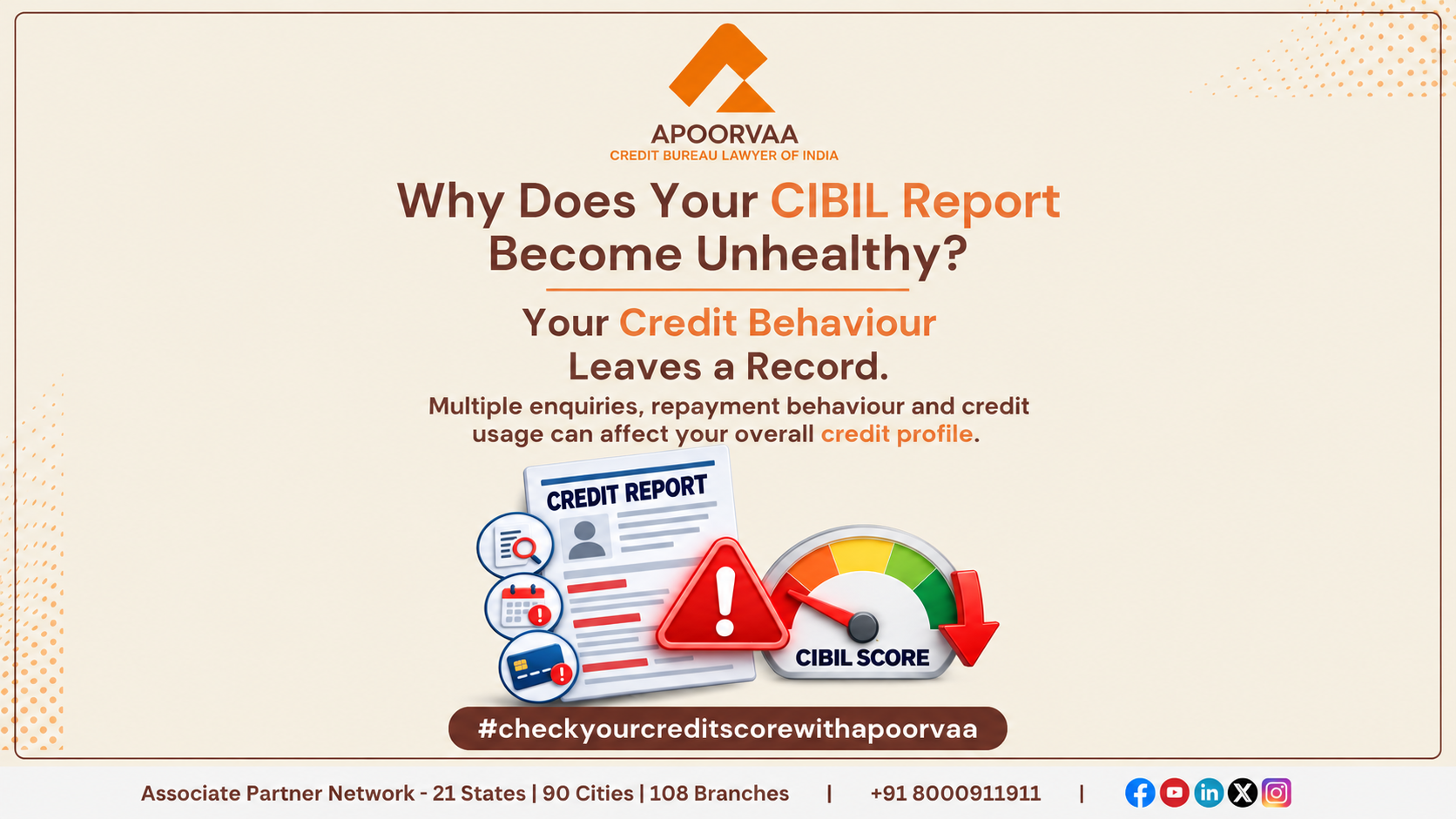
When people discover that their CIBIL Score is low, they often start searching for one thing:
“How can I improve my CIBIL Score?”
But a low score is usually the outcome, not the complete explanation of the problem.
The more important question is:
“What inside my complete CIBIL Report may be affecting my credit profile?”
Your CIBIL Report contains information about your credit accounts, repayment history, outstanding positions, account status and lender enquiries. CIBIL itself recommends reviewing the complete Score and Report to understand credit health and identify possible inaccuracies.
This matters because two customers with similar CIBIL Scores may have completely different credit situations.
One may have delayed EMIs.
Another may have high credit-card utilisation.
Another may have made several loan applications within a short period.
Someone else may have an old settled or written-off account.
And another customer may believe that information appearing in the CIBIL Report is inaccurate or outdated.
Therefore:
Don’t look only at the CIBIL Score. Understand what inside the complete CIBIL Report may be affecting your credit profile.
Here are 10 important factors to consider.
- EMI and Loan Repayment History
Your past repayment behaviour is an important part of your credit profile.
When you take a loan from a bank or NBFC, the manner in which you service that credit facility becomes relevant to your credit history.
If EMIs were regularly paid according to schedule, the repayment history reflects one type of credit behaviour.
If payments were repeatedly delayed, missed or bounced, the history can look very different.
A customer may currently be financially stable and paying every EMI on time, but that does not necessarily erase what happened earlier.
This is why the right question is not only:
“Am I paying my EMI today?”
It is also:
“What repayment history is appearing in my CIBIL Report?”
Your current financial position and your historical credit behaviour are not necessarily the same thing.
- Credit-Card Payment Behaviour
Customers sometimes pay close attention to loan EMIs while treating credit cards differently.
But a credit card is also a credit facility.
Repeated late payments or irregular credit-card payment behaviour can become relevant to the overall credit profile.
For example, someone may have a perfectly regular home loan but a history of delayed credit-card payments.
Looking only at the home-loan account could therefore create an incomplete picture.
When assessing why a credit profile appears weak, the customer’s different credit facilities need to be understood together.
- High Credit Utilisation
Credit-card payment history is one issue.
Credit utilisation is another.
Suppose your credit-card limit is ₹2,00,000 and you consistently use a very large portion of that available limit.
Even if you make payments, the level of credit utilisation can still be relevant to the CIBIL Score.
CIBIL specifically advises customers to keep balances low and identifies credit utilisation as an important part of healthy credit behaviour.
This is why:
“I always pay my credit card.”
does not necessarily answer every question about how the card is affecting the credit profile.
How you repay credit matters, but how you use available credit can matter too.
- Multiple Loan and Credit Enquiries
This is one of the most important factors in today’s discussion.
Imagine that you urgently require a loan.
You apply with Bank A.
The application does not proceed.
You then apply with Bank B.
Then Bank C.
Then an NBFC.
The thinking is understandable:
“If one lender doesn’t approve me, another one might.”
But repeated applications can lead to multiple lender enquiries appearing in the CIBIL Report.
CIBIL itself advises customers to apply for new credit in moderation rather than continuously seeking additional credit.
This creates an important lesson.
If a lender has raised a credit concern, applying everywhere else without understanding the original problem may not be the right response.
First determine whether the difficulty actually relates to the CIBIL Report.
If it does, understand what the report is showing before creating unnecessary additional credit activity.
- Settled or Written-Off Accounts
Words such as Settled and Written-Off can become important when evaluating a CIBIL Report.
A customer may say:
“That was an old loan. The matter was dealt with years ago.”
But the historical status of a credit facility can still be relevant to understanding the overall credit profile.
More importantly, customers need to understand a critical distinction:
Negative information is not automatically incorrect information.
If an account genuinely went through settlement or another negative credit event and the report accurately reflects what occurred, it should not automatically be treated as a reporting error simply because it is affecting the customer’s present credit profile.
This distinction becomes particularly important when discussing CIBIL Rectification.
The objective should not be to assume that every negative word can simply be deleted.
The first objective should be to understand what the account status represents.
- Overdue and DPD History
Another area that often creates confusion is DPD — Days Past Due.
Customers sometimes look only at the current outstanding or overdue amount and conclude:
“There is no overdue today, so my repayment history should be fine.”
But current account position and historical payment behaviour are different.
The Accounts section of a CIBIL Report contains information about credit facilities and payment history. CIBIL’s own explanatory material notes that account information includes items such as current balance, amount overdue and monthly payment records.
Therefore:
“My account is regular today” does not necessarily mean “my account has always been regular.”
Historical delays can still be relevant when understanding why the overall credit profile is weaker than expected.
- Multiple Existing Credit Obligations
Having several loans does not automatically mean that a customer has a bad CIBIL Report.
However, the overall level and nature of existing credit obligations can still be relevant when understanding a customer’s financial and credit position.
A person may simultaneously have:
- a home loan,
- vehicle loan,
- personal loan,
- consumer finance,
- and several credit cards.
Looking at only one account would not show the complete picture.
This is another reason why the complete CIBIL Report is more informative than focusing only on one loan or one three-digit score.
Credit health should be understood as a profile—not as one isolated account.
- Co-Borrower, Joint Account or Guarantor Exposure
A frequently overlooked area is credit where the customer is not the only or primary person using the funds.
Someone may say:
“That isn’t my loan. I was only the guarantor.”
Or:
“The loan was mainly for my family member. I was only the co-borrower.”
But CIBIL specifically advises customers to monitor co-signed, guaranteed and jointly held accounts, noting that missed payments on such accounts can affect the person’s ability to access credit.
This is why becoming a guarantor, co-borrower or joint borrower should never be treated as merely signing a document.
A credit obligation can matter even when you were not the person who primarily used the borrowed money.
- Incorrect, Unrecognised or Outdated Information
Not every CIBIL Report concern originates from poor credit behaviour.
Sometimes the concern may involve the information being reported.
A customer may notice:
- an account that does not appear to belong to them,
- an unfamiliar enquiry,
- an unexpected current balance or overdue amount,
- an account status that appears incorrect,
- or information that has not been updated as expected.
CIBIL acknowledges that inaccuracies can include ownership issues, incorrect personal details and inaccurate account information. It also states that the information in the report is based on data supplied by credit institutions and that CIBIL cannot independently modify lender-reported information without confirmation from the relevant credit institution.
This is fundamentally different from ordinary score improvement.
If information genuinely appears inconsistent, the important question becomes:
“Is my Credit Report accurately reflecting my credit position?”
not simply:
“How can I increase my score?”
- Looking Only at the CIBIL Score Instead of the Complete Report
This may be the most important factor of all.
A customer checks the score.
It is 620, 650 or 680.
Immediately the question becomes:
“How do I make it 750?”
But what does the number alone tell you about the underlying cause?
Not enough.
You still need to understand whether the broader profile involves:
repayment delays,
credit-card payment behaviour,
high utilisation,
multiple enquiries,
settled or written-off accounts,
historical overdue or DPD,
multiple credit obligations,
co-borrower or guarantor exposure,
or information that appears inaccurate or outdated.
This is the fundamental difference between score-focused thinking and credit-profile assessment.
A low CIBIL Score is an outcome. The complete CIBIL Report is where you start looking for the cause.
Why the Same CIBIL Score Can Mean Different Things for Different Customers
Consider three customers who all have a relatively weak score.
Customer A
Has genuine historical repayment delays.
Customer B
Has several recent credit enquiries and high credit utilisation.
Customer C
Believes certain account information appearing in the CIBIL Report is inaccurate.
All three may tell us:
“My CIBIL is bad.”
But these are clearly not identical credit situations.
This is exactly why generic advice such as “follow these five tricks to increase your CIBIL Score” can miss the real issue.
Before deciding what should happen next, the underlying reason needs to be understood.
Different credit problems require different understanding.
And this is where analysing the complete credit profile becomes far more meaningful than focusing only on the headline score.
Don’t Start With “How Do I Increase My Score?”
Start with:
“Why is my credit profile at this position?”
That single change in question can completely change how you understand a CIBIL problem.
If the cause is genuine repayment behaviour, that needs to be recognised.
If utilisation or repeated enquiries are contributing factors, that is a different situation.
If the concern involves a settled or written-off account, the historical circumstances matter.
And if information genuinely appears inaccurate, that becomes a different kind of credit-report concern altogether.
Understanding the cause comes before deciding the solution.
A Bad Credit Profile and an Incorrect CIBIL Report Are Not the Same Thing
After understanding the 10 factors in Part 1, there is one distinction every customer should understand:
A low CIBIL Score does not automatically mean there is an error in your CIBIL Report.
Suppose your score is affected by genuine delayed payments, high credit utilisation, multiple enquiries or historical account status. The information may be negative, but that does not automatically make it incorrect.
Now consider a different situation.
A customer finds an account they do not recognise, an unexpected balance, an account status they believe is inconsistent, or information that appears outdated.
That may represent a different type of credit-report concern.
This distinction matters because genuine negative history and potentially inaccurate reporting should not be treated as the same problem.
When Does CIBIL Rectification Become Relevant?
Customers sometimes approach CIBIL Rectification with only one objective:
“My score is low. Please increase it.”
But professional Credit Rectification should begin by understanding why the credit profile is weak and whether there is a genuine reporting concern.
A low CIBIL Score alone does not prove that something in the report can or should be rectified.
Similarly, a settled account, written-off status or historical DPD should not automatically be classified as an error merely because it is negatively affecting the credit profile.
At Apoorvaa – Credit Bureau Lawyer of India, the important starting point is understanding the nature of the credit-report concern.
The question is not simply “How many points can the score increase?” The question is “What is actually affecting the CIBIL Report?”
This distinction helps separate genuine Credit Rectification matters from general credit-health issues.
Genuine Negative Credit History Cannot Simply Be Treated as an Error
This is particularly important with historical credit problems.
Suppose a customer genuinely:
- delayed EMIs,
- defaulted on repayments,
- settled a credit facility,
- or experienced another negative credit event.
If the CIBIL Report accurately reflects what happened, the customer cannot assume that the information is incorrect simply because it is now creating difficulty.
On the other hand, if the information does not accurately reflect the actual account circumstances, that deserves a different assessment.
Therefore:
Negative information may be accurate. Inaccurate information may require attention. The two should never be confused.
This is why responsible Credit Rectification cannot be based on blanket promises to “remove all negative entries.”
Why “Increase My CIBIL Score” May Be the Wrong Starting Point
A customer may have a score of 620, 650 or 680 and immediately set a target:
“I need 750.”
But the target number does not tell us what is happening inside the CIBIL Report.
Consider the difference:
Customer A: Historical EMI delays are affecting the credit profile.
Customer B: Multiple recent enquiries and high utilisation are present.
Customer C: A settled account appears in the report.
Customer D: The customer believes certain reported information is inaccurate.
All four may want a higher score.
But their underlying situations are different.
That is why the first objective should be diagnosis of the credit-profile concern, not simply chasing a predetermined number.
Understand the cause first. The score is the outcome.
Why Repeated Loan Applications Can Make the Situation More Complicated
Today’s video highlights another common borrower mistake.
A loan application does not proceed.
The borrower immediately approaches another bank.
Then another lender.
Then another NBFC.
But if the original difficulty relates to the credit profile, changing the lender does not automatically change what appears in the CIBIL Report.
At the same time, additional credit applications can create additional lender enquiries.
This does not mean every loan rejection is caused by CIBIL. Banks and NBFCs evaluate many factors, including income, repayment capacity, existing obligations and their own credit policies.
But where a lender specifically raises a credit-report concern, repeatedly applying elsewhere without understanding that concern may not be the right first move.
Before creating another loan application, understand why the previous application faced difficulty.
What Does Professional Credit Report Assessment Mean?
Professional assessment of a credit-report concern is different from simply reading out the CIBIL Score.
The objective is to understand the nature of the issue appearing in the overall credit profile.
For example:
Is the concern connected with historical repayment behaviour?
Is an old account status involved?
Are multiple credit obligations relevant?
Does the customer believe certain reported information is inconsistent with the actual account?
Is the customer confusing genuine negative history with an incorrect entry?
These questions help establish what type of credit concern actually exists.
At Apoorvaa, this distinction is important because not every low score represents the same problem, and not every negative entry represents a rectification matter.
A Credit Report should be understood before a rectification strategy is considered.
Don’t Wait Until Your Loan Becomes Urgent
Many customers first examine their complete CIBIL Report when they urgently need finance.
A home has already been selected.
A business needs working capital.
Machinery needs to be purchased.
A loan against property is required.
Then the lender raises a credit concern.
At that point, the customer is under pressure and begins searching for an immediate solution.
A better approach is to understand your credit profile before an important borrowing requirement becomes urgent.
This is particularly useful if you already know that your credit history includes past delays, settlement, multiple obligations or another issue that may deserve attention.
Credit awareness before a loan application is better than discovering a credit problem after rejection.
Frequently Asked Questions About a Bad CIBIL Report
Why is my CIBIL Score low even though I currently pay all EMIs on time?
Your current repayment behaviour is important, but the complete CIBIL Report may also contain historical repayment information, credit utilisation, enquiries, account status and other credit information. The score should therefore be understood in the context of the broader report.
Can multiple loan enquiries affect my CIBIL Score?
Frequent applications for credit within a short period can affect the credit profile. If a loan has already faced a credit-related concern, understanding the reason before applying repeatedly can be important.
Does a settled account mean there is an error in my CIBIL Report?
No. A settled status is not automatically an error. Whether the information accurately reflects the history of the account is the more important question.
Can old DPD affect my credit profile even if there is no overdue today?
Current overdue position and historical repayment behaviour are different. Earlier payment delays can remain relevant when understanding the credit history.
Can a guarantor or co-borrower face a credit-report issue?
Credit facilities involving a guarantor, co-borrower or joint borrower should not be treated casually. Depending on the facility and reporting circumstances, such exposure can be relevant to the person’s credit profile.
What if information in my CIBIL Report appears incorrect?
If an account, balance, status or other information genuinely appears inconsistent with your understanding of the credit facility, it should be distinguished from genuine negative credit history and appropriately assessed.
Does CIBIL Rectification guarantee that my score will increase?
No. Credit Rectification should not be understood as a guarantee of a particular CIBIL Score.
Will my loan definitely be approved after CIBIL Rectification?
No. Loan sanction is ultimately the lender’s decision. Credit profile is only one part of a lender’s overall credit assessment.
The Right Question Is “Why?”, Not Just “How Much?”
When a customer contacts us and says:
“My CIBIL Score is low.”
the number alone does not explain the problem.
The more important questions are:
What is appearing in the complete CIBIL Report?
What is affecting the credit profile?
Is the information genuinely negative but accurate?
Or is there a genuine reporting concern that needs professional attention?
These distinctions matter.
Because Credit Rectification should not be approached as a shortcut for artificially increasing a score.
It should begin with understanding the actual credit-report concern.
Final Takeaway: Understand the CIBIL Report Before Trying to Fix the Score
A low CIBIL Score is an outcome.
Behind that outcome may be:
EMI repayment history, credit-card behaviour, high utilisation, multiple enquiries, settled or written-off accounts, DPD history, multiple obligations, guarantor exposure or potentially incorrect reporting.
Sometimes one factor is important.
Sometimes several factors may be involved.
And sometimes the issue may not be a rectification matter at all.
That is why the complete CIBIL Report matters.
Don’t start by asking, “How can I increase my CIBIL Score?”
Start by asking:
“What is affecting my credit profile?”
Once the cause is properly understood, the next financial decision can be made with greater clarity.
Need Professional Assistance With Your CIBIL Report?
If your CIBIL Report contains information you do not understand, your credit profile remains weak despite your expectations, or you believe there may be a genuine reporting concern, professional assessment can help identify the nature of the issue.
Apoorvaa – Credit Bureau Lawyer of India provides professional assistance for genuine Credit Rectification and credit-bureau concerns involving individual and business credit profiles.
📞 Free Credit Helpline: +91 8000 911 911
Credit Rectification does not guarantee removal of genuine credit history, a particular CIBIL Score, loan eligibility or loan approval. Outcomes depend on the facts and reporting circumstances of each credit profile.
Related Credit Education