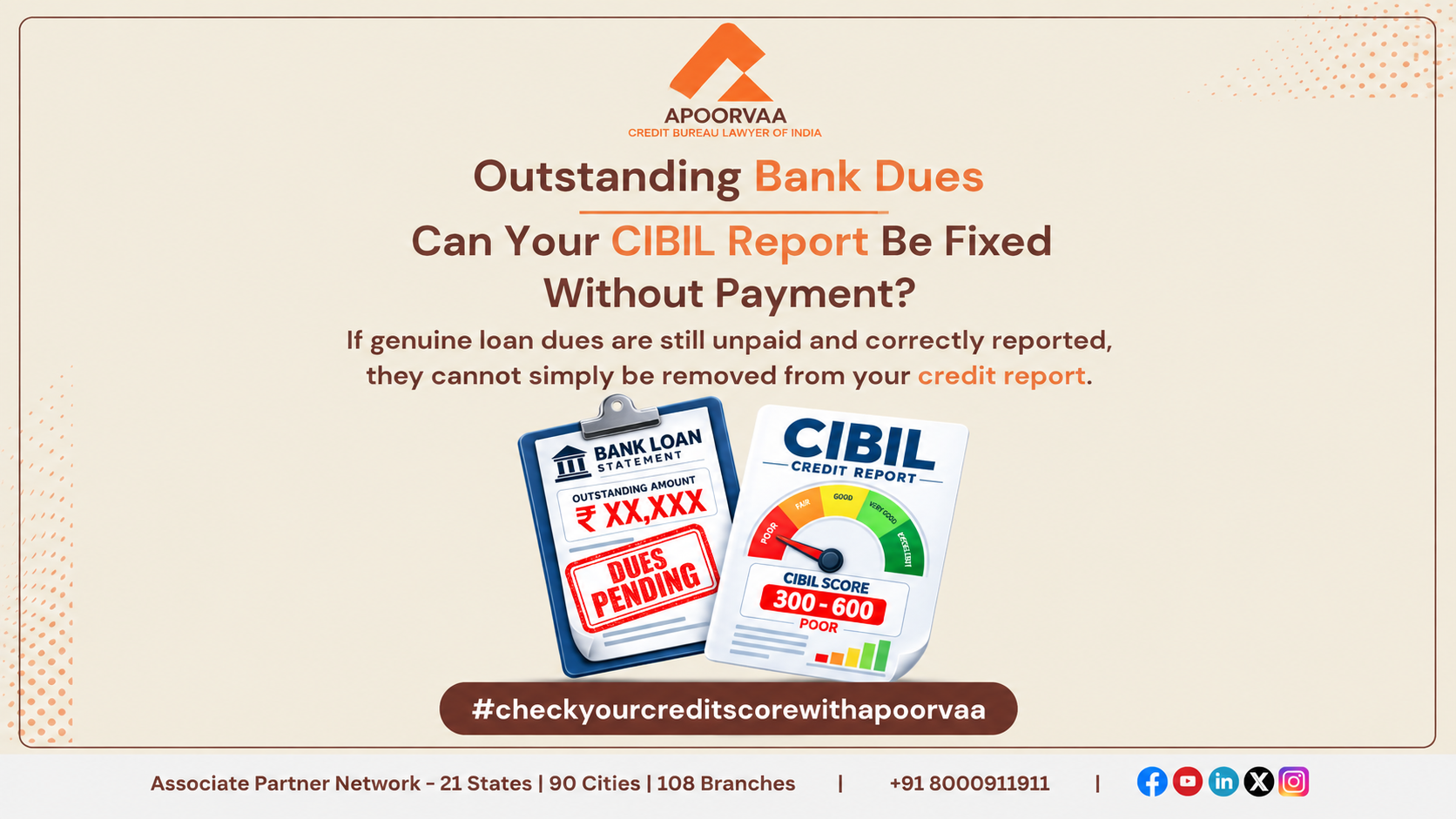
Outstanding Bank Dues cannot simply be removed from a CIBIL Report when the loan is genuine, the repayment remains unpaid and the lender is accurately reporting the account. Credit Rectification can address incorrect credit information, but it cannot be used as a substitute for resolving a genuine financial obligation with the lender.
One question we frequently hear is:
“Mere paas abhi bank ka outstanding amount bharne ke paise nahi hain. Kya payment kiye bina mera CIBIL Report theek ho sakta hai?”
The core answer is straightforward:
If the outstanding loan dues are genuine and correctly reported, they cannot simply be made to disappear from the credit report because the borrower is presently unable to pay them.
This distinction is extremely important because borrowers facing financial difficulty are sometimes attracted by claims such as:
“Bank ko payment karne ki zaroorat nahi.”
“Hum CIBIL se outstanding remove karwa denge.”
“Payment ke bina negative account clean ho jayega.”
Before accepting any such claim, the borrower should first understand the difference between:
a genuine unpaid liability
and
an inaccurate credit-report entry.
They are not the same problem and should not be handled in the same way.
What Are Outstanding Bank Dues in a CIBIL Report?
When you take a loan or use another credit facility, you agree to repay the amount according to the terms of that facility.
If scheduled repayments are not made, the lender’s reporting may reflect information relating to the unpaid position.
Depending on the account, the credit report may contain fields such as:
- Current balance
- Amount overdue
- Payment history
- DPD
- Account status
- Date reported
- Date of last payment
- Credit facility details
- Settlement/write-off related information, where applicable
The appearance of an outstanding balance is therefore not automatically evidence of a credit-reporting error.
The first question in any Credit Rectification exercise should be:
“Is the information being reported accurate according to the actual loan account?”
Only after answering this can the appropriate course of action be determined.
Genuine Outstanding Bank Dues vs CIBIL Reporting Error
This is the most important distinction in today’s topic.
Consider two cases.
Case 1: Genuine Outstanding Bank Dues
A borrower took a loan.
The borrower stopped making the required repayments.
₹2 lakh genuinely remains payable according to the lender’s records.
The credit report reflects the outstanding balance and overdue information.
The borrower wants that information removed because it is affecting the credit profile.
This is primarily an underlying repayment issue.
It cannot simply be converted into a CIBIL reporting error because the borrower wants a better credit report.
Case 2: Dues Already Paid but Report Still Incorrect
Now consider another borrower.
The required payment has already been made.
The lender’s records support the updated account position.
However, the CIBIL Report continues to show an incorrect current balance or overdue amount.
That may represent a credit-reporting discrepancy.
CIBIL itself identifies inaccurate current balances and overdue amounts as account information that can be disputed. It also states that it cannot modify reported information without confirmation from the relevant credit institution.
This is where legitimate Credit Rectification may become necessary.
So the correct principle is:
Genuine unpaid dues → resolve the underlying financial obligation.
Incorrectly reported dues → verify and rectify the credit information.
Can Credit Rectification Remove Genuine Unpaid Dues?
No legitimate Credit Rectification process should begin with a promise that every negative item can be deleted.
Credit Rectification should begin with:
Accuracy.
Suppose your CIBIL Report says:
Current Balance: ₹3,00,000
Amount Overdue: ₹75,000
If those figures accurately reflect the lender’s records and the borrower genuinely owes the money, there is no factual basis to simply declare the information incorrect.
A dispute mechanism exists to correct credit information that genuinely requires correction.
It does not eliminate the underlying loan contract or repayment obligation.
This is why a borrower should be cautious when someone says:
“Outstanding genuine hai ya nahi usse farak nahi padta; CIBIL se hata denge.”
The correct question should always be:
What exactly is wrong in the reported information?
If there is no reporting error, the underlying liability needs to be addressed.
“I Don’t Have Money Right Now” — What Should the Borrower Do?
This is the real difficulty behind many cases.
A person may genuinely acknowledge the loan and outstanding amount but simply be unable to arrange the money today.
That may happen because of:
- Loss of employment
- Reduction in income
- Business losses
- Medical or family expenses
- Multiple existing liabilities
- Unexpected financial stress
- Prolonged cash-flow difficulties
Inability to pay immediately is a financial problem.
But it does not automatically create a credit-reporting error.
If immediate payment is not possible, the borrower should first understand the actual position with the lender rather than searching for an artificial credit-report deletion.
That means understanding:
- Current amount claimed by the lender
- Principal outstanding
- Interest and applicable charges
- Existing overdue amount
- Current status of the loan
- Previous payments
- Whether recovery action has been initiated
- What legitimate repayment/resolution options the lender may offer
- How any proposed resolution may be reported to credit bureaus
The borrower can then make an informed decision when financially capable of addressing the account.
Should You Simply Wait Until You Have Enough Money?
Waiting without understanding the account is not a strategy.
If you cannot pay today, you should still know what is happening with the loan.
Do not ignore communications from the lender indefinitely.
At the same time, do not make a rushed payment arrangement solely because somebody tells you:
“Bas itna amount bhar do, CIBIL clean ho jayega.”
Before making a substantial payment, understand exactly what the lender is offering.
Ask:
What is the total amount currently payable?
Is this full repayment or settlement?
What amount, if any, is being waived?
How will the account be treated after payment?
What documentation will the lender issue?
What account status will subsequently be reported?
These questions become especially important when the borrower is being offered a settlement.
Full Repayment and Settlement Should Not Be Confused
A borrower who cannot afford the complete amount may sometimes be offered an opportunity to settle the account by paying less than the contractual dues.
That may provide immediate financial relief.
But:
Settlement ≠ Full contractual repayment.
Suppose the amount claimed under the loan is ₹2 lakh.
The lender agrees to accept ₹1.25 lakh under a settlement arrangement.
The borrower may think:
“₹75,000 bach gaya aur CIBIL bhi theek ho jayega.”
That assumption can be misleading.
Before agreeing to settlement, the borrower should understand how the lender intends to treat and report the account.
A lower immediate payment should not be evaluated only on the amount saved today.
The borrower should also consider the possible credit-history implications of the resolution chosen.
This is why loan settlement should not be treated as an automatic CIBIL-fixing strategy.
What About a “No Due Certificate”?
Once the loan obligation has been appropriately resolved, borrowers should preserve the relevant documentation.
Depending on the facility and circumstances, this may include:
- Payment receipts
- Loan account statement
- Closure letter
- No Due Certificate
- NOC, where applicable
- Settlement correspondence, if applicable
- Relevant lender emails or letters
However, there is another misconception:
“NOC mil gaya means pura old CIBIL history delete ho jayega.”
That is not necessarily correct.
Closure/no-dues documentation helps establish the account position after resolution.
It does not automatically make genuine historical repayment behaviour inaccurate.
For example, if the borrower genuinely had delayed payments before eventually clearing the loan, those historical events and the present outstanding balance are two different aspects of the account.
The objective after payment should therefore be:
Ensure that the updated account position is accurately reported.
Not:
Erase every accurate historical fact associated with the loan.
Payment Made but CIBIL Still Shows Outstanding — Is That Rectifiable?
Yes, this is exactly where we need to distinguish a genuine reporting discrepancy from genuine unpaid dues.
Suppose:
Bank dues have been appropriately resolved.
The borrower has documentary evidence.
The lender’s records support the updated position.
But the credit report continues to display an incorrect outstanding or overdue balance.
That situation may require verification and rectification.
CIBIL’s consumer guidance recognises that recent payments may not appear immediately and says consumers can raise a dispute where an inaccurate balance remains after the relevant reporting period.
Importantly, RBI’s current framework now requires credit institutions to submit credit information on a fortnightly basis, as of the 15th and last day of each month, with submission within seven calendar days of the relevant reporting fortnight.
Therefore, when analysing an apparently outdated balance, check:
Date of payment
Date Reported
Lender’s records
Current credit-report information
before concluding that a reporting error exists.
Why Payment Alone Is Not the Final Step
Resolving the financial obligation is one stage.
Ensuring that the updated position is accurately reported is another.
A better process is:
Understand → Resolve → Document → Verify → Rectify if required
Understand
Establish the genuine amount and current account position.
Resolve
Address the dues appropriately with the concerned lender.
Document
Preserve evidence of payment and closure/resolution.
Verify
Review the subsequent credit report.
Rectify
If the information remains genuinely inaccurate, use the appropriate lender and credit-bureau correction process.
This sequence protects the borrower from both extremes:
Trying to delete genuine dues without payment
and
Paying the dues but never checking whether the updated information was correctly reported.
What If the Lender Does Not Correct an Actual Reporting Error?
If the borrower has evidence that credit information is inaccurate and the issue is not being appropriately corrected, there is a formal regulatory framework for rectification.
RBI’s framework provides an overall 30-calendar-day period for resolution of complaints concerning updation/rectification of credit information. It also provides for compensation of ₹100 per calendar day where an eligible complaint is not resolved within that period, subject to the framework’s conditions and exclusions.
This is important—but it should be understood correctly.
The 30-day framework does not mean:
“Raise a complaint and genuine outstanding dues must be deleted within 30 days.”
It means that a legitimate credit-information complaint must be dealt with within the regulatory resolution framework.
A complaint can also be rejected where the information is verified as accurate; RBI requires the complainant to be informed of the action taken, including reasons in cases of rejection.
That is why evidence and factual accuracy remain central to Credit Rectification.
How Apoorvaa Approaches Outstanding Bank Dues and Credit Rectification
At Apoorvaa – Credit Bureau Lawyer of India, the purpose of Credit Rectification is not to promise deletion of every negative entry appearing in a credit report.
The first objective is to determine whether the information is accurate or inaccurate.
When Outstanding Bank Dues appear in a CIBIL Report, the case should first be classified correctly:
- Genuine dues remain unpaid and are correctly reported.
The underlying financial obligation needs to be addressed with the lender. - Dues have already been paid, but incorrect outstanding information continues to appear.
The reporting discrepancy needs verification and appropriate rectification. - The amount reported does not match the lender’s records.
The difference needs to be investigated. - The loan itself does not belong to the consumer.
This becomes an account-ownership issue and requires a different process.
This classification prevents a common mistake: treating every negative item as something that can simply be “removed from CIBIL.”
Step 1: Analyse the Complete Credit Report
Looking only at the CIBIL Score is not sufficient.
The relevant loan account should be examined in detail, including:
- Account type
- Ownership
- Current balance
- Amount overdue
- Date reported
- Date of last payment
- Payment history
- DPD
- Account status
- Settlement or write-off information, where applicable
- Loan opening and closure information
- Other relevant account remarks
For example, if a borrower says:
“Maine bank ka payment kar diya hai, phir bhi CIBIL kharab hai.”
we should not immediately assume that the lender has made an error.
The report needs to be checked to understand what information is actually creating the concern.
Step 2: Establish Whether the Outstanding Amount Is Genuine
The next question is:
Does the borrower genuinely owe the amount appearing in the report?
Suppose the report shows an outstanding balance of ₹1,80,000.
There can be several possibilities:
Situation A
The borrower genuinely has ₹1,80,000 unpaid.
This is primarily a repayment issue.
Situation B
The borrower has already cleared the required amount, but ₹1,80,000 continues to appear.
This may be a reporting discrepancy.
Situation C
The borrower believes only ₹1,20,000 is payable, while the lender’s records show ₹1,80,000.
The lender’s account statement and calculation need to be examined before deciding whether there is a credit-reporting error.
Situation D
The borrower says:
“Maine ye loan liya hi nahi.”
Now the matter concerns ownership of the account rather than merely the outstanding amount.
The solution therefore depends on the underlying facts.
Step 3: Compare the Credit Report With Lender Records
Credit Rectification becomes meaningful when the credit information is compared against supporting records.
Relevant documents may include:
- Loan account statement
- Payment receipts
- Bank statements
- Closure letter
- No Due Certificate
- NOC, where applicable
- Settlement correspondence
- Emails exchanged with the lender
- Other relevant account documents
Suppose the lender’s closure letter confirms that the account has been closed, but the latest credit report continues to show an incorrect current balance after the relevant reporting process.
There is now a factual basis for seeking verification.
The objective is not:
“Remove this because it looks negative.”
It is:
“The reported information does not appear consistent with the lender’s records. Please verify and correct it.”
That is a much stronger and more legitimate basis for Credit Rectification.
What If You Have Paid but the CIBIL Report Is Not Updated?
Consumers should first consider the timing of the payment and reporting.
Credit information is not necessarily updated at the exact moment a borrower makes a payment.
Under RBI’s current credit-information reporting framework, credit institutions are required to submit information to credit information companies on a fortnightly basis, as of the 15th and last day of every month, with the relevant submission timelines prescribed by RBI.
Therefore, after making a payment, check:
When was the payment made?
What is the Date Reported in the latest CIBIL Report?
Has the lender’s subsequent reporting cycle occurred?
What does the lender’s own account statement show?
If sufficient reporting time has passed and the information remains inconsistent with the lender’s records, the issue can then be taken up appropriately.
What Happens to DPD After Outstanding Dues Are Paid?
This is another area where expectations need to be realistic.
Suppose a borrower had genuine payment delays:
30 DPD → 60 DPD → 90 DPD
and later clears the outstanding loan.
The borrower may expect:
“Ab pura payment kar diya hai, toh purana DPD bhi remove ho jana chahiye.”
Payment of the outstanding amount does not automatically make genuine historical payment delays inaccurate.
DPD represents repayment behaviour reported for the relevant historical period.
Therefore, we need to distinguish:
Current outstanding position
from
Historical repayment behaviour.
If the current outstanding amount has been paid, the updated current position should be reported appropriately.
But if the historical DPD was factually accurate, subsequent repayment does not automatically mean that the historical information should be deleted.
If the historical DPD itself was incorrectly reported, that is a different matter and may require verification.
What About Written-Off or Settled Accounts?
Older problematic accounts require particularly careful analysis.
Suppose a borrower had an outstanding loan several years ago and the account was subsequently settled or reported with another adverse status.
The borrower now wants to improve the credit profile and asks:
“Kitna payment karne se account normal ho jayega?”
Do not calculate this merely by subtracting the amount previously paid from the old outstanding amount.
For example:
Old amount: ₹1,00,000
Previously paid under settlement: ₹60,000
It should not automatically be assumed:
“Now only ₹40,000 is payable.”
The current amount claimed by the lender may depend on the lender’s records, contractual terms, previous waiver, applicable interest or charges and the manner in which the earlier account was resolved.
The borrower should therefore approach the lender and obtain clarity regarding:
- Present amount claimed
- Basis of calculation
- Previous settlement treatment
- Amount required for any further resolution
- Proposed account treatment after payment
- Documentation to be issued
Only after understanding these facts should a financial decision be made.
Settlement Should Not Be Used as a Quick CIBIL Strategy
When borrowers cannot arrange the entire outstanding amount, settlement may appear to be an easy solution.
But the decision should be made primarily on the financial and contractual circumstances—not on a promise that:
“Settlement karo aur CIBIL clean ho jayega.”
If a lender accepts less than the contractual amount payable, the account may be reported accordingly.
Therefore, before accepting settlement, ask:
What amount am I paying?
What amount is being waived?
What status will the lender report?
What document will I receive?
What are the possible future credit implications?
A borrower facing genuine financial distress may still decide that settlement is necessary.
But it should be an informed decision, not a shortcut sold as guaranteed CIBIL improvement.
No Due Certificate: Important, but Understand Its Purpose
After appropriately resolving an account, obtaining relevant documentation is important.
A No Due Certificate or closure confirmation, where applicable, can help establish the lender’s position that the relevant dues have been addressed.
But it should not be misunderstood as:
“NDC mil gaya, ab pura old credit history delete ho jayega.”
The document establishes the resolved position of the account according to the lender.
It does not automatically rewrite every historical repayment event.
This is why borrowers should preserve the document and subsequently compare it with the updated credit report.
Credit Rectification Is About Accuracy, Not Cosmetic Cleaning
A credit report contains financial history.
Some of that history may be favourable.
Some may be unfavourable.
The fact that information negatively affects a credit profile does not automatically make it incorrect.
A responsible Credit Rectification process asks:
Does this account belong to the consumer?
Is the current balance accurate?
Is the overdue amount accurate?
Is the payment history accurate?
Does the account status correspond with the lender’s records?
Has a payment or closure been properly reflected?
Is there any duplicate, mixed or incorrect information?
The objective is to establish accuracy, not to create an artificially perfect report.
Be Cautious of Guaranteed “CIBIL Cleaning”
A person with serious Outstanding Bank Dues can be particularly vulnerable to unrealistic promises.
Be cautious if someone says:
“Bank ka paisa mat bharo.”
“Outstanding hum CIBIL se delete kar denge.”
“Written-off account guaranteed remove ho jayega.”
“DPD sab hata denge.”
“7 din mein score increase kar denge.”
Instead, ask:
What information is actually inaccurate?
What evidence supports the correction?
Does the lender’s record support the claim?
What legitimate process will be followed?
If nobody can explain the factual basis for the correction, a promise of guaranteed deletion should be treated cautiously.
Common Mistakes Borrowers Should Avoid
- Thinking Every Negative Entry Is an Error
Negative information can still be accurate information.
- Raising Disputes Against Genuine Outstanding Dues
A dispute should have a factual basis.
- Ignoring the Lender and Contacting Only the Credit Bureau
The underlying information originates from the credit institution, and lender verification is central to correcting reported data.
- Making Payment Without Written Clarity
For old or disputed accounts, understand the amount and proposed treatment before making payment.
- Assuming Settlement and Closure Are the Same
They can have different implications and should not be treated interchangeably.
- Not Collecting Documentation
Keep payment receipts, account statements and relevant closure/no-dues documentation.
- Assuming Payment Deletes Old DPD
Accurate historical payment delays do not automatically become inaccurate after repayment.
- Not Checking the Credit Report After Payment
Resolving the dues is only part of the process. Subsequent reporting should also be reviewed.
The Apoorvaa Action Framework
For cases involving Outstanding Bank Dues, a practical framework is:
- REPORT
Obtain and analyse the complete credit report.
- IDENTIFY
Identify the loan account creating the issue.
- VERIFY
Determine whether the loan, outstanding amount, overdue amount and payment history are accurate.
- COMPARE
Compare credit-bureau information with lender records and supporting documents.
- RESOLVE
Where genuine dues remain, address the underlying position appropriately with the lender.
- DOCUMENT
Obtain and preserve relevant payment and closure documentation.
- REVIEW
Check the subsequent credit report after lender reporting.
- RECTIFY
Where genuine inaccuracies remain, follow the appropriate lender and credit-bureau rectification process.
In short:
Report → Identify → Verify → Resolve → Document → Review → Rectify
Frequently Asked Questions About Outstanding Bank Dues
Can CIBIL be fixed without paying outstanding bank dues?
If genuine Outstanding Bank Dues remain unpaid and are accurately reported, they cannot simply be treated as incorrect and removed through Credit Rectification. The underlying financial obligation needs to be appropriately addressed.
What if I don’t have enough money to pay the bank today?
Understand the exact amount and current status of the account and communicate appropriately with the lender regarding legitimate available options. Financial inability to pay immediately does not make an accurate outstanding balance a reporting error.
Can someone remove genuine bank dues from my CIBIL Report without payment?
Be cautious of such a promise. If the loan and outstanding amount are genuine and accurately reported, there needs to be a legitimate factual basis for any correction.
What if I have already paid but CIBIL still shows an outstanding amount?
Compare the lender’s records and payment documents with your latest credit report. Also check the reporting dates. If the information remains genuinely inaccurate after the relevant reporting process, the discrepancy may require rectification.
Will paying my outstanding loan immediately increase my CIBIL Score?
No specific score increase should be guaranteed. Resolving an outstanding account can change the information in your credit profile, but a credit score is based on the overall credit information and scoring methodology.
Will my old DPD disappear after payment?
Not simply because the loan is paid. If historical DPD was accurately reported, subsequent repayment does not automatically make that historical information inaccurate.
Is settlement the same as full closure?
No. A settlement where the lender accepts less than the contractual dues should not automatically be treated as equivalent to full contractual repayment. Understand the lender’s proposed reporting before proceeding.
Should I obtain an NOC after paying the dues?
Obtain appropriate closure/no-dues documentation from the lender where applicable and preserve it with your payment records.
What if the loan itself does not belong to me?
That is an account-ownership issue rather than a genuine outstanding-dues case. The account should be investigated with the concerned lender and appropriately disputed if it genuinely does not belong to you.
What if the bank does not correct genuinely inaccurate information?
Where there is a genuine credit-information discrepancy, the borrower can follow the prescribed grievance/dispute process. RBI’s framework provides an overall 30-calendar-day resolution period for qualifying credit-information correction complaints, with compensation provisions for eligible delays beyond that period.
Importantly, this framework does not guarantee deletion of accurate information. It provides a mechanism for resolving legitimate complaints.
Final Thoughts
The fundamental rule regarding Outstanding Bank Dues is straightforward:
You cannot solve a genuine repayment problem merely by calling it a CIBIL problem.
If the loan belongs to you, genuine dues remain unpaid and the lender is accurately reporting them, the underlying obligation needs to be appropriately addressed.
But the opposite is equally important.
A borrower should not continue suffering because incorrect information remains in the credit report after the genuine financial obligation has already been resolved.
That is where proper verification and Credit Rectification become relevant.
The correct approach is:
Genuine dues → Resolve them appropriately.
Paid dues → Obtain documentation and verify subsequent reporting.
Incorrect reporting → Seek appropriate rectification.
Unknown account → Investigate ownership.
Accurate historical information → Do not expect artificial deletion.
Credit Rectification should restore accuracy, not manufacture a credit history that never existed.
Use descriptive anchor text inside the relevant paragraphs rather than placing all internal links only at the bottom.
Need Help Understanding Outstanding Dues in Your Credit Report?
If your credit report shows an outstanding loan, overdue amount, incorrect balance, old settlement, written-off status or an account that you believe has not been updated correctly, the first step should be a complete analysis of the credit report and supporting lender records.
At Apoorvaa – Credit Bureau Lawyer of India, our Credit Rectification approach focuses on identifying the actual problem before recommending the appropriate course of action.
We distinguish between:
Genuine repayment obligations
and
genuine credit-reporting discrepancies.
Where dues are genuinely payable, they should not be falsely presented as reporting errors.
Where the lender’s updated records and credit-bureau information do not correspond, the discrepancy can be examined and the appropriate rectification process followed.
Don’t look for shortcuts to erase genuine dues. Understand the account, resolve the underlying issue and rectify only what is genuinely inaccurate.