
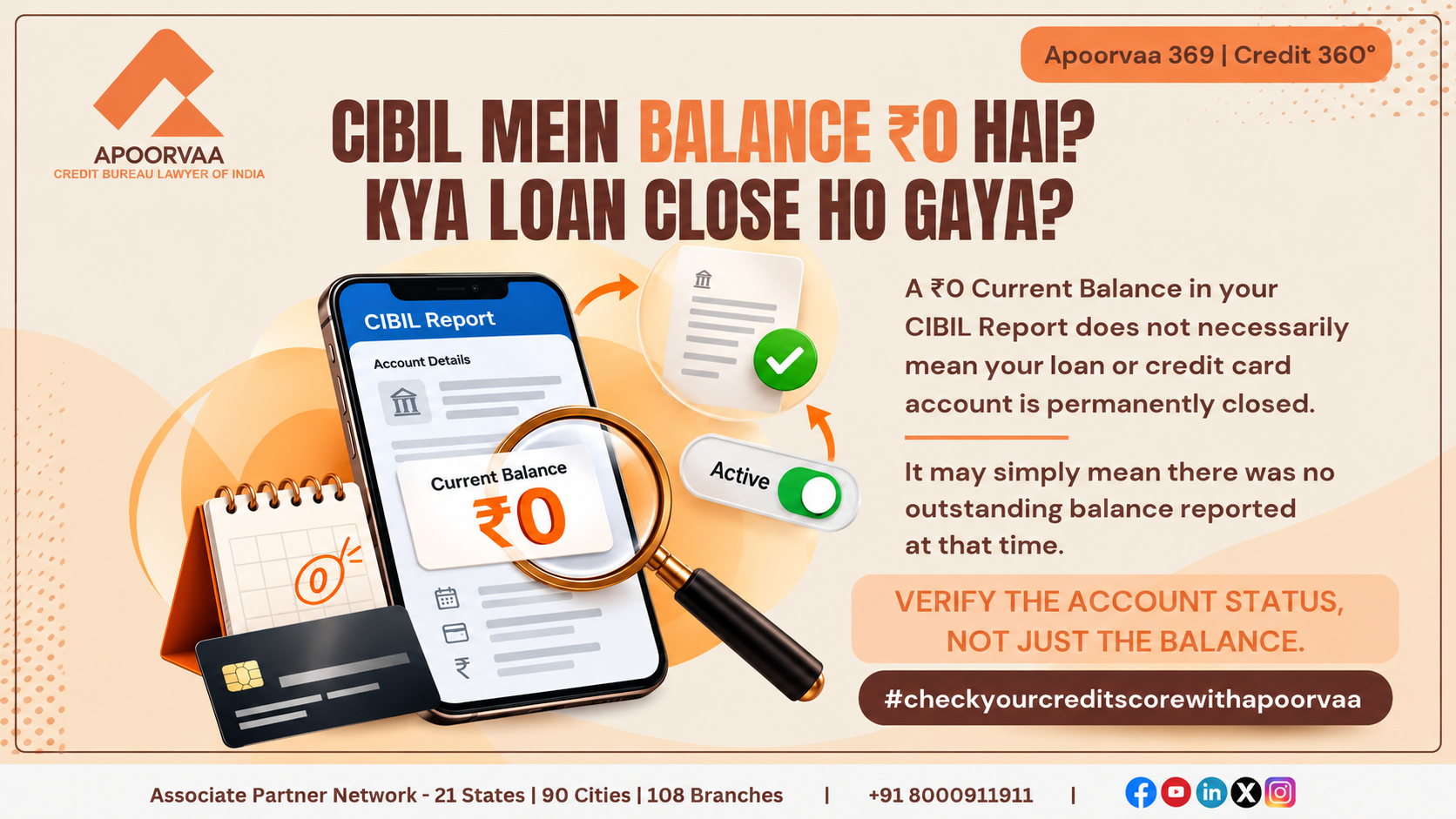
“My CIBIL Report shows ₹0 Current Balance. Does that mean my credit card is closed?”
A zero balance in a CIBIL Report can create a misleading impression. Many consumers assume that because they have cleared their credit-card dues, the account has automatically been closed.
However, CIBIL Current Balance Zero does not automatically mean the credit-card facility has been permanently terminated.
An active credit card can show a Current Balance of ₹0 while retaining its sanctioned credit limit and remaining available for future transactions.
This distinction becomes important when consumers stop using a card without formally closing it. Depending on the card’s terms, applicable charges may still arise.
It is equally important when a card issuer has confirmed closure but the credit report contains inaccurate account-status information.
To interpret the report correctly, three matters must be considered separately:
Outstanding Balance — Account Closure — Credit-Bureau Reporting Accuracy
- What Does Current Balance ₹0 Mean in a CIBIL Report?
TransUnion CIBIL’s consumer guidance identifies Current Balance as part of the Account Information section of the Credit Report.
It represents the outstanding balance reported by the credit institution for the relevant account.
When a credit-card account displays Current Balance: ₹0, it generally indicates that no outstanding amount was reported under that field as of the relevant reporting date.
It does not establish that the card has been cancelled, deactivated or permanently closed.
Example: Active Card With Zero Balance
Consider a consumer with the following credit-card details:
| Account information | Reported details |
| Credit Limit | ₹1,00,000 |
| Current Balance | ₹0 |
| Amount Overdue | ₹0 |
| Account position | Active |
| Date Closed | Not recorded |
The consumer may have cleared the entire outstanding balance while the card remains active.
The available credit facility may still be usable, subject to the issuer’s terms and controls.
₹0 Current Balance ≠ Permanent Account Closure
Another important consideration is the reporting date.
A CIBIL Report reflects information furnished by the lender at a particular point in time. It is not a real-time statement of every transaction or charge.
Therefore, a fee or transaction arising after the reporting date may not yet be reflected in the Current Balance.
- Current Balance, Amount Overdue, Credit Limit and Date Closed
Consumers often interpret individual credit-report fields without considering how they relate to one another.
However, each field serves a different purpose.
| Field | What it tells you |
| Current Balance | The outstanding balance reported against the account |
| Amount Overdue | The amount reported as overdue |
| Credit Limit | The sanctioned limit associated with the credit-card facility |
| Account Status | Relevant classification or status information |
| Date Closed | The reported closure date, where applicable |
| Date Reported | When the relevant account information was reported |
A card can have a Current Balance of ₹0 and an Amount Overdue of ₹0 while remaining active.
Similarly, a formally closed credit card may continue to appear in the report with its historical credit limit and account information.
The presence of a credit limit in historical records does not, by itself, establish that a closed facility remains available for use.
The account’s actual position must be interpreted using the relevant fields and issuer records.
- Zero Balance vs Closed Credit Card: Why the Difference Matters
A zero balance describes the reported financial position of an account.
Formal closure means the credit-card facility has been terminated through the issuer’s applicable process.
These are not interchangeable.
Zero-Balance Active Credit Card
The consumer has cleared the reported outstanding amount.
The card may remain available for purchases.
The account may continue to be subject to applicable fees and terms.
Formally Closed Credit Card
The issuer has completed the closure process.
The credit facility should no longer be available for new transactions under the closed account.
The issuer should communicate closure confirmation and report the relevant account information accurately.
Blocked or Deactivated Card
A card may be blocked because it was lost, compromised or temporarily restricted.
However, blocking the card does not necessarily terminate the underlying credit-card account.
Similarly, deactivation and permanent account closure should not automatically be treated as identical.
Card Not Usable ≠ Account Necessarily Closed
The distinction matters because consumers may believe that a blocked or unused card no longer carries any account-related obligations.
- Can Annual Fees Apply to an Unused Credit Card?
Yes, where applicable under the card’s terms.
A consumer may clear the outstanding balance and stop using the credit card for several months.
However, non-use does not automatically cancel the card agreement.
If the account remains active, annual or renewal fees may arise according to the disclosed terms and applicable conditions.
For example, a card may carry an annual fee unless a specified spending requirement or other waiver condition is satisfied.
If a valid charge remains unpaid, it may create a new outstanding obligation and potentially lead to credit-reporting complications.
However, it is important not to generalise.
Not every unused credit card attracts an annual fee.
Some cards are lifetime-free, while others have conditional fee waivers or different product terms.
It would also be inaccurate to suggest that annual fees necessarily continue accumulating indefinitely on every unused account.
The correct position depends on the card’s terms, account status and applicable regulatory requirements.
No Card Usage Does Not Automatically Mean No Future Charges.
- What Does RBI Say About Credit-Card Closure?
The Reserve Bank of India’s Credit Card and Debit Card – Issuance and Conduct Directions, 2022, as amended, establish requirements for credit-card closure.
These directions help distinguish a consumer’s intention to close a card from the issuer’s obligation to complete the process.
Seven-Working-Day Closure Rule
Under paragraph 8(a), a card issuer must honour a closure request within seven working days, subject to payment of all dues.
Issuers must provide multiple channels through which cardholders can submit closure requests.
These include appropriate customer-service and digital channels.
Once the card account has been closed, the issuer must immediately notify the cardholder through the prescribed communication channels.
Penalty for Delayed Closure
RBI provides for a penalty of ₹500 per calendar day of qualifying delay where closure is not completed within the prescribed period, provided there is no outstanding amount and the applicable conditions are satisfied.
This provision should not be interpreted as automatically payable merely because the consumer has stopped using the card or because the CIBIL Report displays ₹0.
The validity of the closure request, outstanding-dues position and issuer’s compliance are relevant.
Closure Request vs Closure Confirmation
A consumer may submit a closure request and receive a service-request number.
That reference helps document the request.
However, it is not necessarily proof that closure has been completed.
The issuer’s final confirmation establishes the completed closure more reliably.
Closure Requested ≠ Closure Completed
- What Happens When a Credit Card Is Unused for More Than One Year?
RBI also prescribes a process for credit cards that have remained unused for more than one year.
Under paragraph 8(b) of the credit-card directions, the issuer must initiate the closure process after intimating the cardholder.
If the cardholder does not respond within 30 days, the issuer must close the account, subject to payment of all dues.
The issuer must also update the relevant Credit Information Companies regarding closure within the prescribed period.
This does not mean every card automatically closes exactly one year after its last transaction.
The prescribed notification, response period and dues-related conditions remain relevant.
For consumers, this reinforces an important principle:
An Unused Credit Card Should Not Automatically Be Assumed to Be a Closed Credit Card.
- Why Does the Closure Process Matter for Credit Reporting?
Credit-card closure involves two separate records:
The Issuer’s Account Records
These establish whether the credit-card facility has actually been closed.
The Credit Bureau’s Reported Information
This reflects the account information furnished through the credit-reporting process.
A consumer may have received closure confirmation while the credit report still reflects information from an earlier reporting date.
This difference may arise because credit-bureau reporting is not necessarily immediate.
However, where the issuer has confirmed closure and the relevant reporting obligations have been met, continued inaccurate active-account information may require investigation.
The objective is to establish whether the credit report accurately reflects the account’s actual position.
Account Closure and Accurate Credit Reporting Are Related but Separate Responsibilities.
- Can a Closed Credit Card Still Appear in CIBIL?
Yes. A formally closed credit-card account may continue to appear in your CIBIL Report as part of your historical credit information.
Closing a credit card does not automatically erase its previous account details or repayment history.
For example, a consumer may have held a credit card for five years and subsequently closed it after clearing all dues. The account may still appear in the report, but its closure-related information should accurately reflect the completed closure.
Closed Account Visible in CIBIL ≠ Incorrect Credit Reporting
The important distinction is between an account that remains visible as historical information and an account that is inaccurately represented as active.
- What If the Bank Confirms Closure but CIBIL Still Shows Active?
Suppose your credit-card issuer has confirmed that your account is permanently closed, but your CIBIL Report still appears to show an active account.
This situation requires examination of three important records:
- Closure Confirmation: Has the issuer formally confirmed that the credit-card account was closed?
- Effective Closure Date: When did the issuer complete the closure?
- Credit-Report Information: What account details and reporting dates appear in the CIBIL Report?
Credit-report information is not necessarily updated immediately after an account changes.
A recently closed card may temporarily appear with information from an earlier reporting date.
However, if the issuer has confirmed closure and the account continues to be inaccurately reported after the applicable reporting requirements, a genuine credit-information discrepancy may exist.
The objective is to verify the account’s actual status—not assume that every visible account is incorrectly reported.
- When Does Credit-Card Reporting Require Rectification?
Professional Credit Rectification may be justified when the information furnished to the credit bureau is genuinely inaccurate.
Examples include:
- A formally closed credit card incorrectly reported as active.
- An inaccurate outstanding balance despite verified account records.
- Incorrect account ownership or closure details.
These issues are different from an active credit card correctly displaying a Current Balance of ₹0.
They are also different from a closed account that remains visible as legitimate historical information.
Under India’s credit-information framework, qualifying inaccuracies can be examined through the applicable correction process.
RBI also provides a compensation framework for delayed resolution of qualifying credit-information complaints beyond 30 calendar days, subject to prescribed conditions.
This is separate from RBI’s credit-card closure-delay provisions discussed in Part 1.
Credit Rectification Should Correct Inaccurate Information, Not Remove Accurate Credit History.
- Why Is Complete Credit Report Analysis Important?
A Current Balance of ₹0 answers only one question about a credit account.
It does not independently establish whether the facility remains available, whether closure has been completed or whether the account information is accurate.
A complete assessment considers the relevant balance, overdue, credit-limit, closure and reporting information together.
For consumers, this prevents confusion between clearing dues and closing an account.
For financial professionals, it helps distinguish genuine reporting discrepancies from normal account activity or historical reporting.
The Correct Question Is Not Simply “Is My Balance Zero?” but “Is My Account Status Accurately Reported?”
Frequently Asked Questions
- Does ₹0 Current Balance mean my credit card is permanently closed?
No. An active credit card can have a reported balance of ₹0 while retaining an available credit facility.
- Can an unused credit card attract annual fees?
Yes, where applicable under the card’s terms. Not every card carries annual fees, and fee waivers may apply.
- Will a closed credit card disappear from CIBIL?
Not necessarily. Accurate historical account information may remain visible after closure.
- What if my bank confirms closure but CIBIL still shows active?
The closure confirmation, effective closure date and reporting information should be examined. A genuine discrepancy may require correction.
- Does every zero-balance credit card require Credit Rectification?
No. Rectification is appropriate where the underlying credit information is inaccurate, not merely because the reported balance is zero.
My Perspective
In my experience, consumers frequently confuse repayment of outstanding dues with permanent closure of a credit facility.
A borrower may clear the entire credit-card balance and assume that the account no longer exists.
However, an active credit card can continue to carry an available credit limit even when its Current Balance is zero.
I believe three matters must always be distinguished:
Payment of Outstanding Dues
Formal Credit-Card Closure
Accurate Credit-Bureau Reporting
These are connected, but they are not identical.
Where an issuer has completed closure, the credit information should accurately reflect that position.
Where the account remains active, a zero balance alone does not establish a reporting error.
The objective of Credit Rectification is accuracy—not the deletion of legitimate account history.
Final Takeaway
A CIBIL Current Balance of ₹0 does not automatically mean your credit card is closed.
An active card may show no reported outstanding balance, retain an available credit limit and remain subject to applicable terms.
Remember:
₹0 BALANCE ≠ ACCOUNT CLOSED
NO CARD USAGE ≠ PERMANENT CLOSURE
CLOSURE REQUEST ≠ FINAL CLOSURE CONFIRMATION
CLOSED CARD VISIBLE IN CIBIL ≠ AUTOMATIC ERROR
INACCURATE ACCOUNT INFORMATION = POTENTIAL CREDIT RECTIFICATION ISSUE
VERIFY THE ACCOUNT STATUS, NOT JUST THE BALANCE.
Is Your Credit Card Incorrectly Reported in CIBIL?
If your credit-card issuer has confirmed closure but your CIBIL Report contains inaccurate account information, Apoorvaa can assist with professional Credit Report analysis.
Our services focus on understanding account-level reporting, identifying genuine discrepancies and evaluating Credit Rectification where justified.
📞 8000 911 911
Apoorvaa – Credit Bureau Lawyer of India
Credit Report analysis does not guarantee removal of accurate account history, a particular credit-score outcome or loan approval.
Related Credit Education