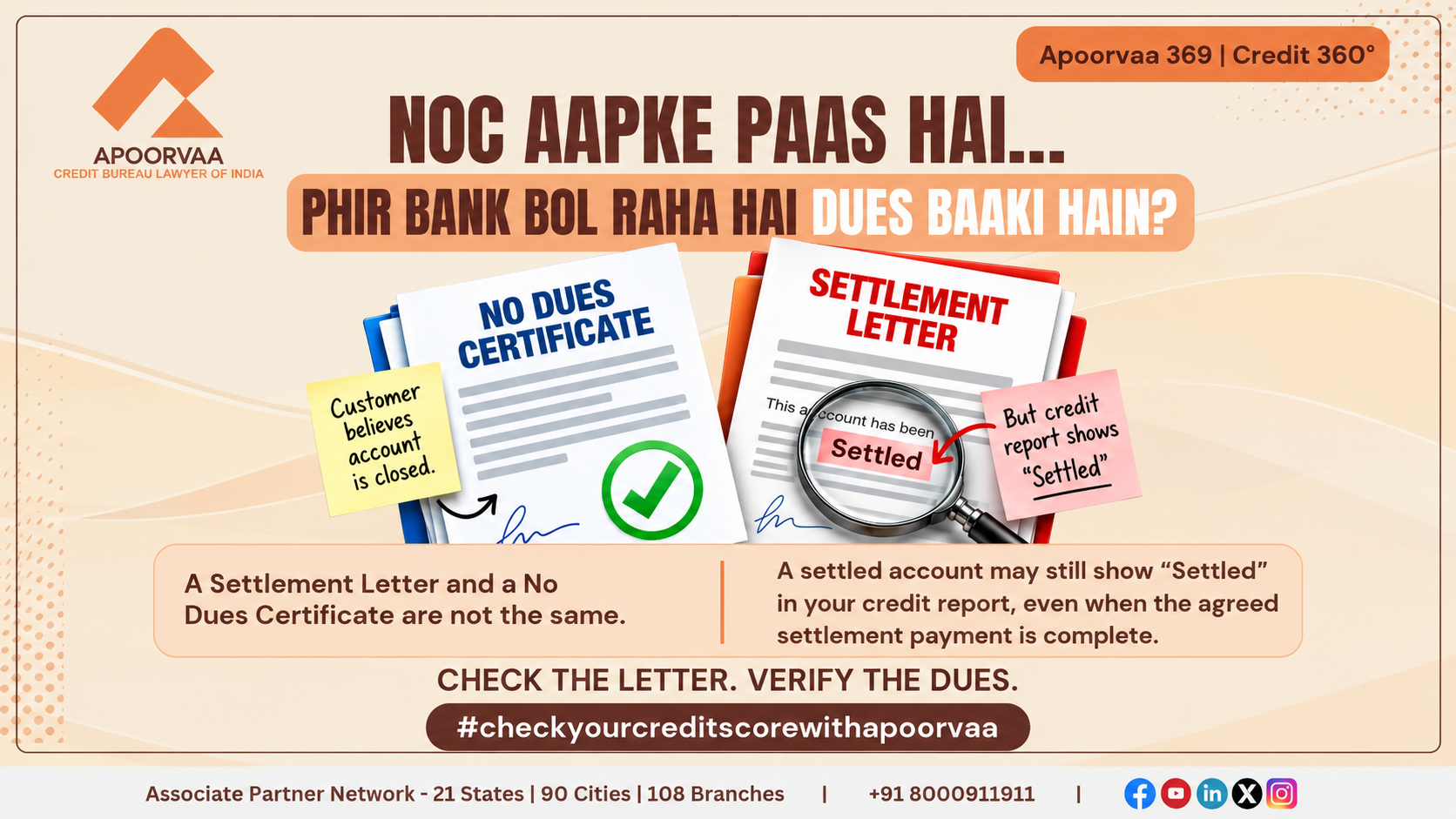
“I have an NOC, but CIBIL still shows Settled. Is the bank reporting incorrectly?”
This is one of the most common questions raised by borrowers who have completed a loan settlement or received closure-related documentation from their lender.
A customer approaches Apoorvaa with a bank letter and explains:
“Sir, I have already paid the amount agreed with the bank. They gave me an NOC. But my CIBIL Report still shows Settled. Now the bank is asking for more money.”
At first, this appears to be one problem.
In reality, it may involve three different issues:
- Document interpretation: What does the bank’s letter actually confirm?
- Financial obligation: Is any amount still legally payable against the loan?
- Credit-reporting accuracy: Does the account status and outstanding balance reported to the credit bureau accurately reflect the transaction?
These questions must be examined independently before deciding whether there is a genuine credit-reporting discrepancy.
A completed full-and-final settlement may result in zero outstanding dues while the account legitimately remains classified as Settled.
On the other hand, if a borrower repaid the full contractual obligation without a compromise settlement, but the lender reported the account as Settled, the classification may require investigation.
The objective of professional Credit Rectification is not to remove every Settled entry. It is to establish whether the reported information accurately represents the underlying account history.
- NOC vs Settlement Letter: What Is the Difference?
The phrase NOC vs Settlement Letter is often misunderstood because borrowers use several banking documents interchangeably.
However, the following documents can have materially different meanings.
Settlement Offer Letter
A settlement offer records the terms on which a lender proposes to resolve an outstanding loan obligation.
For example:
| Particulars | Illustrative amount |
| Outstanding claimed by lender | ₹2,50,000 |
| Proposed settlement amount | ₹1,50,000 |
| Difference | ₹1,00,000 |
| Settlement deadline | As specified in the offer |
The lender may agree to accept ₹1,50,000 in full-and-final settlement, subject to compliance with the agreed conditions.
However, the existence of the offer letter does not establish that the settlement has been completed.
The borrower must fulfil the applicable conditions.
Settlement-Completion Confirmation
After receiving the agreed settlement amount, the lender may issue a confirmation acknowledging that the arrangement has been completed.
This document may establish that the borrower fulfilled the settlement obligations.
However, its exact wording is important.
A letter acknowledging receipt of ₹1,50,000 is not necessarily identical to a letter expressly confirming that all specified claims have been settled in full and final.
No Objection Certificate (NOC)
An NOC communicates that the lender has no objection concerning the matter described in the document.
It may relate to account closure, release of security, removal of a charge or another specified purpose.
The title alone does not conclusively establish that the entire loan was repaid without compromise.
No Dues Certificate
A No Dues Certificate generally confirms that no amount remains payable against the specified account or obligation, according to its wording and scope.
It can provide important evidence when a lender subsequently reports an outstanding amount or raises a payment demand.
However, a No Dues Certificate issued after a completed compromise settlement does not automatically erase the historical fact that a settlement occurred.
Document title and document meaning are not always identical.
- The Three-Layer Verification Framework
When a borrower disputes a Settled classification or outstanding amount, the analysis should separate three layers.
Layer 1: Contractual and Settlement Obligations
This layer establishes the financial arrangement.
Questions include:
- What was originally payable?
- Was a compromise settlement agreed?
- What amount did the lender agree to accept?
- Were there payment deadlines or other conditions?
- Was the agreement completed?
- Did the lender acknowledge full-and-final settlement?
- Are any additional claims expressly reserved under the agreement?
This determines what the borrower may still owe, if anything.
Layer 2: Lender’s Account Records
This layer examines what happened financially.
Relevant information may include:
- Payments received
- Dates of payment
- Adjustments or waivers
- Settlement entries
- Account balances
- Closure entries
- Any subsequent charges or demands
The lender’s records should be examined alongside the settlement documents.
Layer 3: Credit-Bureau Reporting
This layer examines what the lender reported to the Credit Information Company.
Relevant fields may include:
- Account status
- Current balance
- Amount overdue
- Settlement amount, where reported
- Date closed
- Date reported
- Repayment history
- Write-off-related information, where applicable
The central question is whether the reported credit information corresponds with the documented transaction.
Contractual Terms → Account Records → Credit Report
A discrepancy between these layers may justify further investigation.
- Does a Settlement Letter Mean the Loan Is Fully Closed?
Not necessarily.
Consider two different cases.
Case A: Settlement Offer Issued but Conditions Not Fulfilled
A lender offers to accept ₹1,00,000 against a claimed outstanding amount of ₹1,80,000.
The borrower is required to pay the agreed amount by a specified deadline.
Only ₹60,000 is paid.
The borrower later produces the settlement offer letter and claims that the loan is fully settled.
That conclusion cannot be accepted solely from the existence of the letter.
The consequences depend on the agreement, payments, any subsequent understanding and applicable law.
Case B: Full-and-Final Settlement Completed
A lender agrees in writing to accept ₹1,00,000 in full-and-final settlement of the specified loan obligation.
The borrower pays the amount according to the agreement.
The lender acknowledges completion.
In this case, the original difference of ₹80,000 should not automatically be treated as an existing payable balance.
Whether any further amount can lawfully be demanded depends on the settlement’s terms, scope, compliance and applicable law.
A completed compromise settlement can discharge the claims covered by the agreement.
But that does not necessarily mean the account’s historical credit classification becomes equivalent to ordinary full repayment.
This is the distinction many borrowers miss.
- Why Does CIBIL Show Settled Even When the Outstanding Balance Is Zero?
This is the central reporting issue.
A borrower sees:
Current Balance: ₹0
Account Status: Settled
And concludes:
“If the balance is zero, why is the account not showing Closed?”
Because the two fields may describe different aspects of the loan.
Current Balance
The current balance represents the outstanding amount reported for the account at the relevant reporting point.
After a properly completed full-and-final settlement, it may be zero.
Settled Classification
The Settled classification may indicate that the obligation was resolved through a compromise arrangement rather than ordinary repayment of the full contractual amount.
Therefore, the following combination can be accurate:
| Credit-report field | Example |
| Original outstanding claimed | ₹2,50,000 |
| Full-and-final settlement paid | ₹1,50,000 |
| Current balance | ₹0 |
| Account status | Settled |
The borrower may have no further amount payable under the completed agreement.
But the account may still accurately reflect the historical settlement.
Zero Outstanding Does Not Automatically Mean No Settlement Occurred.
Does Every Waiver Require Settled Reporting?
No.
A reversal of an incorrectly levied charge, an administrative fee adjustment or an ordinary interest concession does not automatically establish a compromise settlement.
The nature of the underlying transaction matters.
The classification should reflect the actual arrangement and applicable reporting requirements.
- How to Analyse a Genuine No Dues Certificate Against the Credit Report
Suppose a borrower provides a No Dues Certificate stating that no amount remains payable against a specified loan account.
However, the CIBIL Report shows:
Current Balance: ₹35,000
Amount Overdue: ₹15,000
This requires careful verification.
The first issue is whether the certificate and Credit Report refer to the same account.
The second is whether the certificate was issued before or after the relevant credit-reporting date.
The third is whether the lender’s underlying records support the reported balance.
The fourth is whether the certificate contains conditions, exclusions or limitations.
If the documentary and account records establish that the reported outstanding amount is inaccurate, a genuine credit-information correction issue may exist.
However, if the account was resolved through a valid compromise settlement, correcting the outstanding balance does not automatically justify deleting the historical Settled classification.
Outstanding Balance Accuracy and Account Status Accuracy Must Be Evaluated Separately.
- Why Reporting Dates Matter
Credit Reports contain information furnished by lenders at particular reporting points.
A borrower may complete a settlement and immediately check the Credit Report.
The report may still reflect information furnished before the settlement was completed.
That does not automatically establish a permanent reporting error.
For example:
10 August: Settlement payment completed.
12 August: Lender issues settlement-completion confirmation.
Credit Report reviewed: Still displays information from an earlier reporting period.
The correct analysis must establish when the lender last furnished the relevant account information and whether an appropriate update is due or has already been submitted.
A timing difference and an inaccurate account classification are not necessarily the same problem.
Similarly, a later report showing a zero balance and Settled classification may accurately reflect a completed compromise settlement.
Therefore, both the reporting date and the transaction history matter.
- Can a Bank Demand More Money After a Completed Settlement?
A borrower may have fulfilled a full-and-final settlement and subsequently receive a demand for additional payment.
The demand should be examined against the actual agreement.
Possible explanations include:
Incomplete Settlement
The borrower may not have fulfilled the agreed payment conditions.
Conditional Settlement
The offer may have contained conditions or reservations affecting the final settlement.
Separate Obligation
The demand may concern another account or liability outside the settlement’s scope.
Account Reconciliation Issue
The lender’s records may not accurately reflect the completed arrangement.
Potentially Unjustified Demand
The demand may be inconsistent with a valid full-and-final settlement that discharged the specified claims.
The borrower should not automatically be told to pay the entire original waived amount after successfully completing a valid settlement.
Equally, an NOC or settlement letter should not be treated as proof that every subsequent demand must be invalid.
The enforceability of the demand depends on the agreement, lender records, compliance and applicable law.
- The Difference Between Financial Closure and Credit-Reporting Closure
A loan may be financially resolved without its credit-reporting history becoming identical to that of a loan repaid in full under its original contractual terms.
Consider two borrowers.
Borrower A: Ordinary Full Repayment
The borrower repays the full contractual dues.
The lender issues closure documentation.
No compromise settlement occurred.
The Credit Report should accurately reflect the transaction under the applicable reporting framework.
If it incorrectly shows Settled, investigation may be justified.
Borrower B: Compromise Settlement
The borrower and lender agree to resolve the obligation for a reduced amount.
The borrower fulfils the settlement.
The lender confirms completion.
The Credit Report shows a zero current balance and Settled.
That may be an accurate representation of the account’s history.
Both borrowers may have no remaining amount payable.
But the route through which their obligations were resolved was different.
That difference can legitimately matter for credit reporting.
- When Should a Settled Classification Be Investigated?
A Settled classification may require investigation when the underlying records do not support a compromise settlement.
Examples include:
The borrower paid the full contractual amount but Settled was reported.
A charge reversal was incorrectly treated as a compromise settlement.
The lender’s account records and reported classification appear inconsistent.
The reported settlement information relates to the wrong account or borrower.
The reporting has not been appropriately updated after an established correction.
These situations require factual verification.
The purpose is not to obtain a more favourable classification without a valid basis.
It is to ensure that the account status accurately represents the documented transaction.
- Does Paying the Waived Amount Automatically Change Settled to Closed?
One of the most common questions after a completed loan settlement is:
“My bank agreed to settle the account for a lower amount. If I now pay the waived amount, will my CIBIL status change from Settled to Closed?”
The answer is not automatically.
Consider an example:
| Particulars | Amount |
| Original outstanding claimed | ₹2,00,000 |
| Agreed full-and-final settlement | ₹1,30,000 |
| Amount paid under settlement | ₹1,30,000 |
| Difference from original claim | ₹70,000 |
| Further amount payable under a valid completed settlement | ₹0, subject to its terms |
The borrower may now want to pay ₹70,000 because the Settled classification is affecting confidence in future loan applications.
However, three separate questions arise.
First: Is the ₹70,000 still legally payable?
If the original agreement validly discharged the specified claim, the difference should not automatically be treated as an existing debt.
Second: What would an additional payment legally represent?
It might form part of a separately documented arrangement or another account reconciliation. Its effect depends on the facts and terms.
Third: What credit-reporting change, if any, would be accurate?
Accepting an additional payment does not necessarily establish that the historical compromise settlement never occurred.
Therefore, borrowers should not make further payments solely on an unsupported assurance that the Settled classification will disappear.
Additional Payment ≠ Guaranteed Status Change
Any proposed change should have a valid documentary and reporting basis.
- How to Identify an Incorrect Outstanding Balance After Settlement
An inaccurate outstanding balance and an accurate historical Settled classification can exist within the same account.
This distinction is important.
Suppose a borrower completes a valid full-and-final settlement and receives written confirmation from the lender.
However, the Credit Report continues to display:
Current Balance: ₹45,000
Amount Overdue: ₹20,000
Account Status: Settled
The borrower may assume that every field is wrong.
That conclusion should not be reached without verification.
The correct analysis separates three matters.
- Current Balance
Does the lender’s account record support the amount currently reported as outstanding?
If the settlement discharged the relevant claims and no further amount is payable, a continuing positive balance may require investigation.
- Amount Overdue
Does the reported overdue amount correspond with a legally payable obligation at the relevant reporting date?
The settlement completion date and credit-information reporting date are important.
- Account Status
Did the account genuinely undergo a compromise settlement?
If so, the historical Settled classification may remain accurate even when the current balance and overdue amount require correction.
This means the appropriate outcome may be:
Correct Current Balance
Correct Amount Overdue
Retain Accurate Settled Classification
Professional Credit Rectification should identify which specific information is inaccurate rather than seeking an unsupported change to every field.
- Why Settlement Completion and Reporting Dates Must Be Reconciled
Timing can create confusion.
A borrower may complete a settlement and immediately obtain a fresh Credit Report.
The report may still contain information from an earlier reporting cycle.
For example:
| Event | Illustrative date |
| Settlement offer accepted | 5 August |
| Agreed payment completed | 12 August |
| Lender confirms settlement completion | 16 August |
| Reported information last updated | 31 July |
| Consumer downloads report | 18 August |
The report downloaded on 18 August may still reflect data furnished before the settlement was completed.
This does not automatically establish a permanent reporting error.
The relevant questions include:
- What was the effective settlement completion date?
- When was the lender’s account updated?
- What reporting period does the Credit Report reflect?
- Has the lender furnished updated information?
- Does the subsequent report accurately reflect the completed arrangement?
RBI’s credit-information reporting and correction framework is relevant to the timely updating and accuracy of credit information.
However, a reporting delay and an incorrect historical classification are different issues.
Reporting Timeliness ≠ Account Classification Accuracy
Both may require examination, but they should not be confused.
- What If the Settlement Letter and Loan Account Statement Do Not Match?
A settlement letter records an agreed arrangement.
A Loan Account Statement records financial transactions and accounting entries.
Sometimes, the two appear inconsistent.
For example, a lender agrees to accept ₹1,40,000 under a full-and-final settlement.
The borrower pays the agreed amount.
However, the Loan Account Statement continues to display a balance or adjustment that the borrower does not understand.
This does not automatically establish that the borrower owes additional money.
Nor does it automatically prove that the lender’s accounting is incorrect.
The difference may arise from the timing of entries, accounting adjustments, the scope of the settlement or another account-specific issue.
A proper review should establish:
What amount was agreed?
What amount was actually received?
How was the payment applied?
What adjustments were recorded?
What did the lender confirm after completion?
What information was subsequently reported to the CIC?
This is why a Settlement Letter should not be examined independently of the account records.
The goal is to determine whether the lender’s financial records and credit reporting accurately reflect the completed arrangement.
- When Can an Incorrect Settled Classification Be Corrected?
A Settled classification should be investigated when the underlying transaction does not support it.
Consider three different cases.
Case A: Genuine Compromise Settlement
A borrower agrees to pay a reduced amount in full-and-final settlement.
The borrower fulfils the arrangement.
The lender reports Settled with zero current balance.
The classification may be accurate.
Case B: Full Repayment Incorrectly Classified as Settlement
A borrower repays the full contractual dues without entering into a compromise settlement.
The lender issues ordinary loan-closure documentation.
However, the Credit Report shows Settled.
This may be a legitimate classification discrepancy requiring investigation and correction.
Case C: Charge Reversal Incorrectly Treated as Settlement
A lender reverses an incorrectly levied charge or makes an ordinary account adjustment.
The account is subsequently reported as Settled even though the transaction did not involve a compromise settlement.
The classification may require verification.
Not every waiver or concession automatically constitutes a compromise settlement.
The underlying transaction and applicable reporting requirements determine whether the classification is appropriate.
Credit Rectification should correct inaccurate information—not erase accurately reported credit history.
- What Is the Role of the Lender and Credit Information Company?
India’s credit-information framework operates under the Credit Information Companies (Regulation) Act, 2005, applicable rules and regulations, and RBI directions.
Credit institutions furnish information concerning credit accounts to Credit Information Companies.
The CICs maintain and process credit information within the applicable framework.
Therefore, when an account contains a potentially incorrect settlement classification or outstanding balance, the reporting lender’s records are central to the investigation.
A Credit Information Company generally cannot independently rewrite lender-furnished account information merely because a consumer requests a more favourable status.
The relevant information must be verified and corrected through the applicable framework.
RBI’s Credit-Information Correction Framework
RBI has established requirements for handling credit-information correction complaints.
Under the applicable compensation framework, a complainant may be entitled to ₹100 per calendar day where a qualifying credit-information correction complaint remains unresolved beyond 30 calendar days, subject to the prescribed conditions.
However, this should not be misunderstood.
The framework does not mean that every request to change Settled to Closed must be approved.
A consumer’s entitlement to correction depends on whether the information is inaccurate and the relevant regulatory requirements are satisfied.
The right to seek correction is not the same as a right to delete accurate historical information.
- Why Four-Bureau Credit Report Analysis Can Matter
Many borrowers review only their CIBIL Report.
However, India has four Credit Information Companies:
TransUnion CIBIL
Experian
Equifax
CRIF High Mark
A settlement-related account may need to be examined across more than one CIC, particularly when the borrower is concerned about inconsistent reporting.
For example:
| Reporting field | Bureau A | Bureau B |
| Account status | Settled | Closed |
| Current balance | ₹0 | ₹25,000 |
| Date reported | Recent | Earlier |
Illustrative example only.
This difference does not automatically establish which report is correct.
One bureau may contain more recent information.
The lender may have furnished different data.
Or an actual reporting discrepancy may exist.
The appropriate analysis must consider:
Underlying Settlement Terms
↓
Lender’s Account Records
↓
Reporting Dates
↓
Information Furnished to Each CIC
A difference between bureau reports can be a useful reason for further examination, but it is not conclusive proof of an error.
- Why Professional Document Verification Becomes Relevant
A borrower may approach Apoorvaa with the statement:
“I have an NOC. Please remove Settled from my CIBIL Report.”
However, the actual concern may involve something else.
For example:
- The borrower has only a conditional settlement offer.
- The settlement was completed but the current balance is incorrect.
- The lender is demanding an amount apparently inconsistent with the agreement.
- The account was repaid in full but incorrectly classified as Settled.
- Different CICs display inconsistent account information.
- The account has not been updated after settlement completion.
Each situation requires a different assessment.
Professional Credit Report analysis can help establish whether the issue concerns:
Document Interpretation
Outstanding Balance Accuracy
Account Classification Accuracy
Reporting Timeliness
Four-Bureau Data Consistency
The purpose is to identify genuine discrepancies supported by account records.
Apoorvaa’s professional Credit Rectification approach focuses on accuracy-based correction where justified.
It should not be represented as a guarantee that every Settled account can be converted to Closed.
- Can a Corrected Settlement Entry Improve Future Loan Eligibility?
A historical Settled classification may be relevant when a lender assesses a future credit application.
However, lending decisions depend on multiple factors.
These may include:
- Repayment history
- Existing liabilities
- Income or business cash flow
- Credit utilisation
- Security or collateral
- Loan amount
- Overall credit profile
- Lender-specific underwriting policies
Where an account has been inaccurately reported, correction may improve the accuracy of the information available to lenders.
But it does not guarantee a particular credit-score increase.
Nor does it guarantee that the next loan application will be approved.
The primary objective should remain accurate credit reporting, not a promised lending outcome.
Frequently Asked Questions
- Why does CIBIL show Settled when I have an NOC?
An NOC does not necessarily establish that the loan was repaid in full without a compromise settlement.
If the account was resolved through a valid settlement, the historical Settled classification may remain accurate.
- Can a loan show zero outstanding and Settled together?
Yes.
Zero outstanding and Settled can describe different aspects of the account.
The balance concerns the amount currently reported as payable, while the status may reflect how the obligation was historically resolved.
- Does a Settlement Letter prove that the loan is fully closed?
Not necessarily.
A settlement offer and a settlement-completion confirmation are different documents.
The wording, conditions and payment records must be examined.
- Can a bank demand more money after full-and-final settlement?
The validity of an additional demand depends on the settlement terms, compliance, scope of the agreement, lender records and applicable law.
A properly completed settlement should not automatically be treated as leaving the original waived amount payable.
- Will paying the waived amount remove Settled status?
Not automatically.
An additional payment does not guarantee that the lender will change the historical account classification.
- What if my No Dues Certificate says zero balance but CIBIL shows outstanding dues?
The discrepancy may require verification of the certificate, account statement, settlement terms and reporting dates.
If the reported outstanding amount is inaccurate, correction may be justified.
- Can an incorrectly reported Settled classification be corrected?
Yes, where the underlying facts and applicable reporting requirements establish that the classification is inaccurate.
- Why does CIBIL show Settled while another bureau shows Closed?
Differences can arise from reporting dates, data furnished by the lender or an actual discrepancy.
The account records and reporting history must be examined before deciding which information is accurate.
- Does correcting Settled status guarantee a higher credit score?
No.
Credit-score outcomes depend on the applicable scoring methodology and the overall credit profile.
- Can professional Credit Rectification remove every settlement entry?
No.
Professional rectification should focus on correcting inaccurate credit information, not deleting accurately reported historical settlements.
My Perspective
A borrower may have a Settlement Letter, NOC or No Dues Certificate and still misunderstand what the document establishes.
The most important question is not simply:
“Does the borrower have a bank letter?”
It is:
“What does the letter actually confirm about the account?”
A completed full-and-final settlement may discharge the lender’s specified claims while the Credit Report accurately preserves the historical Settled classification.
A genuine No Dues Certificate may provide important evidence when the lender reports an inaccurate outstanding amount.
And a Settled classification may require correction where the account was actually repaid in full without a compromise settlement.
These are materially different situations.
I believe Credit Rectification should begin with understanding the transaction, not with promising a particular account status.
The lender’s agreement, account records and credit information must tell a consistent and accurate story.
Where they do not, the discrepancy deserves investigation.
Document Verification → Account Reconciliation → Reporting Accuracy → Rectification Where Justified
That is the principle behind responsible credit-report analysis.
Final Takeaway
The difference between an NOC and a Settlement Letter is not merely a difference in document titles.
It concerns what the lender agreed, what the borrower paid, what remains legally payable and what the Credit Report accurately reflects.
Remember:
Settlement Offer ≠ Completed Settlement
No Dues ≠ No Historical Settlement
Zero Outstanding ≠ Automatically Closed
Additional Payment ≠ Guaranteed Status Change
Different Bureau Reporting ≠ Automatic Proof of Error
Accurate Historical Settlement ≠ Information That Can Simply Be Deleted
Incorrect Outstanding or Account Classification = Potential Credit Rectification Issue
Before applying for another loan, understand the complete account history—not just the credit score or the document title.
CHECK THE LETTER. VERIFY THE DUES. CONFIRM THE REPORTING.
Have a Settlement Letter or NOC but Your Credit Report Still Shows Settled or Outstanding Dues?
If your bank documentation and Credit Report appear inconsistent, the issue may require professional verification.
Apoorvaa assists individuals and businesses with:
- Credit Report analysis
- Settlement and loan-closure document review
- Outstanding balance verification
- Four-bureau reporting analysis
- Credit Rectification where inaccuracies are established
Our focus is to identify genuine reporting discrepancies and pursue appropriate correction.
📞 8000 911 911
Apoorvaa – Credit Bureau Lawyer of India
Credit Rectification does not guarantee deletion of accurately reported settlement history, waiver of legally payable dues, a particular credit-score increase or future loan approval.
Related Credit Education