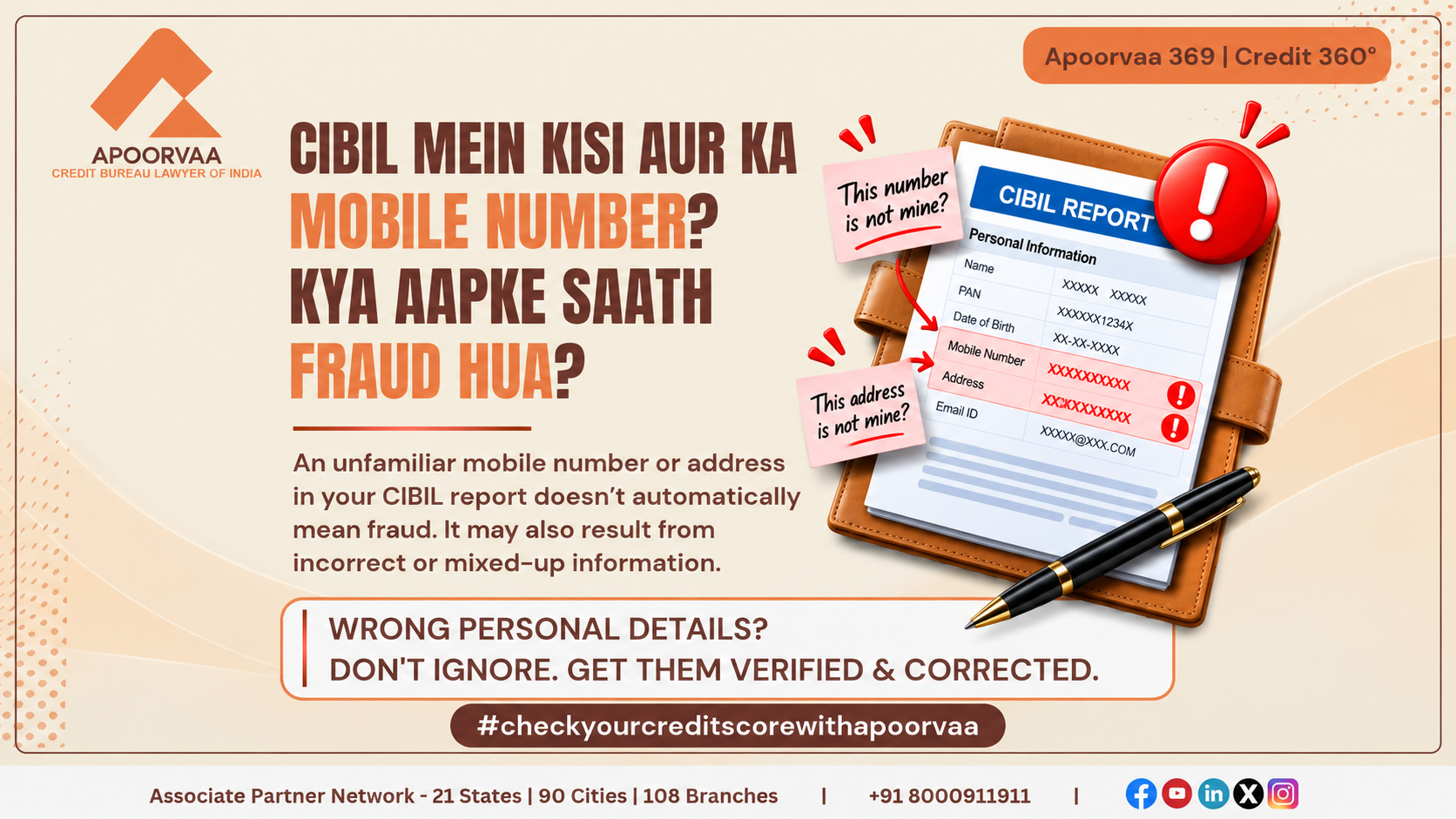
“Someone else’s mobile number or address is appearing in my CIBIL Report. Does that mean fraud has already happened?”
This concern arises when a consumer discovers an unfamiliar mobile number, email address, residential address or identity identifier in their CIBIL Report.
The immediate fear is often that someone has misused their identity to obtain credit.
However, a Wrong Mobile Number or Address in CIBIL Report does not automatically establish identity theft, fraudulent borrowing or an unauthorised loan.
Such discrepancies may arise from outdated records, inaccurate information submitted by a lender, identity-matching problems or potentially unauthorised activity.
The correct approach is to distinguish between historical information, genuine reporting inaccuracies and circumstances that require further investigation.
Incorrect contact information is not proof of fraud. But accurate identity information is essential to reliable credit reporting.
- Why Is Someone Else’s Mobile Number in My CIBIL Report?
A CIBIL Report is not merely a record of outstanding loans and credit-card balances.
It is a credit information record containing details reported by banks and other credit institutions.
Alongside credit accounts, lenders submit relevant identifying and contact information about borrowers.
This may include names, identification numbers, addresses, telephone numbers and other reported details.
Consider a borrower who has maintained a personal loan and two credit cards.
The borrower obtains a fresh CIBIL Report and notices three mobile numbers. Two are familiar, but the third is completely unknown.
There are several possible explanations.
The number may have been recorded during an earlier credit application. It may reflect an incorrect lender submission. Alternatively, the information may have become associated with the wrong consumer profile.
Without reviewing the relevant records, it would be premature to conclude that the number belongs to someone who has committed fraud.
The important question is whether the information can legitimately be associated with the borrower.
If it cannot, the discrepancy requires investigation and, where verified as inaccurate, correction.
- Does a Wrong Address or Phone Number Mean Identity Theft?
A wrong address or mobile number is an indicator of possible data inaccuracy, not independent evidence of identity theft.
This distinction is particularly important because credit reports may retain multiple contact details reported at different points in time.
For example, a borrower may have lived in Ahmedabad when obtaining a vehicle loan and later relocated to Surat.
Both addresses may appear in the credit report.
The older Ahmedabad address is not necessarily incorrect simply because the borrower no longer lives there.
The same principle applies to previous mobile numbers and email addresses.
However, a different situation arises when a borrower discovers an address where they have never lived, an email address they have never used or a phone number they cannot associate with any previous credit relationship.
Such information may require verification with the relevant reporting institution.
When Does the Concern Become More Significant?
The discrepancy deserves particular attention when:
- Multiple unfamiliar identity or contact details appear together.
- An unfamiliar PAN or another important identity identifier is reported.
- An unknown loan or credit-card account also appears.
- The enquiry section contains lender enquiries the consumer does not recognise.
- The information cannot be explained by historical addresses, earlier applications or legitimate contact changes.
Even in these circumstances, investigation is necessary before concluding that fraudulent borrowing has occurred.
A suspected identity mismatch and a confirmed identity-theft incident are not the same thing.
- What Personal Information Appears in a CIBIL Report?
TransUnion CIBIL identifies several important sections within a consumer credit report.
Understanding these sections is essential when evaluating a possible identity mismatch.
Personal Information
This section contains reported identity details such as:
- Consumer name.
- Date of birth.
- Gender.
- PAN and other reported identification numbers.
These details help identify the individual to whom the credit information relates.
Contact Information
The contact-information section may include:
- Residential and correspondence addresses.
- Mobile and telephone numbers.
- Email addresses.
Multiple entries may appear because different credit institutions have reported information at different times.
The presence of multiple addresses or contact numbers is therefore not automatically an error.
Account Information
This section contains reported credit facilities, including:
- Name of the lender.
- Type of loan or credit card.
- Account ownership and status.
- Loan amount or credit limit.
- Outstanding balance.
- Repayment history.
Enquiry Information
This section records credit enquiries made by lending institutions.
An enquiry indicates that a lender requested credit information; it does not, by itself, mean a loan was approved or disbursed.
Why These Sections Must Be Examined Together
Suppose the contact-information section contains an unfamiliar address.
If the remaining identity details and credit accounts are accurate, the issue may be limited to contact information.
However, if an unfamiliar PAN, loan account or enquiry also appears, a wider examination of the reported information may be necessary.
The consumer’s CIBIL Score alone cannot establish whether these records are correctly associated.
- Common Reasons for Incorrect Personal Information in CIBIL
Not all personal-information discrepancies arise from the same underlying problem.
- Historical or Outdated Contact Records
A lender may have submitted an address or mobile number that was valid when the consumer originally applied for credit.
That information may remain visible even after the consumer changes residence or contact details.
The first question is whether the information was previously associated with the borrower.
- Incorrect Information Submitted by a Lender
A bank or financial institution may submit inaccurate information because of a data-entry mistake, an incorrect customer record or another reporting discrepancy.
Where the information is inaccurate, the reporting institution must verify the underlying records and provide the appropriate correction.
- Identity-Matching Discrepancies
Credit information companies maintain records received from multiple reporting institutions.
Identity-matching problems can arise where information from different individuals is incorrectly associated.
Similar names, inconsistent identifiers or inaccurate submitted information may contribute to circumstances requiring investigation.
However, the appearance of an unfamiliar contact detail does not establish that two individuals’ credit files have been merged.
That conclusion requires supporting evidence.
- Potential Unauthorised Use of Identity Information
In some cases, unfamiliar contact details may appear alongside credit activity that the consumer does not recognise.
This can raise a legitimate concern about possible unauthorised activity.
Nevertheless, an unknown mobile number alone cannot establish whether another person has obtained credit using the consumer’s identity.
The credit accounts, enquiries and relevant lender records must be considered.
- Wrong Mobile Number vs Unknown PAN: Why the Difference Matters
Different information fields serve different purposes within a credit report.
A mobile number is primarily a contact detail.
An address may identify a current, previous, residential, office or correspondence location.
PAN, by contrast, is a significant identity identifier.
This distinction matters when assessing the nature of a discrepancy.
| Reported discrepancy | Key verification question |
| Previous mobile number | Was this number used during an earlier credit relationship? |
| Unfamiliar email address | Was this address ever provided to a lender? |
| Unknown residential address | Is this a historical address or genuinely unrelated information? |
| Incorrect PAN | Does this identifier belong to the consumer whose credit information is being reported? |
| Multiple unfamiliar details | Are the reported identity and account records correctly associated? |
An unknown PAN deserves prompt investigation because it may raise questions about the association of credit information with the correct individual.
However, it is not appropriate to conclude that an incorrect PAN automatically means fraud.
The distinction is between a reporting discrepancy that requires verification and an unauthorised financial transaction supported by evidence.
Both may require attention, but they are not interchangeable.
- Can Another Person’s Loan Appear Alongside Incorrect Personal Details?
An unfamiliar mobile number or address does not automatically mean that someone else has taken a loan using your identity.
However, incorrect personal information may sometimes appear alongside an unknown credit account or enquiry.
Consider a consumer whose CIBIL Report contains an unfamiliar residential address and a personal loan account that the consumer does not recognise.
There are several possibilities:
- The account information may have been incorrectly associated with the consumer.
- A reporting institution may have submitted inaccurate identifying details.
- An identity-matching discrepancy may have occurred.
- The account may require investigation for possible unauthorised borrowing.
The presence of these details warrants further examination, but the underlying cause cannot be established from the unfamiliar address alone.
An Unknown Enquiry Is Not the Same as an Unknown Loan
An enquiry indicates that a credit institution accessed the consumer’s credit information.
It does not necessarily mean that a loan was approved or disbursed.
Therefore, unfamiliar enquiries and unfamiliar accounts should be assessed separately.
For a detailed discussion of account-level discrepancies, read our related article on what an unknown loan appearing in your CIBIL Report could mean.
- Why You Should Not Ignore an Identity Mismatch
A common mistake is to assume that unfamiliar personal information will automatically disappear during the next reporting cycle.
That should not be taken for granted.
If an address, mobile number, email address or identity identifier is genuinely unrelated to the consumer, the discrepancy deserves timely investigation.
This becomes particularly important when the report also contains an unfamiliar PAN, credit account or enquiry.
Is Monitoring Your CIBIL Report for One Month Enough?
No.
Continued monitoring is useful during and after an investigation, but it is not a replacement for addressing a discrepancy.
A consumer should not wait for a month merely to see whether genuinely unfamiliar information disappears.
Monitoring helps assess whether the reported information changes. Verification helps establish whether the information is accurate.
Both serve different purposes.
- Can Incorrect Personal Information Be Corrected?
Yes. Inaccurate personal or contact information can be disputed through the applicable credit-information correction process.
TransUnion CIBIL provides dispute categories covering personal information, contact information, account information and enquiries.
However, the responsibilities of the reporting lender and credit bureau must be understood.
Responsibility of the Reporting Credit Institution
Banks and other credit institutions supply credit information to credit information companies.
The reporting institution is responsible for examining the relevant underlying records and confirming whether its submitted information requires correction.
Responsibility of TransUnion CIBIL
TransUnion CIBIL facilitates the dispute process and updates information based on the appropriate confirmation from the reporting credit institution.
It cannot independently remove lender-reported information simply because a consumer believes it is incorrect.
A disputed detail is not automatically an inaccurate detail. Verification determines whether correction is justified.
RBI’s 30-Day Complaint-Resolution Framework
Under RBI’s framework for delayed updation or rectification of credit information, the overall period for resolving a complaint is 30 calendar days.
The reporting credit institution has 21 calendar days to provide corrected information, leaving the credit information company effectively nine calendar days within the overall period.
Where the prescribed resolution period is exceeded, eligible complainants may be entitled to compensation of ₹100 per calendar day, subject to RBI’s applicable conditions.
Importantly, 30 days is the complaint-resolution timeframe, not a waiting period before a consumer can raise a dispute.
Correction is subject to the relevant information being verified as inaccurate. It should not be represented as an automatic or immediate deletion.
- Why Complete Credit-Report Verification Matters
A consumer may have a satisfactory CIBIL Score and still discover inaccurate personal information.
The score does not establish whether every reported address, telephone number, PAN, credit account or enquiry is correctly associated with that individual.
A comprehensive credit-report assessment considers the relationship between:
- Reported identity and contact details.
- Historical and current credit accounts.
- Account ownership and repayment information.
- Credit enquiries and the institutions associated with them.
- Potential inconsistencies requiring lender verification.
This helps distinguish historical information from genuine reporting discrepancies.
The Role of Professional Credit Rectification
At Apoorvaa, professional Credit Report analysis focuses on understanding the reported information, identifying potentially affected records and assessing discrepancies that may require correction.
Where inaccurate information is identified, Credit Rectification involves pursuing appropriate verification and correction through the relevant reporting institutions and credit-information processes.
Professional analysis does not guarantee that every disputed detail will be removed.
Nor does correction of an inaccurate contact field guarantee prevention of identity theft or future unauthorised borrowing.
The objective is to support accurate, appropriately verified credit information.
Frequently Asked Questions
- Does a wrong mobile number in CIBIL mean someone has taken a loan in my name?
No. An unfamiliar mobile number alone does not establish that a fraudulent loan exists. The account and enquiry sections may provide additional information requiring investigation.
- Can an old residential address remain in my CIBIL Report?
Yes. Historical addresses reported by lenders may remain visible. An old address is not necessarily inaccurate.
- What if an unfamiliar PAN appears in my CIBIL Report?
An unfamiliar PAN warrants prompt investigation because it raises questions about whether identity information has been correctly associated with your credit records.
- Can CIBIL immediately delete incorrect personal information?
Not necessarily. Changes to lender-reported information generally require verification and confirmation from the concerned credit institution.
- Should I check my CIBIL Report again after a dispute?
Yes. Reviewing the updated report helps establish whether the reported discrepancy has been corrected and whether further concerns remain.
My Professional Perspective
In my experience, consumers often focus on the CIBIL Score while overlooking the accuracy of their identity and contact information.
But responsible credit reporting requires more than accurate loan balances.
It also depends on credit information being associated with the correct individual.
An unfamiliar mobile number should not automatically trigger a conclusion of fraud. At the same time, a genuinely unknown PAN, address or other identifying detail should not be dismissed as a minor technical issue.
The correct approach is timely investigation, accurate verification and appropriate correction—not panic or unnecessary delay.
Final Takeaway
A wrong mobile number or address in your CIBIL Report may arise from outdated information, incorrect lender reporting, identity-matching discrepancies or potentially unauthorised activity.
The presence of unfamiliar information alone does not establish fraud.
However, genuinely unrelated identity information should be investigated promptly.
WRONG CONTACT DETAILS ≠ CONFIRMED IDENTITY THEFT
UNKNOWN IDENTITY INFORMATION ≠ SOMETHING TO IGNORE
ACCURATE CREDIT REPORTING GOES BEYOND THE CIBIL SCORE
Professional Credit Report Analysis — Apoorvaa
If your CIBIL Report contains an unfamiliar mobile number, email address, residential address, PAN or other identity detail, understanding the complete report is essential.
Purchase your Credit Report and get it professionally analysed by Apoorvaa.
Our professional assessment focuses on reported discrepancies, potentially affected credit records and genuine Credit Rectification requirements.
📞 8000 911 911
Apoorvaa – Credit Bureau Lawyer of India
Related Credit Education