
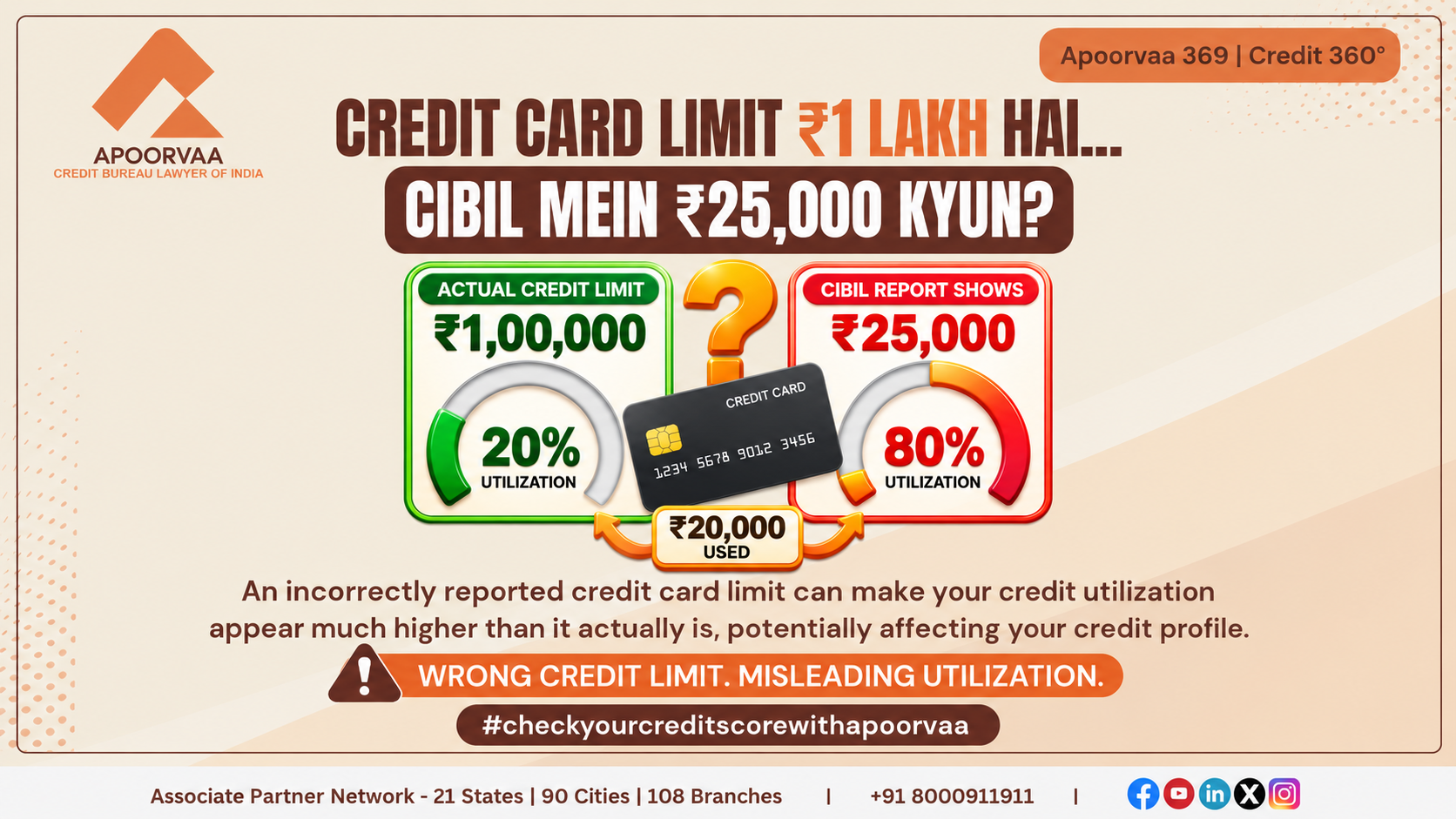
“My credit-card limit is ₹1 lakh, but my CIBIL Report shows only ₹25,000. Can this affect my credit score?”
A wrong credit card limit in CIBIL Report can potentially affect how a borrower’s revolving credit exposure is interpreted.
Consider a credit card with a sanctioned limit of ₹1,00,000 and an outstanding balance of ₹20,000. If the report incorrectly shows a limit of ₹25,000, the same outstanding balance represents a substantially higher proportion of the reported limit.
This difference matters because credit utilisation is relevant to credit-profile assessment.
However, an incorrectly reported credit limit does not automatically establish that a CIBIL Score will fall. The effect depends on the broader credit profile and the scoring model.
The first step is to distinguish a genuine reporting inaccuracy from a recent limit change that has not yet appeared in the report.
- Why Does My CIBIL Report Show the Wrong Credit Card Limit?
A credit-card limit is the maximum revolving credit facility sanctioned by the issuer, subject to the card’s applicable terms.
TransUnion CIBIL receives account information from reporting credit institutions. The credit limit appearing in a report therefore depends on the information furnished by the lender.
A difference between the sanctioned and reported limits may arise because:
- The lender recently approved a credit-limit increase.
- The report reflects information from an earlier reporting date.
- The lender furnished an inaccurate credit-limit figure.
- The consumer is comparing the sanctioned limit with available credit, a temporary limit or another account field.
Not every difference represents an error.
For example, if a bank increased the limit from ₹25,000 to ₹1,00,000 after the date reflected in the report, the older figure may simply represent the account’s previous position.
But if the sanctioned limit was already ₹1,00,000 for the relevant reporting period and the lender continues to report ₹25,000 incorrectly, the discrepancy may require investigation.
The effective limit and reporting date are central to determining accuracy.
- How Does Credit Utilisation Work?
Credit utilisation measures the proportion of a revolving credit limit represented by an outstanding balance.
A commonly used illustrative formula is:
Credit Utilisation (%) = Outstanding Balance ÷ Credit Limit × 100
For example:
Credit Limit: ₹1,00,000
Outstanding Balance: ₹20,000
Illustrative Credit Utilisation:
₹20,000 ÷ ₹1,00,000 × 100 = 20%
The borrower has an outstanding balance equivalent to 20% of the sanctioned limit.
Credit utilisation can help describe how extensively a revolving credit facility is being used.
However, this calculation should not be applied indiscriminately to personal loans, vehicle loans, home loans or other instalment facilities. Their outstanding balances and repayment structures have different meanings.
- ₹1 Lakh Actual Limit vs ₹25,000 Reported Limit: Why It Matters
Consider the following account details:
| Particulars | Actual account | CIBIL-reported figures |
| Credit-card limit | ₹1,00,000 | ₹25,000 |
| Outstanding balance | ₹20,000 | ₹20,000 |
| Illustrative utilisation | 20% | 80% |
With the correct sanctioned limit, the ₹20,000 balance represents 20% utilisation.
Using the incorrectly reported limit of ₹25,000, the same balance represents 80% utilisation.
The borrower has not spent additional money.
The outstanding balance has not increased.
Yet the reported figures may create a substantially different impression of the borrower’s revolving credit exposure.
This is why credit-limit accuracy is important.
Important: The 20% and 80% figures are illustrative calculations. They do not prove that TransUnion CIBIL’s proprietary scoring algorithm uses these exact figures or that the borrower’s score will change by a predictable number of points.
- Can an Incorrect Credit Limit Affect the CIBIL Score?
Potentially, yes.
Credit utilisation is relevant to understanding credit-card exposure and may influence credit-risk assessment.
An incorrectly low limit can make the outstanding balance appear large relative to the reported credit facility.
However, an individual’s CIBIL Score reflects multiple aspects of their credit history.
These may include repayment behaviour, existing credit obligations, credit-account characteristics and recent credit enquiries.
It would therefore be incorrect to claim that every credit-limit mismatch causes a score reduction.
It would also be misleading to promise that correcting the limit will automatically increase the score.
Accurate Credit Information Is the Objective. A Higher Score Is Not a Guaranteed Outcome.
- Credit Limit vs Current Balance vs Available Credit vs High Credit
Correct interpretation requires understanding the account fields.
| Credit information | Meaning |
| Credit Limit | Sanctioned maximum credit-card facility |
| Current Balance | Outstanding amount reported by the lender |
| Available Credit | Unused credit currently available, subject to transactions and issuer adjustments |
| High Credit | Highest credit amount recorded or reported under the relevant field; not automatically the sanctioned limit |
For example, a card with a ₹1,00,000 limit and ₹20,000 outstanding may have approximately ₹80,000 of unused limit before accounting for pending transactions, holds and other adjustments.
However, a figure appearing under High Credit should not automatically be interpreted as the current sanctioned credit limit.
Confusing these fields may lead consumers to conclude that the lender has made an error when they are actually comparing different types of information.
A professional credit-report review considers the correct field, account records and reporting period before identifying a genuine discrepancy.
- Why High Credit Utilisation Is Not the Same as Default
High utilisation may indicate that a large portion of a revolving credit facility is being used.
But it is not the same as an overdue amount, missed EMI or loan settlement.
A borrower can have high credit-card utilisation while making payments on time.
Similarly, a borrower may have low utilisation but an unrelated overdue account.
Credit utilisation is therefore only one part of the credit profile.
For an accurate assessment, revolving credit usage must be considered alongside repayment behaviour, other credit obligations and the reliability of the reported account information.
- What If My Bank Recently Increased My Credit Limit?
A recently approved credit-limit increase may not immediately appear in your CIBIL Report.
For example, suppose your bank increased your credit-card limit from ₹25,000 to ₹1,00,000 on 5 October, but your report reflects information furnished before that date.
In this situation, the older limit may be consistent with the reporting period.
Three dates are particularly important:
- Limit Approval Date: When the bank approved the increase.
- Effective Date: When the increased limit became applicable to the account.
- Reporting Date: The date associated with the account information furnished to the credit bureau.
Under RBI’s credit-information reporting framework, credit institutions are required to update credit information on a fortnightly basis, as of the 15th and last day of the month, or at shorter agreed intervals, subject to prescribed timelines.
Therefore, a recent increase not yet reflected in CIBIL is not automatically a reporting error.
A reporting delay and an incorrect credit-limit entry are different issues.
- When Does a Wrong Credit Card Limit Require Rectification?
A credit-limit difference may require correction when the information furnished to the credit bureau does not accurately reflect the lender’s confirmed account records.
Consider a borrower whose bank has confirmed a sanctioned credit-card limit of ₹1,00,000.
If the relevant CIBIL Report continues to incorrectly show ₹25,000 after accounting for the applicable reporting dates, the discrepancy may warrant investigation.
Important considerations include:
- The latest confirmed sanctioned credit limit.
- The effective date of any limit increase or reduction.
- The credit-limit figure appearing in the CIBIL Report.
- The lender’s relevant reporting date.
A genuine inaccuracy may require verification and correction through the lender and applicable credit-bureau process.
TransUnion CIBIL identifies incorrect credit limits among potential credit-report inaccuracies. However, changes to lender-reported account information generally require confirmation from the reporting credit institution.
Credit Rectification is justified by demonstrably inaccurate information—not simply by dissatisfaction with a credit score.
- Why Professional Credit Report Analysis Matters
Many consumers focus on their CIBIL Score without examining the account information behind it.
An incorrect credit limit may remain unnoticed even when the outstanding balance and repayment history appear correct.
Professional analysis can help distinguish between a recent account update, confusion between report fields and a genuine lender-reporting discrepancy.
This is particularly relevant where the borrower has multiple credit facilities or is preparing for a significant lending decision.
However, credit-card utilisation should not be confused with instalment-loan repayment progress, overdue payments or settlement information.
Each requires a different interpretation.
At Apoorvaa, our focus is on account-level credit-information accuracy and professional evaluation of genuine Credit Rectification requirements.
Frequently Asked Questions
- Can an incorrect credit-card limit reduce my CIBIL Score?
Potentially. An incorrectly low reported limit may affect the information used to assess revolving credit exposure. However, no specific score reduction can be predicted or guaranteed.
- Why does CIBIL show ₹25,000 when my bank limit is ₹1,00,000?
The report may reflect an earlier limit, a recent increase may not yet have been reported, or the information may be inaccurate. The relevant account records and reporting dates determine the explanation.
- Is High Credit the same as Credit Limit?
No. High Credit is a separate credit-reporting field and should not automatically be treated as the sanctioned credit-card limit.
- Will correcting my credit limit guarantee a higher CIBIL Score?
No. Correcting inaccurate information improves reporting accuracy. Any scoring outcome depends on the complete credit profile and the scoring model.
My Perspective
In my professional experience, credit-report inaccuracies are not limited to overdue amounts or incorrect account status.
Even a credit-limit discrepancy can change how a borrower’s revolving credit exposure appears.
When a sanctioned limit of ₹1,00,000 is incorrectly reflected as ₹25,000, the issue deserves attention—not because a particular score increase can be promised, but because credit decisions should be informed by accurate account information.
I believe consumers and financial professionals should examine the complete credit report rather than rely exclusively on the three-digit score.
Accurate reporting is the foundation of meaningful credit assessment.
Final Takeaway
A wrong credit card limit in CIBIL Report can potentially create a misleading picture of credit utilisation.
However, not every difference is a reporting error. Recent limit increases and reporting dates must be considered.
Where the lender’s confirmed credit limit and the reported information genuinely differ, professional examination may be appropriate.
YOUR CREDIT LIMIT MATTERS. ACCURATE CREDIT REPORTING MATTERS MORE.
Is Your Credit Card Limit Incorrect in CIBIL?
Does your bank confirm a credit-card limit of ₹1,00,000 while your CIBIL Report continues to show only ₹25,000?
Apoorvaa provides professional Credit Report analysis to identify account-level reporting discrepancies and evaluate whether Credit Rectification is appropriate.
Purchase your Credit Report and have the discrepancy professionally analysed by Apoorvaa.
📞 8000 911 911
Apoorvaa – Credit Bureau Lawyer of India
Credit Rectification addresses genuine reporting inaccuracies. It does not guarantee a particular credit-score increase or loan approval.
Related Credit Education