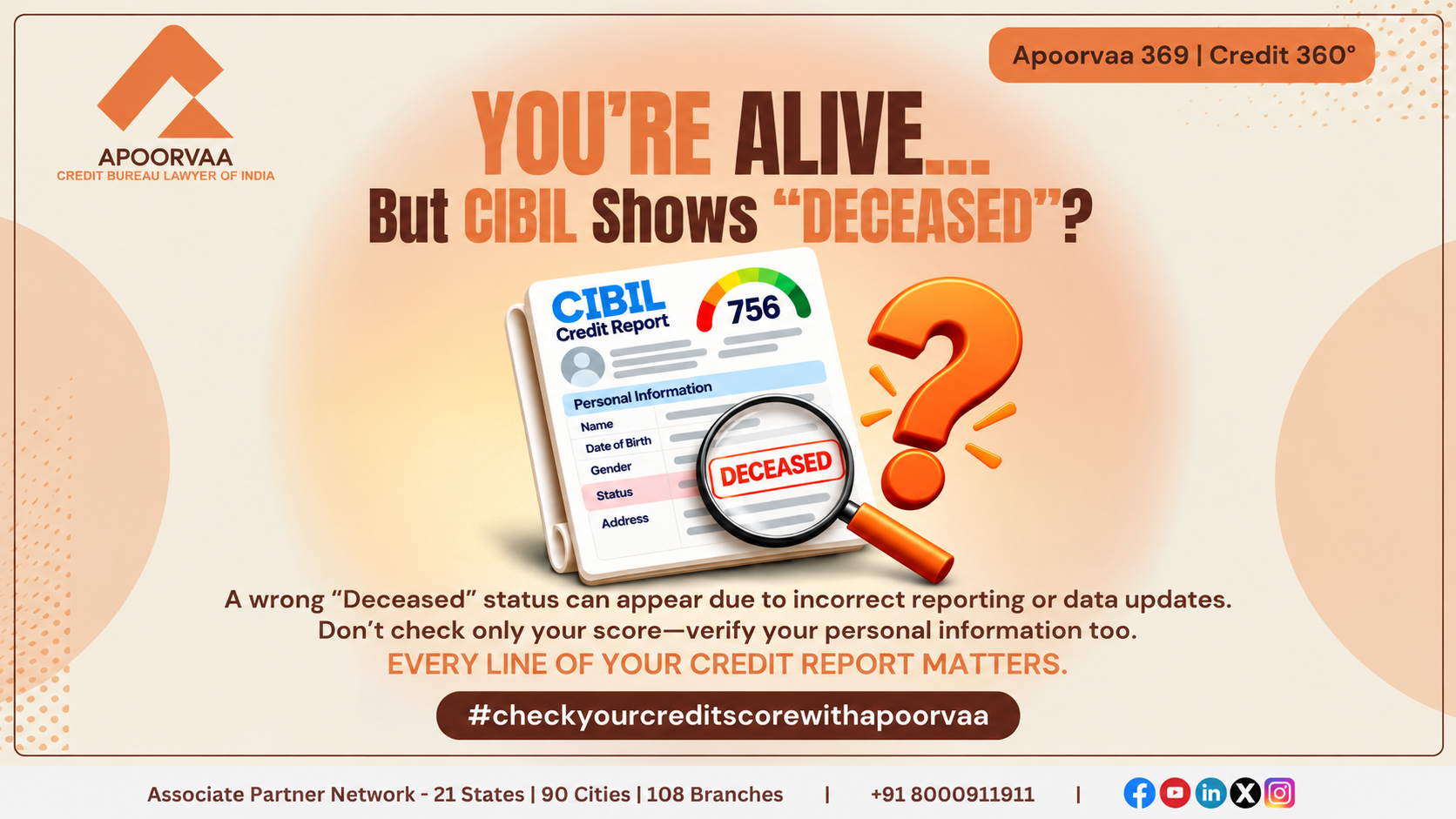
“What if you are alive, but your credit report shows you as deceased?”
It sounds almost impossible.
You walk into a bank for a new credit facility. Your Credit Report is reviewed and somewhere within the reported credit information appears an indication:
“Deceased.”
But you are standing right there.
A customer recently shared an unusual situation involving a relative whose credit information reportedly reflected a “Deceased” indication.
The situation may be rare, but it highlights something that every borrower should understand.
Credit Report errors are not limited to CIBIL Score, Current Balance, Amount Overdue, settlement, write-off or incorrect loan accounts.
Information associated with the consumer and the consumer’s credit relationships can also require verification.
This is why opening your CIBIL Report, looking only at the three-digit score and closing the report is not enough.
Your complete Credit Report deserves examination.
But before discussing how such an issue should be approached, we need to answer an important technical question:
Where can “Deceased” actually appear in India’s credit-reporting framework?
- Can “Deceased” Actually Appear in CIBIL Credit Information?
Yes.
But this issue must be described carefully.
Under the RBI-prescribed Uniform Credit Reporting Format (Consumer), credit information is organised into multiple data segments covering consumer identification, contact information and credit-account information.
Within the prescribed framework, “Deceased” exists as an additional catalogue value under the Ownership Indicator.
This technical point matters.
We should therefore not automatically describe every such case as:
“CIBIL has marked the customer’s personal status as dead.”
Nor should we assume, without examining the actual report, that “Deceased” necessarily appears as a generic personal-information field beside the consumer’s name.
Instead, professional analysis should establish:
Where exactly does the indication appear?
Which credit facility is associated with it?
What is the relevant ownership information?
Which credit institution furnished the associated data?
What does the consumer’s actual Credit Report show?
Only after these questions are answered can the nature of the discrepancy be properly understood.
This is an important principle of Credit Rectification:
Do not begin with the assumption. Begin with the data actually appearing in the Credit Report.
- Why an Incorrect “Deceased” Indication Requires Attention
Suppose the consumer is alive and the credit information associated with that consumer contains a deceased indication that is inconsistent with the actual circumstances.
That is fundamentally a data-accuracy issue.
It should be taken seriously, but not sensationalised.
We should not tell a consumer:
“Your next loan will definitely be rejected.”
Credit decisions depend on several factors and on the lender’s assessment.
However, inaccurate information may create inconsistency when a lender examines the consumer’s credit profile and may require clarification or verification.
The fundamental question is not whether the error looks dramatic.
It is whether the information being reported is accurate, complete and appropriately associated with the consumer and credit facility.
RBI’s credit-information framework places obligations on credit institutions concerning the accuracy, completeness and updating of information furnished to Credit Information Companies.
Therefore, when a living consumer encounters a deceased indication associated with their credit information, the issue should not simply be ignored because the CIBIL Score appears satisfactory.
Credit-data accuracy matters independently of the score.
- Why Checking Only Your CIBIL Score Is Not Enough
Imagine a consumer downloads a Credit Report.
At the top, the consumer sees:
CIBIL Score: 756
The immediate reaction may be:
“My score is fine.”
The report is closed.
But what if elsewhere in the report:
- An identification detail is inconsistent?
- An address does not belong to the consumer?
- An unfamiliar credit facility appears?
- Account ownership information is incorrect?
- A closed account continues to show inaccurate current information?
- An unusual deceased indication appears against reported credit information?
A Credit Report should not be reduced to a three-digit number.
The score is important, but the report contains the underlying information that forms the consumer’s broader credit profile.
TransUnion CIBIL itself allows consumers to raise disputes concerning inaccurate personal information as well as account-related information.
Therefore, consumers should ask two separate questions:
- What is my CIBIL Score?
and
- Is the information in my CIBIL Report accurate?
These questions are related, but they are not identical.
A satisfactory score does not certify that every field in the Credit Report is correct.
- What Other Personal Information Should You Review in Your Credit Report?
India’s consumer credit-reporting framework contains multiple categories of identifying and contact information.
Depending on the applicable report and data furnished, these may include information relating to:
- Consumer name
- Date of birth
- Gender
- Identification type and identification number
- Telephone details
- Email information
- Address information
TransUnion CIBIL’s consumer guidance also recognises disputes involving personal information such as name, contact information, PAN and address.
This means that a consumer reviewing a Credit Report should not focus exclusively on loan accounts.
The relevant personal information should also be checked for consistency.
Why Does This Matter?
Credit information must be associated with the correct consumer.
If identifying information is inaccurate or inconsistent, it may require verification.
But another important distinction must be maintained:
An incorrect personal-information field and an incorrect account-level field are not necessarily the same type of problem.
For example, an incorrect address is different from an unfamiliar loan account.
A wrong PAN-related detail is different from an incorrect Current Balance.
And a deceased indication associated with an Ownership Indicator requires different analysis from a spelling error in a name.
Professional Credit Report assessment should identify which field is actually inaccurate before determining what needs to be rectified.
- Personal Information Error vs Account-Level Reporting Error
This distinction becomes especially important in an unusual case.
Suppose a consumer says:
“My CIBIL Report says I am deceased.”
Before classifying the problem, the report should be examined.
If the issue concerns identifying information, it may be a personal-information discrepancy.
If it concerns the Ownership Indicator associated with a credit facility, it is necessary to understand the account-level reporting and its relationship with the consumer.
Similarly, a report may contain problems involving:
Current Balance: the reported outstanding amount associated with a credit facility.
Amount Overdue: the amount reported as overdue.
Account Status: the reported position or classification of the credit account.
Ownership: the consumer’s reported relationship to the credit facility.
These fields have different meanings.
Treating every CIBIL issue simply as a “score problem” can therefore result in the actual reporting discrepancy being overlooked.
Before asking how to correct a Credit Report, identify exactly what is incorrect in the Credit Report.
- “Deceased” Is Not the Same as Settlement, Write-Off or Suit Filed
Another important distinction is between data accuracy and adverse credit history.
Consumers frequently contact us because they have seen terms such as:
- Amount Overdue
- Settled
- Written-Off
- Suit Filed
- Current Balance
- Payment delays
These generally relate to credit-account information and repayment circumstances.
An inaccurate deceased indication is different.
It should not automatically be interpreted as a default, missed EMI or unpaid loan.
Consider Two Different Situations
Consumer A has an accurately reported overdue amount because an EMI was not paid when due.
Consumer B is alive, but credit information associated with the consumer contains an inaccurate deceased indication.
Both consumers may have concerns about their Credit Reports.
But the underlying issues are completely different.
For Consumer A, the question is whether the repayment information is accurate.
For Consumer B, the question is whether the consumer/ownership information has been accurately reported and associated.
This is why professional Credit Rectification cannot use one standard solution for every CIBIL issue.
The nature of the reported discrepancy determines what needs to be examined.
- Does a Wrong “Deceased” Indication Mean the Bank Made a Mistake?
Not necessarily.
It is equally inappropriate to immediately conclude:
“CIBIL made the mistake.”
Credit reporting involves information moving through an ecosystem involving Credit Institutions and Credit Information Companies.
The consumer sees the final information in the Credit Report.
But identifying the origin of a discrepancy requires examination of the relevant account and reporting source.
Suppose a deceased indication appears in relation to one particular credit facility.
The questions then become:
Which institution reported that facility?
What information exists in the lender’s underlying records?
Does the lender’s information correspond with what appears in the Credit Report?
Has the information subsequently been updated?
Is the consumer correctly associated with the account?
Until these questions are examined, assigning responsibility would be premature.
Similarly, we should not speculate that the problem occurred because of a software update, data migration, system-version change or technical glitch unless evidence supports that conclusion in the particular case.
There may be several possible causes of inaccurate information.
Professional analysis should establish the facts rather than invent a technical explanation.
- Who Corrects Incorrect Information — The Bank or the Credit Bureau?
This is one of the most misunderstood parts of Credit Rectification.
Consumers sometimes hear:
“CIBIL cannot do anything. Only the bank can change the report.”
That statement is too broad.
At the same time, it would also be incorrect to suggest that a Credit Information Company can simply rewrite lender-furnished account information whenever a consumer asks.
The current correction framework involves distinct roles.
The Credit Institution
The concerned bank, NBFC or other applicable reporting institution maintains the underlying credit-account information and furnishes relevant data through the credit-reporting framework.
Where disputed information originated from that institution, verification of its records may be necessary.
The Credit Information Company
A Credit Information Company such as TransUnion CIBIL maintains and processes credit information and provides mechanisms through which consumers can dispute inaccuracies appearing in their Credit Reports.
Where lender-furnished information is disputed, the CIC may communicate the dispute to the concerned credit institution for verification.
Therefore, Credit Rectification should be understood as a verification and correction process involving the relevant data source and the Credit Information Company under the applicable framework.
It is not simply:
“Tell CIBIL to delete it.”
Nor is it:
“The bank is always responsible.”
The source and nature of the inaccurate information must first be established.
- Why Documentary Verification Becomes Critical
An unusual discrepancy such as a deceased indication cannot be approached only through verbal explanation.
The consumer’s actual identity and the information being disputed need to be supported by appropriate records.
Depending on the nature of the discrepancy, relevant documents may help establish:
- Correct identity
- Date of birth
- Applicable identification details
- Address or contact information
- Relationship with the reported credit facility
- Relevant account information
- Information inconsistent with the disputed reporting
The purpose is not to collect unnecessary documents.
The purpose is to connect the reported information with the verified factual position.
For example, if the problem relates to account ownership, documents relevant to that credit relationship may matter.
If the issue concerns identification information, the relevant identification records become important.
If multiple accounts contain inconsistent information, each may require separate examination.
This is why an unusual Credit Report problem should not immediately be reduced to a generic online dispute.
First establish what is wrong. Then establish what the correct information should be.
- One Error Does Not Mean the Entire CIBIL Report Is Wrong
Suppose a consumer discovers an inaccurate deceased indication.
That is a legitimate concern if it does not reflect the actual circumstances.
But it does not automatically establish that every other piece of information in the Credit Report is inaccurate.
The consumer may still have correctly reported:
- Existing loans
- Closed loans
- Current balances
- Historical repayment behaviour
- Earlier payment delays
- Enquiries
- Other account information
Similarly, correcting one inaccurate field does not provide a basis for removing other information that is accurate.
This principle is central to professional Credit Rectification.
The objective is not to make the Credit Report look favourable.
The objective is to make sure that the information that should be accurate is accurate.
That difference matters.
- What Should You Do After Identifying an Incorrect “Deceased” Indication?
Once the report has been examined and the incorrect information has been identified, the next objective is rectification based on verified facts.
This is different from immediately requesting deletion.
The consumer should first be clear about:
- The exact credit facility or information affected.
- Where the deceased indication appears.
- The concerned Credit Institution.
- What the institution’s underlying records show.
- What documentary information establishes the correct position.
This is particularly important because, as explained in Part 1, “Deceased” exists within the prescribed credit-reporting framework as an additional catalogue value under the Ownership Indicator.
Therefore, a professional assessment should determine exactly what has been reported before deciding how the discrepancy should be addressed.
The objective is not merely to remove the word “Deceased.” The objective is to ensure that the relevant credit information accurately represents the consumer and the credit relationship.
- How Does the Credit Report Dispute and Rectification Process Work?
When a consumer disputes information appearing in a Credit Report, the process may involve both the Credit Information Company and the concerned Credit Institution.
TransUnion CIBIL provides consumers with a mechanism for raising disputes regarding inaccurate information appearing in their Credit Reports.
But raising a dispute does not mean that every requested change is automatically accepted.
Where the disputed information was furnished by a bank, NBFC or another applicable Credit Institution, verification of that institution’s records may be required.
This is important because the CIC maintains credit information within a regulated reporting ecosystem; it does not simply replace lender-furnished account information based solely on a consumer’s request.
At the same time, the CIC has responsibilities within the dispute-resolution process.
Therefore, an accurate way to understand Credit Rectification is:
Consumer identifies the discrepancy → the disputed information is investigated → the relevant source records are verified → appropriate correction is carried through the applicable CI-CIC framework.
The exact process will depend on the nature of the information being disputed.
- RBI’s 30-Calendar-Day Credit Information Rectification Framework
Consumers should also understand the regulatory timeline applicable to complaints concerning credit-information updation or rectification.
Under RBI’s compensation framework for delayed updation/rectification of credit information, an eligible complaint is expected to be resolved within an overall period of 30 calendar days from the date of initial filing.
Within this framework, the concerned Credit Institution gets 21 calendar days to send updated credit information to the Credit Information Company after being informed of the complaint. This leaves the CIC with the remaining period for completing resolution within the overall 30-calendar-day timeline.
This framework is important because it creates accountability around the handling of qualifying credit-information complaints.
However, consumers should understand what the 30-day period means.
It does not mean:
“Every change I request must be made within 30 days.”
A dispute must first concern information that genuinely requires updation or rectification.
If the information is verified as accurate, a consumer’s request to change it does not automatically make it eligible for correction.
- When Does RBI’s ₹100-Per-Day Compensation Apply?
RBI’s framework provides for compensation of ₹100 per calendar day where an eligible complaint involving delayed updation or rectification of credit information remains unresolved beyond 30 calendar days, subject to the framework’s conditions and exclusions.
This provision is sometimes misunderstood.
It should not be promoted as:
“Find a CIBIL error and receive ₹100 every day.”
That would be inaccurate.
The compensation mechanism applies within the regulatory framework and depends on factors such as the nature of the complaint, the resolution timeline and which regulated entity is responsible for the delay.
Therefore, if a consumer discovers an incorrect deceased indication, the immediate objective should remain:
Establish the correct information and have the inaccurate credit data appropriately rectified.
Compensation, where applicable, is a regulatory consequence of qualifying delay—not the purpose of raising the dispute.
- What If the Bank’s Records Are Correct but the Credit Report Is Not?
This is an important scenario in professional Credit Report analysis.
Imagine that the consumer approaches the concerned lender.
The lender’s current records correctly identify the consumer and do not support the disputed deceased indication.
However, the Credit Report still contains inconsistent information.
In such a case, it becomes necessary to understand whether the correct information has been furnished through the credit-reporting process and whether the relevant update has been appropriately reflected.
The opposite situation may also occur.
The Credit Report may reflect information that corresponds with what was furnished, while the underlying information maintained or furnished by the concerned institution itself requires correction.
These two situations are not identical.
This is precisely why consumers should avoid beginning with the conclusion:
“CIBIL is wrong.”
or
“My bank is wrong.”
Professional rectification should establish the point at which the inconsistency exists.
- Can an Incorrect “Deceased” Indication Affect a Future Loan Application?
Potentially, inaccurate information can create difficulties or require clarification when a lender assesses a consumer’s credit profile.
However, it would be inappropriate to state:
“If CIBIL shows deceased, your loan will definitely be rejected.”
Loan approval is not determined by one universal rule.
Banks and financial institutions may consider multiple factors, including:
- Credit information
- Existing obligations
- Repayment behaviour
- Income
- Repayment capacity
- Product eligibility
- Internal lending policies
An unusual inconsistency in credit information may prompt verification or clarification.
That is sufficient reason to take an inaccurate indication seriously without making exaggerated claims about its inevitable effect.
Accurate credit information helps lenders assess the consumer on the basis of the correct reported position.
- What Happens to Your CIBIL Score After Correction?
Another common question is:
“Once the deceased indication is corrected, how many points will my CIBIL Score increase?”
There is no responsible way to promise a particular increase.
The purpose of rectifying inaccurate information is to make the Credit Report accurate.
Whether the correction affects the CIBIL Score depends on the nature of the corrected information and the factors considered by the applicable scoring model.
A consumer should therefore be cautious of promises such as:
“We will remove this and increase your score by 100 points.”
Similarly, rectification does not guarantee:
- A particular CIBIL Score.
- Deletion of accurately reported adverse history.
- Removal of genuine repayment delays.
- Approval of a future loan.
- A particular interest rate or credit limit.
Credit Rectification should be measured first by data accuracy—not by an artificial promise about the final score.
- Correcting One Error Does Not Delete Accurate Negative History
Suppose the consumer has an incorrect deceased indication.
The same Credit Report also contains an accurately reported historical EMI delay.
Correcting the deceased information does not automatically make that EMI delay incorrect.
Similarly, an accurately reported settlement, write-off, overdue amount or other historical information does not become removable merely because another field contains an error.
This distinction is important because consumers sometimes approach Credit Rectification with the expectation that finding one error provides a basis for removing all unfavourable information.
It does not.
The correct principle is:
Incorrect information should be rectified. Accurate information should remain accurate.
That is fundamental to the integrity of the credit-information system.
- Why Complete Credit Report Review Matters Before Applying for New Credit
Many consumers check their Credit Reports only after receiving a rejection or when a bank raises a question.
A better approach is to understand the complete credit profile before making an important credit application.
For example, before applying for a:
- Home loan
- Business loan
- Personal loan
- Vehicle loan
- Credit card
- Other significant credit facility
the consumer may benefit from reviewing whether the report accurately represents their identity and existing credit relationships.
This does not mean that every consumer needs professional rectification before applying for a loan.
It means that if something appears unusual, inconsistent or apparently inaccurate, understanding it before the lending assessment may prevent unnecessary confusion later.
And this review should not stop at the score.
- Why Checking Only Your CIBIL Score Can Hide the Real Problem
Consider two consumers.
Consumer A: CIBIL Score 756, but an unfamiliar loan appears.
Consumer B: CIBIL Score 756, but information associated with a credit facility contains an incorrect deceased indication.
If both consumers check only the score, they may conclude:
“Everything is fine.”
But their Credit Reports tell a different story.
This is why we repeatedly emphasise:
Your CIBIL Score is important. Your complete Credit Report is more than the score.
A professional review looks at the information behind the number.
It asks whether the accounts belong to the consumer.
It examines account ownership and status.
It reviews balances and overdue information.
It considers identification information.
And when something unusual appears, it determines what that information actually means before recommending rectification.
- When Should You Consider Professional Credit Report Review?
Professional review may become useful when the consumer encounters information that is unusual, inconsistent or difficult to interpret.
For example:
“I am alive, but my credit information shows Deceased.”
“This loan does not belong to me.”
“I closed this loan, but an outstanding balance remains.”
“I repaid the loan fully, but the account shows Settled.”
“The loan is mine, but the ownership information is incorrect.”
Each statement sounds like a Credit Report problem.
But each may involve a different data field, reporting source, documentary requirement and rectification issue.
At Apoorvaa – Credit Bureau Lawyer of India, our approach to Credit Rectification begins with understanding the report and identifying the precise account-level or information-level discrepancy.
The objective is not to promise that every negative entry can be removed.
It is to determine whether the information accurately represents the consumer’s actual credit position.
Frequently Asked Questions
- I am alive, but my CIBIL Report shows “Deceased.” What should I do?
First establish exactly where the deceased indication appears and which credit facility or reported information is associated with it. The relevant records and source of the information should then be verified before rectification is pursued.
- Is “Deceased” an official credit-reporting value?
Yes. The RBI-prescribed consumer credit-reporting format includes “Deceased” as an additional catalogue value under the Ownership Indicator.
- Does it mean CIBIL itself marked me as deceased?
Not necessarily. The source of the relevant information should be established before responsibility is attributed to either the CIC or the concerned Credit Institution.
- Can I dispute incorrect personal information in my CIBIL Report?
Yes. TransUnion CIBIL provides mechanisms for disputing inaccurate personal and account information.
- Can CIBIL simply change the information when I complain?
Not every requested change is automatically made. Where lender-furnished information is disputed, verification through the applicable dispute framework may be necessary.
- How long does Credit Report rectification take?
Under RBI’s applicable delayed updation/rectification framework, qualifying complaints have an overall resolution period of 30 calendar days. The actual outcome depends on the facts and verification involved.
- Will I automatically receive ₹100 per day if my report is incorrect?
No. RBI’s ₹100-per-calendar-day compensation provision applies to eligible complaints that remain unresolved beyond the prescribed period, subject to the framework’s conditions and exclusions.
- Will correcting the deceased indication increase my CIBIL Score?
Not necessarily. The primary objective is accurate credit information. No specific score increase should be guaranteed.
- Will correction guarantee my loan approval?
No. Loan approval depends on multiple factors and the lender’s assessment.
- Should I check only personal information and my CIBIL Score?
No. Review the complete Credit Report, including relevant identifying information, credit accounts, ownership, balances, overdue information, account status and repayment history.
Apoorvaa’s Perspective: Every Line of Your Credit Report Matters
A customer’s unusual experience gave us today’s question:
“What if you are alive, but your credit report shows you as deceased?”
The case is unusual.
But the lesson is not.
For years, consumers have been taught to ask one question:
“What is my CIBIL Score?”
I believe the better question is:
“Is my complete Credit Report accurate?”
Your score matters.
But your name matters.
Your identification information matters.
Your credit accounts matter.
Your account ownership matters.
Your Current Balance and Amount Overdue matter.
Your account status matters.
Your repayment history matters.
And unusual information associated with your credit profile matters.
If something appears incorrect, do not immediately assume that the bank made the mistake.
Do not automatically blame the credit bureau.
Do not speculate about software errors or technical glitches.
Understand what has actually been reported. Identify the relevant source. Establish the correct information. Then pursue rectification through the appropriate framework.
That is how Credit Rectification should be approached.
Final Takeaway
Alive but CIBIL Report Shows ‘Deceased’? What Should You Do?
An incorrect deceased indication may be rare, but it demonstrates why consumers should never reduce their Credit Reports to a three-digit score.
Review your identifying information.
Review your credit accounts.
Understand ownership and account status.
Check balances and overdue information.
Verify whether unfamiliar or unusual information actually belongs to you.
And if information appears inaccurate, first establish exactly what has been reported and what the verified position should be.
Correction should be based on facts and documentary verification—not assumptions.
Your CIBIL Score matters. But every material line of your Credit Report matters too.
Professional Credit Report Assessment & Rectification
Found unusual, inaccurate or inconsistent information in your Credit Report?
Apoorvaa provides professional Credit Report assessment and Credit Rectification services for individuals and businesses where credit information requires detailed examination and verification.
📞 8000 911 911
Apoorvaa – Credit Bureau Lawyer of India
Credit Rectification does not guarantee deletion of accurately reported information, an increase in the CIBIL Score or future loan approval.
Related Credit Education