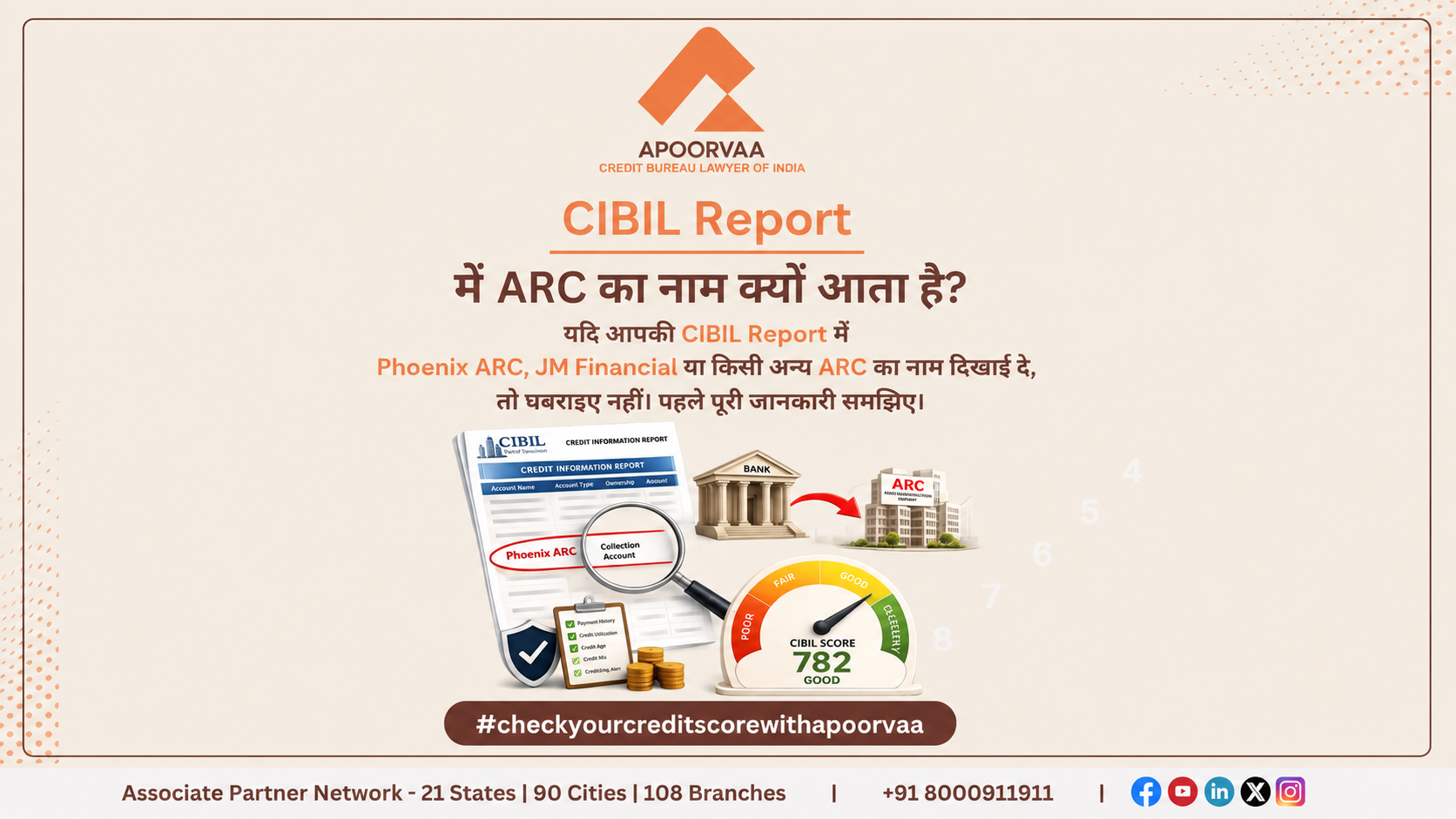
When borrowers download their credit report, they expect to see the name of the bank or financial institution from which they originally borrowed. However, many people are surprised to find an unfamiliar organisation instead. Seeing an ARC in CIBIL Report often creates confusion and raises several questions.
“Who is this company?”
“Why has my bank’s name disappeared?”
“Has my loan been sold?”
“Should I make payment immediately if this company contacts me?”
These questions are natural because most borrowers are unaware that banks can transfer certain loan accounts to an Asset Reconstruction Company (ARC). When such a transfer takes place, the new organisation may appear in your CIBIL Report as the lender or account holder.
The presence of an ARC in CIBIL Report does not automatically mean there is an error or fraud. In many cases, it simply reflects a legitimate transfer of the loan account or recovery rights from the original lender. However, before making any payment or accepting any settlement offer, every borrower should understand what an ARC is, why it appears in the credit report, and what precautions should be taken.
This article explains everything you need to know in simple language.
What Is an Asset Reconstruction Company (ARC)?
An Asset Reconstruction Company (ARC) is a financial institution that acquires certain loan accounts from banks and financial institutions in accordance with applicable laws and regulatory guidelines.
Banks sometimes decide to transfer eligible loan accounts to an ARC as part of their financial and recovery strategy. Once the transfer is completed, the ARC becomes responsible for managing the account, communicating with the borrower, recovering dues where applicable, and updating information with credit bureaus.
Some well-known Asset Reconstruction Companies include:
- Phoenix ARC
- JM Financial Asset Reconstruction Company
- Edelweiss ARC
- Omkara ARC
- Invent ARC
The appearance of one of these organisations in your CIBIL Report does not necessarily indicate that a new loan has been created. Instead, it usually means that the ownership or recovery rights of an existing loan have been transferred.
Why Does an ARC Appear in a CIBIL Report?
This is one of the most common questions borrowers ask after checking their credit report.
A bank may decide to transfer certain loan accounts to an Asset Reconstruction Company. Once the transfer is completed and the records are updated, the name of the ARC may replace the original lender in your CIBIL Report.
For example, imagine you obtained a personal loan from Bank XYZ several years ago. Later, the bank transfers that loan account to an Asset Reconstruction Company. When the updated information is reported to the credit bureau, your report may display the name of the ARC instead of Bank XYZ.
As a result, borrowers often believe that an unknown company has added a new loan to their credit history. In reality, the account may simply reflect the transferred loan.
This is why understanding an ARC in CIBIL Report is important before assuming that the report contains an error.
Does an ARC in CIBIL Report Mean Something Is Wrong?
Not necessarily.
Many borrowers panic as soon as they notice an unfamiliar lender name. However, the presence of an ARC alone does not prove that the credit report is incorrect.
Instead of assuming the worst, verify the details carefully.
Review the following information:
- Loan account number
- Date the account was opened
- Loan type
- Outstanding balance
- Payment history
- Current account status
If these details match your existing loan records, the change may simply reflect the transfer of the account from the original lender to an Asset Reconstruction Company.
However, if the information appears unfamiliar or inaccurate, you should investigate further before taking any action.
Why Do Borrowers Get Confused?
Most borrowers remember only the bank from which they originally obtained the loan. They are rarely informed about every subsequent administrative change unless formal communication reaches them.
Therefore, when names such as Phoenix ARC or JM Financial ARC suddenly appear in the credit report, borrowers naturally assume that a mistake has occurred.
Some even fear that someone has fraudulently taken a loan in their name.
Others receive phone calls demanding payment and immediately transfer money without verifying who currently owns the account.
These situations can often be avoided by understanding why an ARC appears in the credit report and by confirming the facts before making any financial decision.
Never Make Payment Without Verification
Receiving a recovery call does not mean you should immediately transfer money.
Before making any payment, verify whether the organisation contacting you is genuinely authorised to recover the dues related to your loan.
Request official written communication containing:
- Name of the original lender
- Name of the current account holder or ARC
- Loan account number
- Outstanding amount
- Basis of the outstanding calculation
- Payment instructions
- Official contact details
Compare these details with your own loan records.
If anything appears inconsistent, seek clarification before proceeding.
Written communication protects both the borrower and the institution and helps prevent misunderstandings later.
Verify Whether the Loan Was Actually Transferred
Not every borrower is aware that a loan transfer may have taken place years earlier.
Before accepting any demand or settlement proposal, confirm whether the loan has genuinely been assigned to the Asset Reconstruction Company.
Where appropriate, ask for supporting documentation showing that the account has been transferred or that the ARC is authorised to deal with the loan.
Taking a few extra minutes to verify the ownership of the account can help you avoid unnecessary disputes and ensure that you are dealing with the correct organisation.
Loan Settlement vs Loan Closure – Know the Difference Before You Pay
One of the biggest mistakes borrowers make is assuming that loan settlement and loan closure mean the same thing. They don’t.
Understanding the difference becomes even more important when an ARC in CIBIL Report contacts you regarding an outstanding loan.
What Is Loan Settlement?
A loan settlement generally occurs when the lender or Asset Reconstruction Company agrees to accept an amount that is lower than the total outstanding dues as part of a mutually agreed settlement.
Settlement terms vary from case to case. Before accepting any settlement offer, carefully understand its terms and conditions and obtain them in writing.
What Is Full Loan Closure?
A full loan closure generally means that the borrower has paid the amount required under the loan agreement to close the loan account completely.
Once the payment process is completed, borrowers should obtain appropriate closure-related documents from the concerned institution.
Why This Difference Matters
Many borrowers focus only on completing the payment without understanding its purpose.
Before transferring any amount, ask these questions:
- Is this payment for a settlement or a full closure?
- What will be the account status after payment?
- Which document will be issued after payment?
- Has the amount been calculated correctly?
- When will the updated information be reported to the credit bureau?
Obtaining clear written answers helps avoid confusion in the future.
Documents You Should Always Collect
Payment alone is not enough.
Proper documentation protects your interests if any issue arises later.
Whenever you resolve a loan with an Asset Reconstruction Company or any financial institution, preserve the following documents safely:
- Official communication from the institution
- Settlement letter (if applicable)
- Loan closure letter (if applicable)
- No Dues Certificate, wherever issued
- Payment receipts
- Bank transaction proof
- Updated account statement
- Email communication
- SMS confirmations related to payment
Avoid relying only on verbal assurances.
Written records are always more reliable than verbal commitments.
Check Your Updated CIBIL Report
Many borrowers assume that their responsibility ends once the payment has been made.
In reality, one important step still remains.
After allowing reasonable time for the institution to update the records with the credit bureau, obtain a fresh CIBIL Report and verify whether the account information has been updated correctly.
Review the following:
- Outstanding amount
- Payment status
- Account status
- Name of the reporting institution
- Date of last update
- Any overdue amount, if applicable
If you notice any inconsistency, contact the reporting institution promptly and keep copies of all communication.
Regularly reviewing your credit report helps ensure that your financial records remain accurate.
Common Mistakes Borrowers Should Avoid
Many credit-related disputes arise because borrowers act in haste.
Some of the most common mistakes include:
- Making payment without confirming who currently owns the loan.
- Ignoring written documentation.
- Accepting verbal promises without written confirmation.
- Not understanding whether the payment relates to settlement or full closure.
- Losing payment receipts and important documents.
- Never checking the updated CIBIL Report after payment.
- Assuming every unfamiliar lender name indicates fraud.
Avoiding these mistakes can save both time and unnecessary complications.
Expert Tips for Borrowers
If you notice an ARC in CIBIL Report, follow a structured approach instead of reacting emotionally.
✔ Verify the account details carefully.
✔ Confirm who currently owns or manages the loan.
✔ Request official written communication.
✔ Understand the purpose of the payment.
✔ Preserve every important document.
✔ Review your updated CIBIL Report after the payment has been reflected.
A careful approach helps you make informed financial decisions and reduces the possibility of future disputes.
Frequently Asked Questions (FAQs)
Why is an ARC appearing in my CIBIL Report?
An Asset Reconstruction Company may appear because the original lender has transferred the loan account or certain rights relating to that account. This does not automatically indicate an error.
Is an ARC in CIBIL Report a negative sign?
Not necessarily. It indicates that an Asset Reconstruction Company is associated with the account. The exact implications depend on the account’s history and current status.
Should I make payment immediately if an ARC contacts me?
No. First verify the identity of the organisation, understand the nature of the payment, and obtain official written communication before making any payment.
Can the lender’s name change in my CIBIL Report?
Yes. If a loan account has been transferred to another institution, the reporting entity shown in the credit report may change accordingly.
Should I download another CIBIL Report after payment?
Yes. After sufficient time has passed for the records to be updated, review a fresh CIBIL Report to confirm that the account information reflects the agreed position.
Final Thoughts
Finding an ARC in CIBIL Report can initially be surprising, especially when the organisation’s name is unfamiliar. However, in many cases, it simply reflects that the loan account has been transferred from the original lender to an Asset Reconstruction Company.
The key is not to panic or make immediate financial decisions.
Instead, verify the details, understand the nature of the account, obtain proper documentation, and maintain complete records of every communication and payment.
An informed borrower is always in a stronger position to protect their financial interests and maintain a healthy credit profile.
Conclusion
An ARC in CIBIL Report should never be viewed in isolation. Understanding why the ARC appears, confirming the ownership of the loan, and following a proper verification process before making any payment are essential steps for every borrower.
Whether you are resolving an old loan or reviewing your credit history, taking informed decisions based on accurate information can help prevent unnecessary disputes and strengthen your financial confidence.
Confused about an ARC in your CIBIL Report or another credit report issue?
Before making any financial decision, understand the facts, verify the details, and keep proper documentation. A well-informed approach today can help you avoid unnecessary complications tomorrow. If you’re unsure about your credit report, consider seeking professional guidance before taking the next step.