
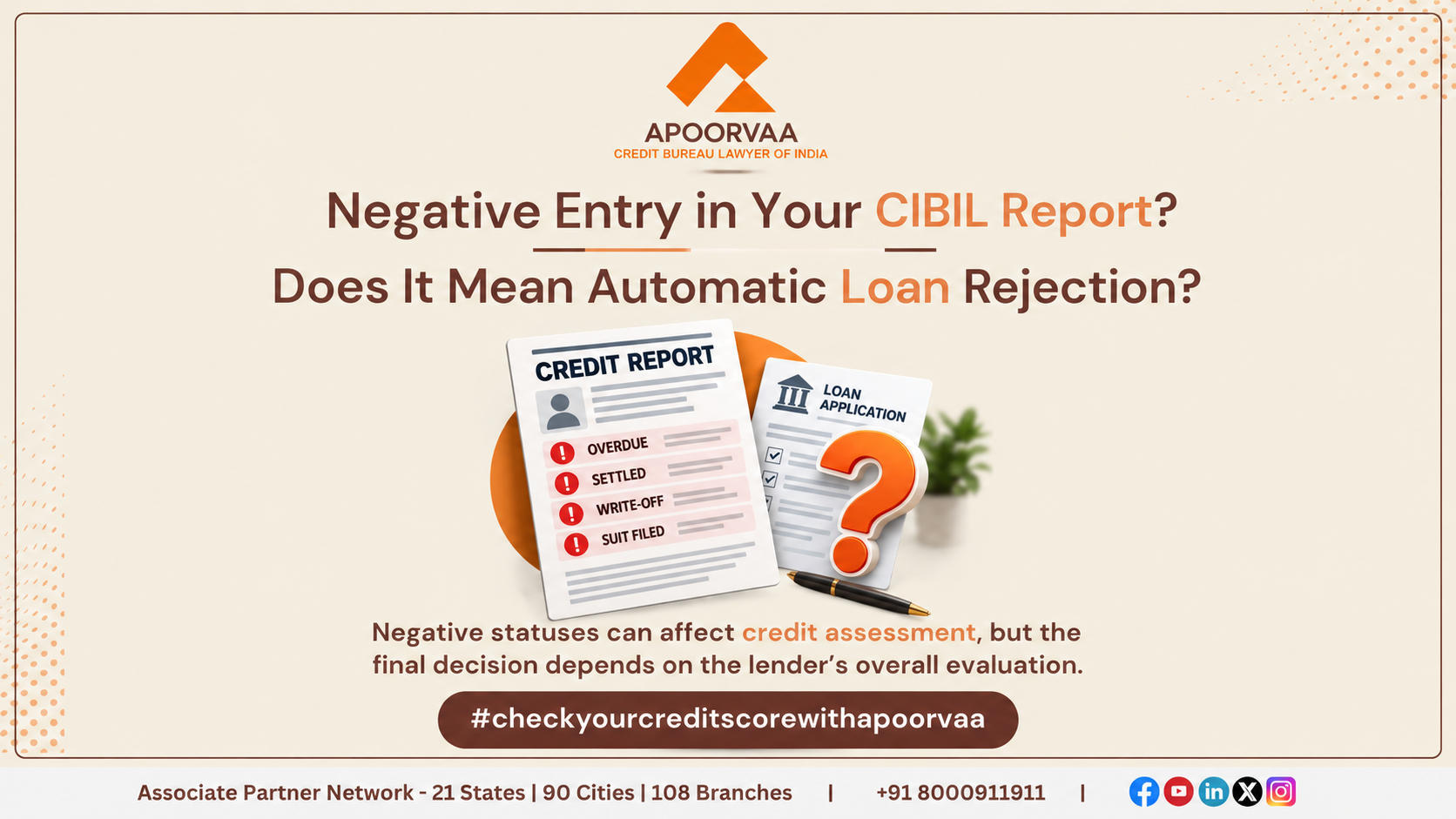
A customer approaches a bank for a home loan, business loan, personal loan or another credit facility.
The banker checks the customer’s CIBIL Report and identifies an adverse entry such as:
Settlement, Write-Off, Overdue or Suit Filed.
The customer may then be told:
“There is a negative entry in your CIBIL, so your loan cannot be approved.”
This often creates the impression that there must be an RBI rule or provision under the Credit Information Companies (Regulation) Act, 2005 that automatically prevents banks from lending whenever such an entry appears.
That is not the correct way to understand the credit-information framework.
RBI has directed credit institutions to make use of Credit Information Reports in lending decisions, and the credit-information framework exists to help lenders make informed credit decisions.
However, that is different from saying:
“CICRA requires every bank to reject every customer whose CIBIL Report contains Settlement, Write-Off, Overdue or Suit Filed.”
These entries can be important adverse indicators and can materially affect the lender’s assessment.
But the final credit decision depends on the lender’s underwriting, eligibility criteria, credit policy and assessment of the customer.
TransUnion CIBIL itself explains that loan eligibility criteria can differ between lenders and loan types, while lenders examine factors including account status, suit-filed cases, payment defaults, overdue amounts, income and existing EMI obligations.
So the correct question is not simply:
“Is there a negative entry in my CIBIL Report?”
The better question is:
“What does that entry mean, and how may a lender interpret it while assessing my complete credit profile?”
CIBIL Report vs Loan Approval: Understand the Difference
One of the most important concepts for customers to understand is that a CIBIL Report and a loan-sanction decision are not the same thing.
The CIBIL Report provides detailed credit information.
According to TransUnion CIBIL’s current consumer material, the Account Information section can contain details such as:
- type of credit facility,
- lender,
- loan amount or credit limit,
- outstanding balance,
- monthly payment history,
- and account status such as open, closed, settled or written-off.
The lender uses this credit information as part of its assessment.
It may also consider factors outside the CIBIL Report, including income, employment, repayment capacity, existing EMI burden, loan type and its own eligibility requirements.
Therefore:
The CIBIL Report provides the credit history. The lender makes the credit decision.
This distinction becomes particularly important when an adverse account status is present.
Why Do Settlement, Write-Off, Overdue and Suit Filed Matter?
Banks lend money with an expectation that the borrower will repay according to the agreed terms.
Past repayment behaviour therefore helps lenders assess future credit risk.
If a CIBIL Report contains information indicating that an earlier credit obligation was not serviced as originally agreed, the lender may want to understand that history before taking additional exposure.
TransUnion CIBIL specifically states that written-off, settled and suit-filed cases are not looked upon favourably by lenders.
But there is another important point:
Settlement, Write-Off, Overdue and Suit Filed do not all mean the same thing.
They can represent different circumstances within the customer’s credit history.
Let’s understand them individually.
- What Does “Settled” Mean in a CIBIL Report?
A customer may think that the word “Settled” sounds positive.
After all, in everyday language, when a matter is settled, it sounds finished.
But in credit reporting, the meaning can be different.
TransUnion CIBIL explains that a settled status can arise where a partial payment is made with the lender’s consent against the total outstanding.
For example, suppose the amount contractually payable was higher, but due to financial difficulty the lender agreed to accept a lower amount in settlement.
The customer may have complied with the settlement arrangement.
However, from the perspective of a future lender, the historical account still indicates that the original repayment obligation was not fulfilled completely according to its original terms.
That is why a settled account can be considered an adverse factor.
Settled does not automatically mean “loan permanently prohibited.”
But:
Settled can materially influence how a lender evaluates previous repayment behaviour.
That is the more accurate distinction.
- What Does “Written-Off” Mean?
A Written-Off status is different from a normal account closure.
TransUnion CIBIL’s reporting material separately identifies written-off amounts and explains that the written-off amount can contain principal and interest components. It also separately recognises statuses such as Written-Off, Settled and Post (WO) Settled.
From the perspective of a lender evaluating a new application, a written-off history can therefore raise significant questions regarding the earlier credit facility.
For example:
Why did the account reach that position?
What was the repayment history before the write-off?
What is the present account status?
What does the rest of the customer’s credit profile show?
These are credit-risk questions.
The presence of a written-off status can therefore contribute to loan rejection depending on the lender’s policy and assessment.
But again:
A Written-Off status is an adverse credit indicator—not a statement that CIBIL itself has rejected the customer’s loan.
- What Does “Overdue” Mean?
Overdue is another term customers frequently see in their credit reports.
An overdue amount broadly indicates an amount that has remained unpaid beyond the applicable due date and has been reported accordingly.
The important point is that Overdue is not identical to Settlement or Write-Off.
A customer may have an active loan where a payment is currently overdue.
Another customer may have historical repayment delays but no current overdue.
Another may have a completely different account status resulting from earlier repayment problems.
These situations should not automatically be grouped together.
TransUnion CIBIL states that lenders examine defaults and amounts overdue because these can present a negative picture of the customer’s overall report.
Therefore, an overdue amount can become an important factor during loan assessment.
But the lender should be understood as assessing the credit profile and associated risk, rather than merely reacting to one word in isolation.
- What Does “Suit Filed” Mean?
A Suit Filed entry needs to be understood separately.
TransUnion CIBIL’s reporting documentation states that where a lender has filed a suit against a borrower, specific reporting is prescribed, with reporting categories including Suit Filed and Suit Filed (Wilful Default).
This is clearly different from simply having an overdue amount.
Because legal proceedings associated with a credit facility can indicate a serious historical credit event, such information can receive significant attention during underwriting.
CIBIL specifically states that credit-facility statuses and suit-filed cases are carefully examined by lenders during the loan approval process.
Therefore:
Suit Filed may have a serious impact on credit assessment, but it should not be described as identical to Settlement, Write-Off or Overdue.
Each term tells the lender something different about the customer’s credit history.
Do These Entries Automatically Require a Bank to Reject the Loan?
This is the central question of today’s article.
No blanket conclusion should be made that CICRA automatically requires rejection of every loan application merely because one of these entries appears.
RBI’s credit-information framework requires and facilitates the use of credit information in lending and is designed to help lenders make better-informed credit decisions. RBI has also emphasised the importance of comprehensive and current Credit Information Reports for the quality of lenders’ credit decisions.
But a credit-information framework and an automatic rejection rule are two different things.
A lender may decide that a particular adverse credit history falls outside its acceptable risk parameters.
That lender may reject the application.
Another application may involve different circumstances, a different product, a different customer profile or different underwriting criteria.
CIBIL itself notes that loan eligibility criteria differ from lender to lender and across loan types.
Therefore, the technically accurate message is:
Settlement, Write-Off, Overdue or Suit Filed may adversely affect loan approval. They do not, merely by appearing in a CIBIL Report, create a universal automatic loan-rejection rule applicable identically to every lender and every borrower.
Why a Good CIBIL Score Alone May Not Be Enough
This is where another common misunderstanding arises.
A customer checks the score and sees a reasonably good number.
The customer thinks:
“My CIBIL Score is good, so why is the bank questioning my credit profile?”
Because the score is not the entire Credit Report.
The CIBIL Report contains account-level information, including credit facilities, balances, monthly payment history and account status.
Therefore, a lender may consider information that cannot be understood simply by looking at the headline number.
For example, the lender may identify:
a settled account,
written-off history,
an overdue amount,
suit-filed information,
historical payment irregularities,
or another account-level concern.
This is why at Apoorvaa we repeatedly emphasise:
Don’t look only at your CIBIL Score. Understand your complete CIBIL Report.
The score tells part of the story.
The report provides the context needed to understand the credit profile.
The Most Important Distinction: Negative vs Incorrect
Suppose your CIBIL Report contains a settled account.
There are two very different possibilities.
Situation A — Genuine Negative History
The customer genuinely entered into a settlement with the lender, and the reporting accurately reflects the history of that account.
The information may be negative, but that does not automatically make it incorrect.
Situation B — Potential Reporting Concern
The customer believes the account status, outstanding balance, ownership, payment information or another reported detail does not accurately reflect the underlying credit facility.
That presents a different question.
RBI’s framework specifically recognises the right to seek correction or updating of inaccurate credit information, and there is a prescribed framework for delayed rectification of credit information.
Therefore:
Negative information should not automatically be treated as incorrect.
At the same time:
Potentially incorrect information should not be ignored simply because it appears in a CIBIL Report.
This distinction is at the heart of genuine Credit Rectification.
When Does Credit Rectification Become Relevant?
When a loan is rejected because of a CIBIL Report concern, many customers immediately ask:
“Can you increase my CIBIL Score?”
But that should not be the first question.
The more important question is:
“What exactly is affecting my complete Credit Report?”
A low score does not automatically prove that something is incorrectly reported. Similarly, the presence of Settlement, Write-Off, Overdue or Suit Filed does not automatically mean that the entry can or should be removed.
Credit Rectification becomes particularly relevant when there is a genuine concern about the accuracy, ownership, status, balance or updating of credit information appearing in the report.
TransUnion CIBIL explains that credit information is provided by banks and financial institutions and that CIBIL cannot independently modify lender-reported information without confirmation from the relevant credit institution.
This creates an important principle:
Credit Rectification should begin with understanding the credit-report concern—not with promising a particular score.
Credit Rectification Is Not Score Manipulation
There is an important difference between Credit Rectification and simply trying to make a negative credit history disappear.
Suppose a customer genuinely delayed repayments and the lender accurately reported those delays.
Or the customer genuinely entered into a settlement and the account status accurately reflects that event.
The information may affect future credit decisions, but that does not automatically make the information incorrect.
Now consider a different situation where the customer believes:
- an account does not belong to them,
- an account status does not reflect the actual position,
- a balance or overdue amount appears inconsistent,
- or information has not been updated correctly.
That presents an accuracy or reporting concern rather than merely dissatisfaction with a low score.
RBI’s framework provides for correction or updating of credit information and also establishes a compensation framework where complaints regarding correction or updating are not resolved within the prescribed overall period of 30 calendar days.
Therefore:
The purpose of genuine Credit Rectification is an accurate credit profile—not an artificially perfect credit profile.
Why Genuine Negative History and Incorrect Reporting Need Different Treatment
Consider two customers.
Customer A
The customer genuinely settled a previous loan after being unable to repay the complete contractual amount.
The CIBIL Report accurately reflects the settled status.
Customer B
The customer believes that an account status or balance appearing in the report does not reflect what actually occurred with the lender.
Both customers may say:
“This negative entry is affecting my loan.”
But professionally, these are two different situations.
The fact that information is creating difficulty in obtaining new credit does not, by itself, establish that the information is inaccurate.
At the same time, potentially inaccurate information should not simply be ignored because it appears in a Credit Report.
The first task is to understand which type of problem actually exists.
This distinction helps avoid unrealistic expectations about Credit Rectification.
Can Settlement, Write-Off, Overdue or Suit Filed Be “Removed”?
This is one of the most common questions customers ask.
There cannot be one universal answer for every account.
Why?
Because the first issue is whether the information being reported is accurate.
If a negative status genuinely reflects the history of the credit facility, it should not automatically be presented as an error simply because the customer now requires another loan.
If the customer believes the information is inaccurate or has not been appropriately updated, that becomes a different matter requiring assessment based on the actual credit facility and reporting circumstances.
Customers should therefore be cautious about claims such as:
“Every negative entry can be removed.”
“All settled accounts can be deleted.”
“We will make your score 750+.”
“After correction, your loan is guaranteed.”
These statements ignore the difference between genuine adverse credit history and genuine reporting concerns.
Credit Rectification cannot responsibly be reduced to deleting negative words from a Credit Report.
Why Applying to Multiple Banks After Loan Rejection May Be the Wrong Approach
Imagine that a customer applies to Bank A.
The application is declined, and the banker specifically points to a concern in the CIBIL Report.
The customer immediately applies to Bank B.
Then Bank C.
Then an NBFC.
But if the underlying credit concern remains unchanged, approaching more lenders does not automatically resolve it.
There is another consideration as well.
When lenders access a customer’s CIBIL Report in connection with applications for new credit, those lender checks can appear as enquiries. CIBIL identifies frequent applications for new credit as a factor that can negatively affect the score.
Therefore, where the first lender has specifically identified a credit-related concern:
Understand the reason before repeatedly creating new loan applications.
This does not mean every loan rejection is caused by CIBIL.
A lender may reject an application because of income, repayment capacity, documentation, existing obligations, product eligibility, internal policy or several other factors.
The purpose is to identify the actual reason rather than assuming either that CIBIL is always responsible or that another lender will automatically solve the problem.
Can Two Banks Give Different Decisions on the Same Credit Profile?
Yes.
A borrower may wonder:
“If Bank A rejected me because of Settlement or Write-Off, how can another lender assess my application differently?”
Because lenders have their own credit policies, risk parameters and eligibility requirements.
TransUnion CIBIL itself states that the decision to grant a loan depends on the credit policy of the credit institution and that eligibility criteria can differ across lenders and loan products.
This means a CIBIL Report is an important input into the credit decision, but it is not the lender’s entire underwriting policy.
An adverse entry may be considered serious by a lender and may lead to rejection.
But the correct statement remains:
Settlement, Write-Off, Overdue or Suit Filed may affect loan approval. They do not create one identical automatic decision across every lender and every loan product.
A Good CIBIL Score Does Not Guarantee Loan Approval
The reverse misconception is also common.
A customer has a relatively good CIBIL Score and thinks:
“My score is good. The bank has to approve my loan.”
That is also incorrect.
The CIBIL Score is an important credit-risk indicator, but lenders may assess the complete Credit Report and other eligibility factors.
CIBIL itself makes clear that it does not approve or reject loans; the credit institution makes the lending decision according to its own policy.
Therefore:
Good CIBIL Score ≠ guaranteed loan approval.
And:
Adverse CIBIL entry ≠ a universal statutory ban on borrowing.
The lender assesses the complete application.
When Should a Customer Consider Professional Credit Report Assessment?
Professional assessment may become useful when a customer:
- does not understand why an adverse status is appearing,
- believes an account does not belong to them,
- believes the reported balance or overdue is inconsistent,
- believes an account status has not been correctly updated,
- has multiple credit-report concerns and cannot identify what is affecting the profile,
- or has been informed by a lender that a specific Credit Report issue is affecting the application.
The objective should be to understand:
What is reported?
What does that information represent?
Is it genuine historical information or is there a genuine reporting concern?
How is it affecting the customer’s complete credit profile?
This is substantially more useful than beginning with:
“How many points can you increase my CIBIL Score?”
At Apoorvaa – Credit Bureau Lawyer of India, our professional positioning is based on understanding genuine credit-bureau and Credit Rectification concerns—not promising artificial score increases or guaranteed loan approvals.
Frequently Asked Questions
Can a bank reject my loan because my CIBIL Report shows “Settled”?
Yes, a settled status can adversely influence the lender’s assessment and may contribute to rejection. However, the final decision depends on the lender’s credit policy and complete assessment. CIBIL does not itself approve or reject the loan.
Does CICRA, 2005 require banks to reject every borrower with a negative CIBIL entry?
It should not be presented as a blanket automatic-rejection rule. The credit-information framework facilitates the collection, reporting and use of credit information, while lenders make credit decisions according to their policies and risk assessment.
Are Settlement and Write-Off the same?
No. They represent different credit-reporting circumstances and should not be used interchangeably.
Is Overdue the same as Suit Filed?
No. An overdue relates to an amount remaining past due, while Suit Filed relates to reported legal proceedings connected with the credit facility. They can carry different implications.
Can an incorrect entry in my CIBIL Report be rectified?
Where information is genuinely inaccurate or requires updating, the RBI/CIC framework provides mechanisms for correction and updating through the relevant credit institution and credit information company.
Can genuine Settlement or Write-Off history always be removed?
No such blanket assumption should be made. The key question is whether the reported information accurately reflects the credit facility and its history.
Will Credit Rectification increase my CIBIL Score?
Credit Rectification should focus on genuine credit-reporting concerns and accuracy. It does not guarantee a particular score increase.
Will my loan be approved after Credit Rectification?
No. Loan approval remains the lender’s decision and can depend on multiple factors beyond the CIBIL Report.
Before Your Next Loan Application, Understand the Complete CIBIL Report
Today’s core message is not that adverse entries are unimportant.
Quite the opposite.
Settlement, Write-Off, Overdue and Suit Filed can be serious credit considerations.
A lender may view them as indicators of previous repayment problems and may decide that the application does not meet its credit policy.
But customers should understand the issue correctly.
An adverse entry may affect or contribute to loan rejection. It does not mean that every lender is automatically required by CICRA to reject every such borrower.
And when a negative entry is creating difficulty, the first question should not be:
“How do I remove this word?”
It should be:
“What exactly does my complete CIBIL Report show, and is that information accurately reflecting my credit history?”
That is where meaningful credit assessment begins.
Need Professional Assistance With Your CIBIL Report?
If your CIBIL Report contains Settlement, Write-Off, Overdue, Suit Filed or another adverse entry and you do not understand what it represents—or you believe there may be a genuine reporting concern—professional assessment can help identify the nature of the issue.
Apoorvaa – Credit Bureau Lawyer of India provides professional assistance for genuine Credit Rectification and credit-bureau concerns involving individuals and businesses.
📞 Free Credit Helpline: +91 8000 911 911
Credit Rectification does not guarantee deletion of genuine negative credit history, a particular CIBIL Score, loan eligibility or loan approval. The final credit decision remains with the respective lender.
Related Credit Education