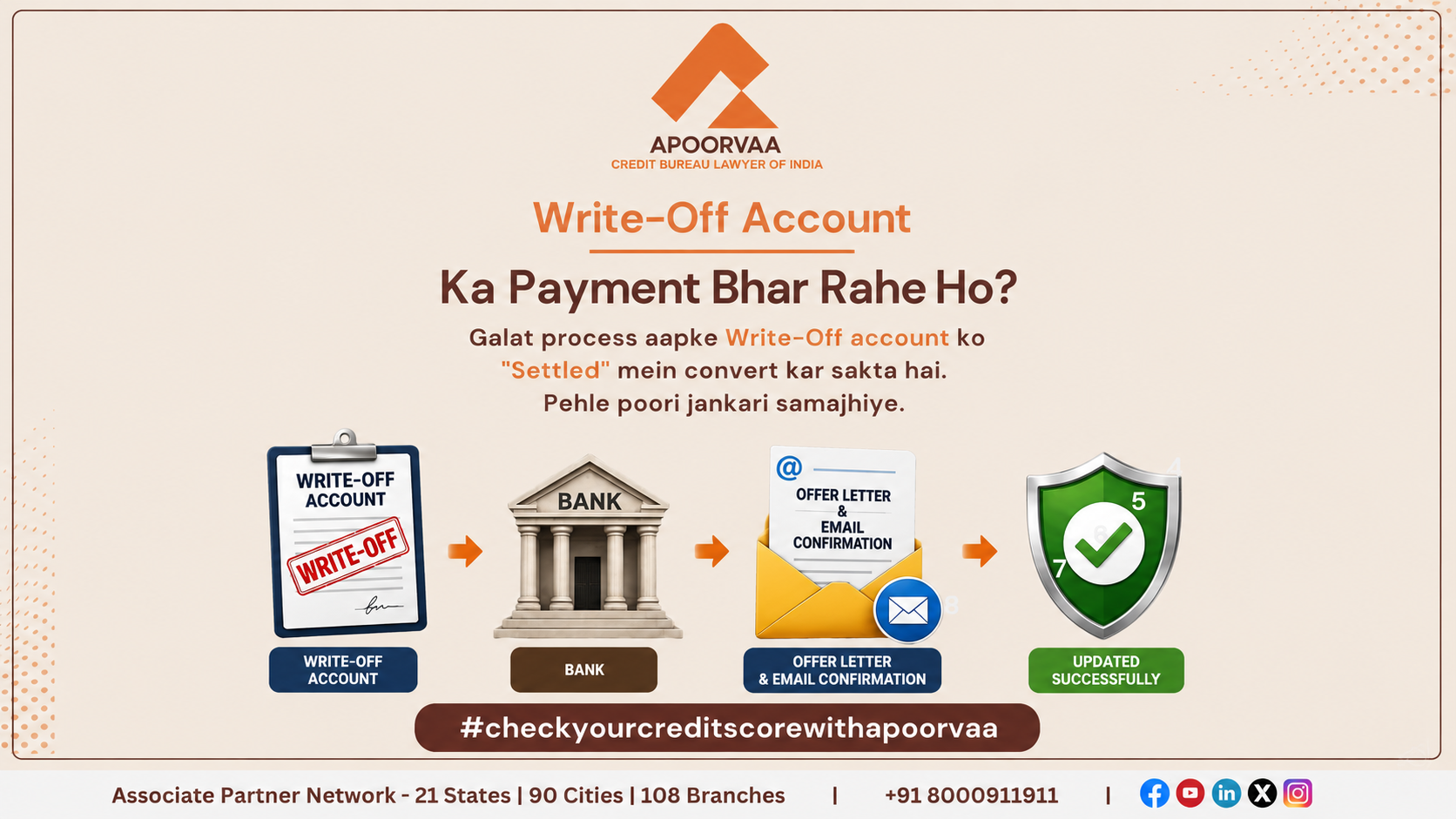
A Write-Off Account Payment should never be treated as an ordinary loan payment. Many borrowers believe that once they deposit the amount demanded by the bank, the write-off status in their credit report will automatically be corrected. Unfortunately, that assumption often leads to unnecessary confusion, repeated follow-ups, and avoidable delays.
Before making a Write-Off Account Payment, it is important to understand the current status of the account, communicate clearly with the bank, obtain appropriate written confirmation wherever possible, and know how the lender intends to update the account after receiving the payment.
A little preparation before making the payment can help you make informed financial decisions and reduce future complications.
What Is a Write-Off Account?
A write-off is an accounting classification used by banks and financial institutions for certain loan or credit card accounts.
One of the biggest misunderstandings among borrowers is that a write-off means the loan has been cancelled.
It does not.
A write-off does not automatically remove the borrower’s responsibility towards the outstanding amount.
This is why borrowers should avoid making assumptions based only on the wording shown in their credit report.
Instead, they should first understand the account status and then decide the appropriate course of action.
Why Borrowers Make Mistakes During a Write-Off Account Payment
When borrowers finally decide to resolve an old account, their primary objective is usually simple:
“I want this issue to be over.”
As a result, many people focus only on arranging the required amount.
However, the payment itself is only one part of the process.
Many borrowers forget to understand:
- What exactly they are paying.
- Why that amount has been calculated.
- Whether the bank has provided written communication.
- What documentation will be available after payment.
- How the account will be updated after the payment is processed.
Ignoring these questions can create unnecessary uncertainty later.
Start by Reviewing Your Credit Report
Before contacting the bank, carefully review your credit report.
Identify the account that shows the write-off status.
Make a note of important information such as:
- Name of the lender
- Loan account number
- Credit card number (where applicable)
- Current account status
- Date of reporting
- Outstanding balance appearing in the report
Preparing these details in advance makes communication with the bank much easier.
It also helps ensure that both parties are discussing the same account.
Contact the Bank Directly
If the bank is still operating, communicate directly with the lender instead of relying only on informal discussions.
You may:
- Visit the branch personally.
- Send an official email.
- Submit a written request.
- Contact the appropriate department as advised by the bank.
While communicating, provide sufficient information for identification.
This may include:
- Loan account number
- Credit card number
- Customer ID
- PAN or other KYC details, wherever required
- Contact information
A complete request helps the bank understand your query more efficiently.
Clearly Explain Why You Are Contacting the Bank
Many borrowers simply ask,
“How much do I have to pay?”
Although this seems like a logical question, it does not fully explain your objective.
Instead, communicate clearly that:
- The account is appearing as Write-Off in your credit report.
- You want to understand the available payment option.
- You would like to know how the account will be updated after payment.
- You are requesting appropriate written communication before making payment.
When the bank understands your objective from the beginning, the discussion becomes much more productive.
Always Prefer Written Communication
One of the most valuable precautions a borrower can take is maintaining written communication.
Many disputes arise because important discussions take place verbally.
Months later, neither party has any written record of what was discussed.
Whenever possible, communicate through:
- Official email
- Written application
- Acknowledged request
- Official response from the bank
Written communication provides clarity and reduces the possibility of future misunderstanding.
It also creates a useful record if you need to refer to the discussion later.
Ask for an Offer Letter or Email Confirmation
Before making a Write-Off Account Payment, request written confirmation regarding the payment terms.
Depending on the bank’s internal process, this may be available in the form of:
- Offer letter
- Official email
- Written confirmation
- Authorised communication
The objective is not simply to know the amount payable.
The objective is to understand the payment terms before transferring any money.
Proper documentation before payment often prevents unnecessary complications later.
Don’t Focus Only on the Amount
Sometimes borrowers receive a discounted amount and immediately assume that accepting the offer will permanently resolve every issue.
However, making financial decisions without understanding the complete terms can create confusion later.
Instead of asking only,
“How much should I pay?”
also ask:
- Why has this amount been calculated?
- What will happen after payment?
- What documents will be issued?
- How will the lender update the account?
A few additional questions before payment can save significant time afterwards.
Common Mistakes Borrowers Make During a Write-Off Account Payment
Many borrowers genuinely want to clear an old loan account and improve their credit profile. However, the way a Write-Off Account Payment is handled often determines whether the process remains smooth or becomes unnecessarily complicated.
Here are some of the most common mistakes borrowers should avoid.
- Paying Without Understanding the Payment Terms
The biggest mistake is making payment immediately after the bank communicates an amount.
Before transferring any money, understand:
- Why this amount has been calculated.
- Whether it is the complete amount payable under the agreed terms.
- What documents the bank will issue after payment.
- How the lender proposes to update the account after receiving the payment.
Making payment without understanding these points may lead to unnecessary confusion later.
- Depending Only on Verbal Discussions
Many borrowers visit the branch, discuss the account with a bank representative, make the payment, and leave without obtaining any written confirmation.
Later, if there is any difference in understanding, they have no documentary evidence to support what was discussed.
Whenever possible, communicate through:
- Official email
- Written application
- Acknowledged letter
- Official response from the bank
Written communication provides clarity for both the borrower and the lender.
- Not Keeping Important Documents
Once the payment is completed, some borrowers assume their responsibility has ended and fail to preserve the related documents.
Always keep copies of:
- Offer letter (where available)
- Email confirmation
- Payment receipt
- Bank transaction proof
- Written communication
- Acknowledgement received from the bank
These documents may become important if clarification is required in the future.
Why Documentation Is Important
Documentation is often overlooked until a problem arises.
If the account is not updated as expected or additional clarification becomes necessary, written records help establish:
- What communication took place.
- What payment terms were shared.
- When the payment was made.
- What supporting documents were provided.
Proper documentation reduces uncertainty and helps both the borrower and the lender refer to the same information.
What Should You Do After Making a Write-Off Account Payment?
Making the payment is not the final step.
Borrowers should continue monitoring the process until they are satisfied that the account information has been updated.
A practical approach includes the following steps.
Preserve Every Record
Keep all communication safely organised, including:
- Emails
- Letters
- Payment receipts
- Bank transaction details
- Offer letters
- Acknowledgements
Good record management can save considerable time if you need to contact the bank again.
Review Your Updated Credit Report
After allowing reasonable time for the lender to report the updated information, obtain a fresh credit report.
Review whether:
- The account details have been updated.
- The reporting information appears accurate.
- Any obvious discrepancy remains.
If you identify any inconsistency, communicate with the lender using your supporting documents.
A Practical Checklist Before Making a Write-Off Account Payment
Before making payment, ask yourself these questions:
✔ Have I reviewed my credit report?
✔ Have I identified the correct loan account?
✔ Have I communicated directly with the bank?
✔ Have I explained that the account appears as a write-off in my credit report?
✔ Have I requested written communication wherever possible?
✔ Have I obtained an offer letter or email confirmation, if available?
✔ Do I understand the payment terms?
✔ Have I preserved copies of every important document?
Following this checklist can reduce unnecessary confusion and make the process more organised.
Practical Tips for Borrowers
If you are planning a Write-Off Account Payment, remember these simple precautions:
- Do not rush into making payment.
- Understand the account status first.
- Communicate clearly with the bank.
- Prefer written communication over verbal discussions.
- Request written confirmation wherever available.
- Keep copies of every important document.
- Review your updated credit report after the payment has been processed.
Small precautions today can prevent lengthy follow-ups later.
Final Thoughts
A Write-Off Account Payment is more than a financial transaction. It is a process that requires careful communication, proper documentation, and a clear understanding of the payment terms.
Many borrowers focus only on arranging the payment amount. However, understanding how the lender intends to process the payment, maintaining written records, and preserving supporting documents are equally important.
If you take these precautions before making payment, you can reduce misunderstandings, avoid unnecessary delays, and manage the process with greater confidence.
Being informed before making a financial decision is always better than trying to resolve avoidable issues afterward.
Frequently Asked Questions
Should I make payment immediately after the bank tells me the amount?
Before making payment, understand the payment terms, request written communication wherever possible, and clarify how the account will be handled after payment.
Why should I communicate with the bank in writing?
Written communication creates a clear record of the discussion and helps avoid misunderstandings if clarification is required later.
Should I keep copies of payment documents?
Yes. Preserve payment receipts, bank transaction proofs, offer letters, emails, and all important communication.
When should I check my credit report again?
After allowing reasonable time for the lender to update the information, download a fresh credit report and verify the updated account details.
Why is documentation important during a Write-Off Account Payment?
Documentation helps establish what was communicated, what payment was made, and what supporting information was shared with the lender.
Conclusion
Planning a Write-Off Account Payment requires more than arranging the required funds. Understanding the account status, communicating clearly with the lender, obtaining written confirmation wherever possible, and preserving important documents are essential steps in the process.
A well-informed borrower is better prepared to make sound financial decisions and avoid unnecessary complications in the future.
Planning to Resolve a Write-Off Account?
Before making any payment, take the time to understand the account, communicate with the bank in writing wherever possible, and maintain complete documentation throughout the process.
A careful approach today can help you avoid unnecessary follow-ups and make more informed financial decisions regarding your credit profile.