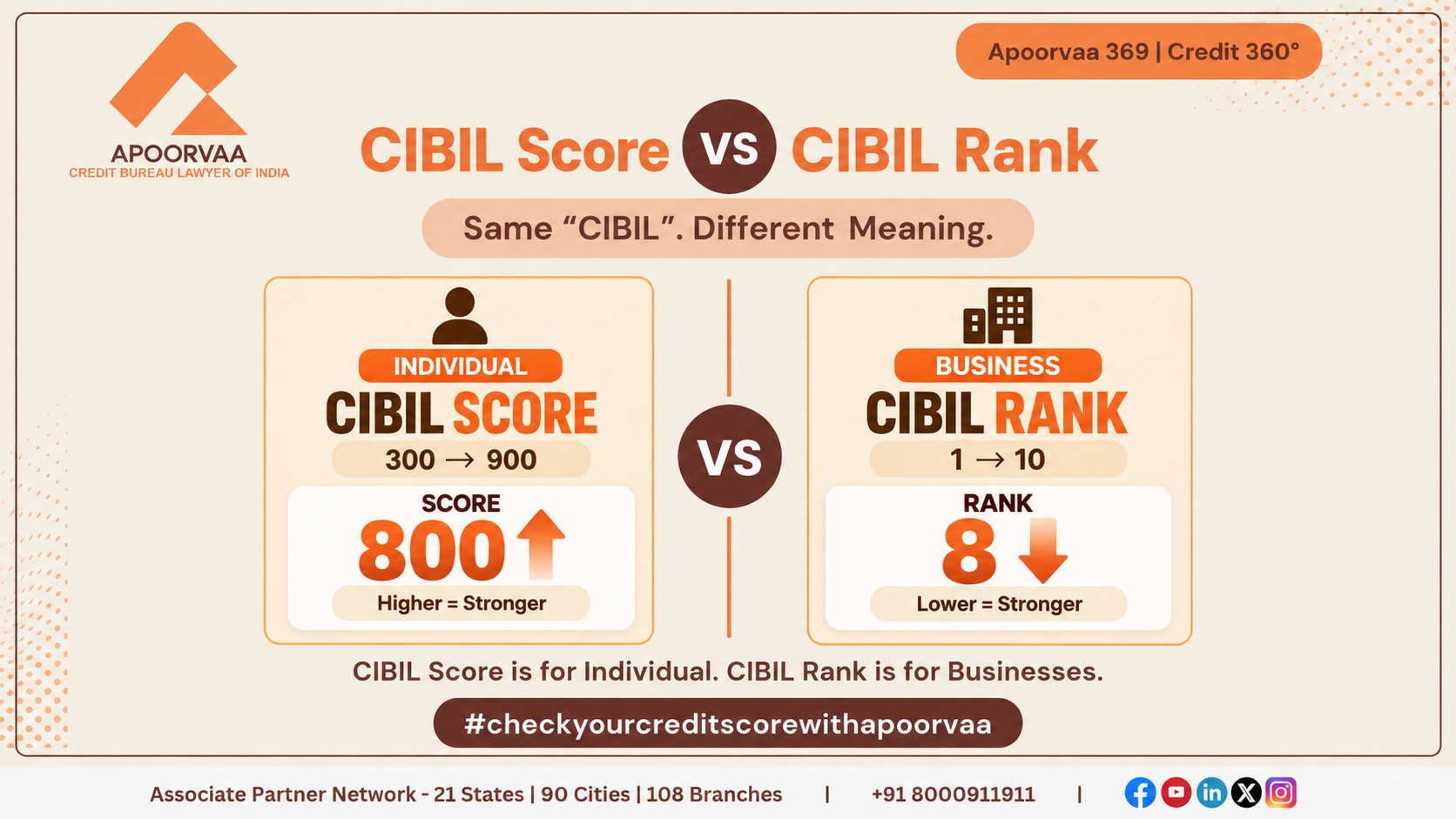
CIBIL Score vs CIBIL Rank is not simply a comparison between two credit numbers. They represent different credit profiles, are interpreted differently and can have different relevance during lending decisions.
Consider this example:
Personal CIBIL Score: 800
Company CIBIL Rank: 8
A business owner may look at both numbers and think:
“800 is good, and 8 out of 10 also sounds good.”
But that interpretation is incorrect.
For an individual CIBIL Score, a higher number generally represents a stronger credit profile.
For CIBIL Rank, the direction is different. The Rank is expressed on a scale from 10 to 1, where 1 is the best Rank.
Therefore:
CIBIL Score → Higher is generally better
CIBIL Rank → Closer to 1 is better
This distinction becomes particularly important for entrepreneurs, promoters and businesses seeking finance because a strong personal CIBIL Score does not automatically mean that the company’s commercial credit profile is also strong.
What Does a CIBIL Score Represent?
A CIBIL Score is a three-digit numerical summary of an individual’s credit history.
The current TransUnion CIBIL Score ranges from:
300 to 900
The Score is calculated using information from the Accounts and Enquiries sections of the individual’s CIBIL Report.
A higher Score generally indicates a stronger credit profile from a credit-history perspective.
But this number should not be treated as a complete lending decision.
A person can have a strong CIBIL Score and still face loan rejection because lenders may consider other aspects of the Credit Report as well as income, existing obligations, repayment capacity, eligibility and their own underwriting policies.
Therefore:
CIBIL Score is an important credit-risk indicator—not a guarantee of loan approval.
What Does a CIBIL Rank Represent?
CIBIL Rank relates to the commercial credit profile of an eligible business borrower.
It is associated with the business’s Company Credit Report (CCR).
The CIBIL Rank scale runs from:
10 to 1
with 1 representing the best Rank.
TransUnion CIBIL currently states that CIBIL Rank is available for commercial borrowers with credit exposure up to ₹50 crore.
This is an important technical distinction because CIBIL Rank should not be explained as simply a “business version of the 300–900 CIBIL Score.”
It is a separate commercial credit-risk indicator based on the company’s credit information.
CIBIL Score 800 vs CIBIL Rank 8: Why the Numbers Can Be Misleading
Suppose the director of a company has a personal CIBIL Score of 800.
At the same time, the company’s CIBIL Rank is 8.
If both numbers are interpreted using the same “higher is better” logic, the business owner may conclude that both profiles are strong.
But that would be incorrect.
For the Individual
800 out of a 300–900 CIBIL Score range generally represents a strong personal credit score.
For the Business
CIBIL Rank 8 sits much farther from Rank 1 and therefore should not be interpreted as “8 out of 10.”
The Rank needs to be understood according to the commercial credit-risk scale and, importantly, together with the underlying Company Credit Report.
This is why numbers without context can create the wrong credit assumption.
Personal Credit Profile and Business Credit Profile Are Different
A promoter and the promoter’s company may be financially connected, but their credit histories are not automatically identical.
Consider a business owner who personally has:
- a home loan,
- a vehicle loan,
- two credit cards,
- and a personal loan.
The company may separately have:
- working-capital facilities,
- term loans,
- business loans,
- cash-credit or overdraft facilities,
- and other commercial credit exposure.
The individual’s repayment behaviour contributes to the personal credit profile.
The company’s borrowing and repayment information forms part of its commercial credit profile.
This means:
A strong promoter credit profile cannot automatically compensate for a weak company credit profile.
Similarly, a strong company credit profile does not automatically mean the promoter’s personal credit history will be strong.
They should be understood separately.
Can You Have a Good CIBIL Score but a Weak CIBIL Rank?
Yes.
This is one of the most important concepts for business owners.
Imagine a promoter with:
CIBIL Score: 810
The promoter has maintained personal loan and credit-card payments responsibly.
Now consider the company.
The company has substantial commercial borrowing and its repayment or utilisation pattern has created a different commercial risk profile.
The company’s Rank could therefore be considerably weaker than the promoter’s personal Score might suggest.
There is no contradiction.
The Score and Rank are evaluating different underlying credit profiles.
This is precisely why a business owner should not enter a business-loan discussion assuming:
“My personal CIBIL Score is above 800, so there cannot be any CIBIL-related concern with my company.”
The lender may also evaluate the company’s commercial credit position where relevant.
What Is the Company Credit Report Behind the CIBIL Rank?
This is where professional credit analysis becomes more important.
A CIBIL Rank should not be viewed in isolation.
The Company Credit Report (CCR) provides the broader commercial credit information associated with the business.
TransUnion CIBIL describes the CCR as a record of the company’s credit payment history based on credit information reported by lending institutions.
Therefore, when a business has a weaker Rank, the more meaningful question is not:
“How do we change Rank 8 into Rank 1?”
It is:
“What does the underlying Company Credit Report show?”
That distinction is fundamental to responsible business Credit Rectification.
What Can Influence a Business CIBIL Rank?
TransUnion CIBIL identifies past repayment behaviour and credit utilisation among the major parameters used in calculating CIBIL Rank.
These factors deserve careful interpretation.
Past Repayment Behaviour
How a business services its credit facilities can influence its commercial credit profile.
If the underlying commercial credit information reflects repayment delays, overdue behaviour or defaults, those events may affect the risk assessment.
But their presence does not automatically mean that something is incorrectly reported.
If the repayment history is genuine, it is part of the business’s actual credit history.
Credit Utilisation
The extent to which a business uses available credit can also influence the commercial risk picture.
A company may be servicing its facilities but operating with substantial utilisation of available credit.
This is another reason why a Rank cannot be understood only as a number.
The underlying credit behaviour matters.
CIBIL Rank 8 Does Not Automatically Mean “There Is an Error”
This is particularly important from a Credit Rectification perspective.
Suppose a business approaches Apoorvaa and says:
“The bank says our CIBIL Rank is 8. Please rectify it.”
The first conclusion should not be:
“Rank 8 means there must be incorrect data.”
A weaker Rank can potentially reflect genuine commercial credit behaviour.
For example, the underlying report may accurately reflect repayment issues or credit utilisation characteristics.
On the other hand, there can also be situations where information in a commercial Credit Report appears inconsistent with the actual credit facility or business records.
Those are two completely different situations.
Weak credit profile ≠ Incorrect credit report
The first requires understanding the genuine credit position.
The second may require professional assessment of the reporting concern.
Genuine Negative Information vs Incorrect Credit Information
This distinction is at the heart of professional Credit Rectification.
Consider two companies.
Company A
The company genuinely delayed repayment on a credit facility, and the delay is accurately reflected in the commercial Credit Report.
Company B
The company believes that a repayment delay, outstanding position or other material information has been reported in a manner that does not correspond with the underlying facility records.
Both companies may be concerned about their commercial credit profile.
But they do not necessarily have the same problem.
For Company A, the information may be negative but accurate.
For Company B, there may be a potential reporting inconsistency requiring examination.
Therefore:
Negative information should not automatically be treated as inaccurate information merely because it affects CIBIL Rank.
Why “Improve My CIBIL Rank” Is Not the First Question
When business finance is delayed or rejected, the immediate reaction is often:
“How can I improve my company’s CIBIL Rank?”
But that question begins with the desired result rather than the underlying cause.
A better sequence is:
What is the current commercial credit position?
What does the Company Credit Report contain?
Is the information accurate?
Is the concern caused by genuine credit behaviour or a potential reporting inconsistency?
Or is the lender’s concern unrelated to credit-report accuracy altogether?
Only after understanding these distinctions can a business determine whether professional Credit Rectification is actually relevant.
A Weak Rank Is Not the Same as a Loan Rejection Reason
There is another important distinction.
If a bank tells a company:
“Your CIBIL Rank is weak.”
the business may assume that the Rank is the only reason the loan is not being approved.
That should not automatically be assumed.
Commercial lending can involve a broader assessment of the business.
Depending on the facility and lender, this may include the company’s financial performance, cash flow, existing liabilities, repayment capacity, nature of finance, security or collateral where applicable, and the lender’s internal credit policy.
Therefore:
CIBIL Rank is important, but it should not be treated as the entire business-loan underwriting process.
This also means that improving or correcting a genuine credit-reporting issue cannot responsibly be presented as a guarantee of business-loan approval.
Why Business Owners Should Understand Both Personal and Commercial Credit Profiles
For many business owners, the distinction between a personal CIBIL Score and a company’s CIBIL Rank becomes important only when they approach a lender for business finance.
A promoter may have an excellent personal CIBIL Score and assume:
“My personal credit profile is strong, so there should be no credit-related concern with my business loan.”
But personal and commercial credit profiles are not interchangeable.
The promoter’s individual CIBIL Report reflects personal borrowing and repayment history. The Company Credit Report (CCR) reflects the commercial credit information reported for the business.
Depending on the nature of the proposed facility and the lender’s underwriting process, both may become relevant.
That is why business owners should understand their personal and commercial credit positions separately rather than relying on one number.
CIBIL Rank and Business Loan Eligibility Are Not the Same Thing
A strong CIBIL Rank can be positive from a commercial credit-risk perspective.
But it does not mean:
“The business is automatically eligible for a loan.”
Business lending involves much more than a credit-bureau indicator.
A lender may also evaluate factors such as:
- business turnover and financial performance,
- profitability and cash flow,
- existing borrowing and repayment obligations,
- repayment capacity,
- purpose and amount of the proposed finance,
- business vintage and profile,
- security or collateral where applicable,
- and the lender’s internal credit and risk policies.
This distinction is important because a company can have a relatively strong commercial credit profile and still fail to meet a particular lender’s eligibility requirements.
Similarly, a weaker Rank should not automatically be interpreted as a universal rejection applicable to every lender.
CIBIL Rank is part of credit assessment—not the complete business-loan decision.
What Should You Understand When a Bank Says “Your CIBIL Rank Is Weak”?
This is a common point of confusion.
A banker may tell a business owner:
“Your company’s CIBIL Rank is not satisfactory.”
The business owner then begins searching for someone to “correct the Rank.”
But the Rank itself is an output of the underlying commercial credit information and risk assessment.
The more useful question is:
Why does the company’s commercial credit profile appear weaker?
There can broadly be different possibilities.
The underlying report may contain genuine credit behaviour that is contributing to the risk profile.
There may be information that appears inaccurate or inconsistent with the underlying facility.
Or the lender may have concerns extending beyond the CIBIL Rank itself.
Until that distinction is understood, simply asking to “improve the Rank” may address the wrong problem.
A Business Credit Problem Should Be Diagnosed Before It Is Rectified
Suppose a company has CIBIL Rank 8.
There are two very different situations.
Situation 1: Genuine Credit History
The company’s commercial Credit Report accurately reflects repayment delays, high utilisation or other genuine credit behaviour.
The information may be unfavourable, but that alone does not make it inaccurate.
Situation 2: Potential Reporting Concern
The company believes that material information in the commercial Credit Report does not correspond with the underlying credit facility or available records.
That may require closer assessment.
The difference is fundamental.
Credit Rectification is about genuine reporting concerns—not simply making every negative credit indicator look positive.
Can Incorrect Commercial Credit Information Affect the Business Profile?
Potentially, yes.
A CIBIL Rank is connected with the information contained in the Company’s Credit Report.
Therefore, if material underlying credit information appears inaccurate or inconsistent, the business should first understand the nature of that reporting concern.
But this does not mean that every Rank of 7, 8, 9 or 10 proves that inaccurate information exists.
The Rank itself is not sufficient evidence of an error.
Professional analysis should therefore begin with the underlying commercial credit information, not with a predetermined promise about what the final Rank will become.
Why a Good Personal CIBIL Score Cannot “Cancel” a Weak Business Rank
Consider a promoter with:
Personal CIBIL Score: 820
and a company with:
CIBIL Rank: 8
The promoter may have an excellent personal repayment history.
But that does not erase or override the company’s commercial borrowing history.
The lender may still need to understand the business’s:
commercial repayment behaviour, existing facilities, credit exposure, utilisation and overall financial capacity.
Therefore, an 820 personal CIBIL Score should not be used to conclude:
“My company’s Rank should also be excellent.”
The individual and company represent different credit profiles.
This is one of the main reasons business owners should understand CIBIL Score vs CIBIL Rank before applying for finance.
What If the Company Has Rank 1 but the Promoter Has a Weak CIBIL Score?
The opposite situation can also occur.
A business may have a strong commercial credit profile while a promoter’s individual credit profile contains concerns.
Again, one does not automatically replace the other.
Whether and how the promoter’s individual profile is considered will depend on the structure of the borrowing arrangement and the lender’s assessment.
This reinforces the broader principle:
Personal credit and business credit should be reviewed as separate profiles wherever both are relevant to the proposed finance.
Should a Business Review Its Company Credit Report Before Applying for a Loan?
For a business planning significant borrowing, understanding the commercial credit profile before approaching a lender can be valuable.
Many companies become aware of their commercial credit position only after a loan application reaches the bank’s credit team.
By then, the business may already be asking:
“Why is our Rank weak?”
“Which account is affecting us?”
“Is this information correct?”
“Why is the bank concerned when the promoter’s personal Score is good?”
Understanding the Company Credit Report earlier can help the business identify whether it is looking at:
genuine historical credit behaviour, current commercial exposure, or a potential reporting inconsistency.
The purpose is not to manufacture a particular Rank before applying.
The purpose is to understand the company’s actual credit position.
When Does Professional Business Credit Report Assessment Become Relevant?
Professional assessment can become relevant when a company has reason to believe that material commercial credit information requires closer examination.
For example, the business may have concerns regarding:
Account or Facility Information
A reported commercial facility appears inconsistent with the business’s understanding of its borrowing relationship.
Outstanding Information
The reported outstanding position appears inconsistent with the underlying facility records.
Repayment Information
The repayment information reflected in the report appears inconsistent with the actual account history.
Account Status
The status of a facility appears not to correspond with the company’s underlying records.
Other Material Reporting Inconsistencies
Important commercial credit information appears inaccurate, incomplete or inconsistent and requires proper assessment.
These situations are different from simply having a weaker Rank.
What Credit Rectification Can and Cannot Address
This distinction protects businesses from unrealistic promises.
Credit Rectification May Be Relevant When:
There is a genuine concern regarding the accuracy or consistency of underlying reported credit information.
Credit Rectification Is Not a Guarantee That:
- CIBIL Rank will become 1,
- every negative credit entry will disappear,
- the promoter’s personal CIBIL Score will increase,
- a lender will approve the proposed business loan,
- or the business will qualify for a particular amount of finance.
A credit-reporting concern and a lending decision are two separate matters.
Even where genuine inaccurate information is appropriately corrected, the lender still makes its own credit decision.
Don’t Confuse “Unfavourable” With “Incorrect”
A business may understandably want its credit profile to appear as strong as possible.
But professional Credit Rectification requires an important discipline:
The objective is accuracy—not cosmetic improvement.
If a business genuinely had repayment delays, the fact that those delays may influence the commercial credit profile does not automatically make them incorrect.
If a business genuinely has substantial outstanding borrowing, the fact that the exposure affects risk assessment does not automatically create a reporting error.
However, if what is being reported does not accurately represent the underlying facility, that is a different concern.
This distinction should be understood before any rectification decision is made.
CIBIL Score vs CIBIL Rank: Quick Comparison
| Factor | CIBIL Score | CIBIL Rank |
| Credit Profile | Individual | Eligible commercial/ business borrower |
| Scale | 300–900 | 10–1 |
| Better Direction | Higher is generally better | Closer to 1 is better |
| Underlying Report | Individual CIBIL Report | Company Credit Report |
| Can strong result guarantee a loan? | No | No |
| Can strong result guarantee a loan? | No | No |
This is why CIBIL Score 800 and CIBIL Rank 8 should never be interpreted in the same way.
Frequently Asked Questions
Is CIBIL Score only for individuals?
The CIBIL Score discussed here represents an individual’s credit profile. Businesses have commercial credit information through the Company Credit Report, and eligible commercial borrowers may receive a CIBIL Rank.
What is the CIBIL Score range?
The current CIBIL Score ranges from 300 to 900. A higher Score generally represents a stronger individual credit profile.
What is the CIBIL Rank range?
CIBIL Rank is expressed on a 10-to-1 scale, with 1 being the best Rank.
Is CIBIL Rank 8 good because 8 is a high number?
No. CIBIL Rank should not be read as “8 out of 10.” The direction is different from an individual CIBIL Score; closer to Rank 1 is better.
Can I have a CIBIL Score of 800 and CIBIL Rank of 8?
Yes. Your individual and business credit profiles are different and can therefore show very different risk indicators.
Does CIBIL Rank 8 mean my Company’s Credit Report is incorrect?
No. A weaker Rank does not itself prove a reporting error. The underlying commercial credit information needs to be understood.
Can a strong personal CIBIL Score guarantee a business loan?
No. Business lenders may consider the company’s commercial credit profile, financials, repayment capacity, existing obligations and their own eligibility and underwriting requirements.
Can a strong CIBIL Rank guarantee business-loan approval?
No. The final lending decision remains with the lender.
Can Credit Rectification guarantee Rank 1?
No. Credit Rectification should address genuine reporting concerns and should not guarantee a predetermined Rank or loan approval.
The Apoorvaa Approach: Understand the Report Behind the Number
At Apoorvaa – Credit Bureau Lawyer of India, business credit-report matters should not begin with a promise such as:
“We will convert your Rank 8 into Rank 1.”
The first question is more important:
What is causing the current commercial credit position?
If the Company Credit Report accurately reflects genuine credit history, that should not be misrepresented as an error.
If material information appears inaccurate or inconsistent, the underlying issue may require professional assessment.
And if the business loan concern is actually related to financial eligibility or lender underwriting rather than credit-report accuracy, Credit Rectification should not be presented as the solution.
Understand the report. Identify the root cause. Then determine whether rectification is actually relevant.
Final Takeaway
The difference between CIBIL Score vs CIBIL Rank is easy to remember:
CIBIL Score → Individual → 300–900 → Higher is generally better
CIBIL Rank → Business/commercial profile → 10–1 → Closer to 1 is better
But the bigger lesson is not about memorising two number ranges.
It is about understanding that personal and business credit are different profiles.
A business owner can have an 800+ personal CIBIL Score while the company has a weaker CIBIL Rank.
A weak Rank does not automatically prove that something is wrong in the Company Credit Report.
And neither a strong personal Score nor a strong business Rank guarantees loan approval.
The correct starting point is always the same:
Understand the complete credit information behind the number.
Professional Individual & Business Credit Report Assessment
If your personal or business Credit Report contains information that appears inaccurate or inconsistent, or you need professional assessment to understand whether a genuine Credit Rectification issue exists, the underlying report should be reviewed before deciding on the appropriate course of action.
Apoorvaa – Credit Bureau Lawyer of India
📞 Free Credit Helpline: +91 8000 911 911
Credit Rectification does not guarantee a particular CIBIL Score, CIBIL Rank, deletion of genuine credit history, loan eligibility or loan approval.
Related Credit Education
- 750+ CIBIL Score but Loan Rejected? Why a Good Credit Score May Not Be Enough
- CIBIL Rank 5 but Business Loan Rejected? Here’s Why
- Four Credit Bureaus in India: Is Correcting Only CIBIL Enough?