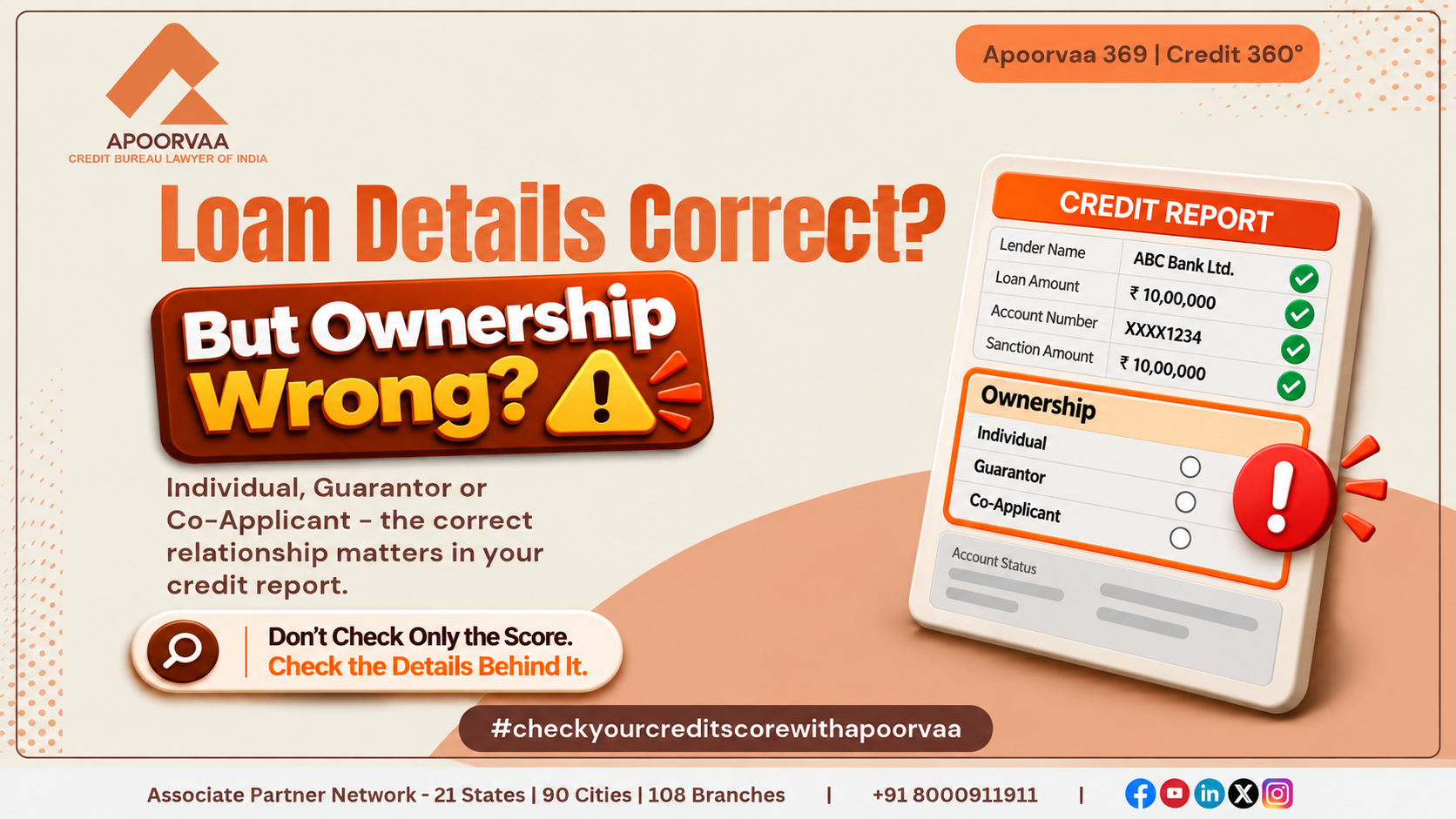
The loan is genuine. The lender is correct. The sanctioned amount is correct. Even the account details may be correct. But what if the ownership shown in your CIBIL Report is wrong?
This is a very different problem from finding a completely unknown loan in your Credit Report.
A customer may genuinely have a relationship with a credit facility—as the sole borrower, joint borrower or guarantor—but the ownership classification appearing against that account may not accurately represent that relationship.
For example, a person may genuinely have provided a guarantee for another borrower’s loan, but the account may appear as though the person is the Single borrower.
Or a genuine Joint relationship may be represented under a different ownership category.
In such situations, the first question should not be:
“How can I delete this loan from CIBIL?”
The correct question is:
“Does the ownership field accurately represent my actual relationship with this credit facility?”
That distinction is central to proper Credit Report analysis and responsible Credit Rectification.
What Is Ownership in a CIBIL Report?
A CIBIL Report contains much more than a three-digit CIBIL Score.
Its account-level information can include details relating to the credit facility, balances, repayment history and the person’s relationship with the account.
TransUnion CIBIL’s consumer material identifies four ownership indicators:
Single
Joint
Authorized User
Guarantor
In everyday language, customers often refer to Single ownership as an “Individual loan.” However, when discussing CIBIL’s official ownership terminology, Single is the appropriate category.
This field matters because simply seeing a loan in a Credit Report does not fully explain in what capacity the person is connected with that loan.
That relationship provides important context to the credit account.
- What Does Single Ownership Mean?
Under CIBIL’s ownership terminology, Single represents an account where the individual is solely responsible for making payments.
For example, a customer independently takes a personal loan in their own capacity.
The customer is the borrower associated with that credit facility and is solely responsible for payments under that relationship.
This is fundamentally different from a person who merely provided a guarantee for somebody else’s borrowing.
Therefore:
Single borrower and Guarantor should not be treated as interchangeable classifications.
Even where both relationships can create legal or financial responsibility, they describe different relationships with the underlying credit facility.
- What Does Joint Ownership Mean?
Joint ownership reflects a credit facility involving joint responsibility.
A housing loan, for example, may have more than one borrower depending on the loan arrangement.
One important point is often misunderstood:
The person who physically pays the EMI is not necessarily the only person legally or contractually connected with the loan.
Suppose two people are genuine joint borrowers, but the EMI is debited every month from only one person’s bank account.
That payment arrangement does not automatically convert the other person into a Guarantor or remove their Joint relationship.
The actual loan documentation and lender records determine the nature of the credit relationship.
If the Credit Report represents a genuine Joint borrower under an incorrect ownership category, that may therefore require examination.
- What Does Guarantor Ownership Mean?
A Guarantor provides a guarantee in connection with another borrower’s credit obligation.
This category needs careful explanation because two opposite misconceptions are common.
The first is:
“I am only a guarantor, so I have absolutely no responsibility for this loan.”
That is not legally accurate.
Section 128 of the Indian Contract Act, 1872 provides that the liability of the surety is co-extensive with that of the principal debtor unless the contract provides otherwise.
A guarantee can therefore create genuine legal liability.
The second misconception is:
“Because a guarantor can have legal liability, the guarantor can simply be treated as the Single borrower.”
That is also an incorrect way to understand the ownership relationship.
Legal liability and ownership classification are related issues, but they are not identical issues.
A person can genuinely be a Guarantor and have legal responsibility associated with the guarantee while still not being the Single borrower of the credit facility.
This distinction becomes especially important when analysing a possible Wrong Ownership in CIBIL Report.
Why Guarantor and Individual Ownership Should Not Be Confused
Consider an example.
A company or individual takes a loan.
Another person signs as the guarantor.
The loan is genuine.
The guarantee is genuine.
The guarantor therefore has a real relationship with that credit facility.
Now suppose the guarantor’s Credit Report shows the account as though the guarantor were the Single borrower.
The correct response is not:
“This loan has nothing to do with me.”
That would ignore the genuine guarantee.
But it would also be inappropriate to say:
“You have liability as guarantor, so Single ownership is automatically correct.”
The more accurate question is:
What relationship do the underlying loan and guarantee documents establish, and does the ownership field correctly represent that relationship?
This is why professional Credit Report analysis needs to distinguish between the existence of an obligation and the accuracy of its classification.
- What Is Authorized User Ownership?
CIBIL also identifies Authorized User as an ownership indicator, commonly relevant to arrangements such as add-on credit cards.
This category is useful for understanding the broader principle behind ownership reporting.
Not every account appearing in a person’s Credit Report necessarily represents the same type of borrowing relationship.
A Single borrower, Joint borrower, Guarantor and Authorized User may all have different relationships with the relevant facility.
Therefore, the ownership field should not be overlooked simply because other account details appear correct.
“This Loan Is Not Mine” vs “Ownership Is Wrong”
This distinction is critical in Credit Rectification.
Situation 1: Completely Unknown Account
A customer discovers a loan from a lender with whom they have never had a credit relationship.
The customer did not borrow the money.
The customer was not a joint borrower.
The customer did not provide a guarantee.
The account is completely unknown.
Here, the fundamental question concerns the account itself and why it is associated with the customer.
Situation 2: Genuine Account, Wrong Ownership
Now suppose a customer genuinely stood as guarantor for a loan.
The lender is known.
The account is genuine.
The loan amount corresponds with the facility.
But the customer’s relationship with the account is shown as Single instead of Guarantor.
Here, the existence of the account is not necessarily the dispute.
The classification of the customer’s relationship with the account is the issue.
These cases should not be approached as though they were identical.
Loan Details Are Correct but Ownership Is Wrong — Is It Still a Credit Report Error?
Yes, it can still represent an account-level reporting discrepancy.
A credit account contains multiple data points.
For example:
the lender can be correct,
the account can be genuine,
the sanctioned amount can be correct,
the current balance can be correct,
and yet the ownership field can potentially be inaccurate.
One correct field does not automatically validate every other field.
This is why a professional review should identify the specific discrepancy rather than immediately treating the complete account as wrong.
If the account is genuine but the ownership classification does not correspond with the underlying credit relationship, the appropriate objective is generally accuracy of the account information, not automatic deletion of the entire credit facility.
Why Wrong Ownership Can Matter to Your Overall Credit Profile
When a lender assesses a fresh credit application, the CIBIL Score is not necessarily the only information considered.
Lenders may evaluate credit information alongside factors such as income or financial position, existing obligations, repayment capacity and their own credit and underwriting policies.
Account-level ownership helps provide context about how the applicant is connected with the credit facilities appearing in the report.
If the relationship is inaccurately classified, the Credit Report may not accurately communicate the nature of that connection.
For example, a person genuinely connected as a Guarantor being shown as a Single borrower represents a different reported relationship.
However, this point should not be exaggerated.
We should not claim:
“Every lender will calculate the complete EMI as your obligation if ownership is wrong.”
Different lenders can apply different underwriting approaches.
Similarly, correcting ownership does not guarantee that a lender will approve a new loan.
The core concern is that:
Credit information used to understand a customer’s profile should accurately reflect the underlying credit relationship.
Does Wrong Ownership Automatically Affect Your CIBIL Score?
Not necessarily in a predictable way.
There is no responsible basis for saying:
“Wrong ownership will reduce your CIBIL Score by X points.”
Likewise, nobody should promise:
“Correct the ownership and your Score will definitely increase.”
TransUnion CIBIL does not publish a formula guaranteeing a particular Score movement when an ownership field is corrected.
Therefore, a Wrong Ownership in CIBIL Report should primarily be approached as a question of data accuracy.
The first objective is not to chase a particular Score increase.
It is to determine:
Is the account relationship being reported correctly?
What If the Account Is Correctly Reported as Guarantor?
Then simply being a guarantor should not automatically be described as a CIBIL error.
This is important from a Credit Rectification perspective.
If the customer genuinely provided a guarantee and the account accurately reflects that Guarantor relationship, the fact that the customer would prefer not to see the account does not by itself make the reporting inaccurate.
A genuine credit relationship should not be challenged merely because it may be relevant to the customer’s broader credit profile.
On the other hand, if the customer was only a Guarantor but is being represented under an incorrect ownership category, that becomes a different accuracy question.
Credit Rectification begins by identifying what is actually wrong—not by assuming that every unwanted account should be removed.
Why Your Complete CIBIL Report Matters More Than Your Score
Ownership errors are a strong example of why customers should not review only their CIBIL Score.
Imagine a customer has a CIBIL Score of 780.
The customer sees the number and assumes:
“My CIBIL is completely fine.”
But the Account Information section may contain a genuine loan with an inaccurate ownership classification.
The Score alone does not tell the customer whether every account-level field is correct.
The opposite is also true.
A lower Score does not automatically prove that an ownership error or any other reporting discrepancy exists.
This is why the complete Credit Report matters.
The CIBIL Score provides an overall risk indicator.
The account-level information provides the details behind the credit relationships appearing in the profile.
When reviewing a potential ownership discrepancy, the key is therefore to understand the account itself, the actual relationship established with the lender, and whether the information being reported accurately represents that relationship.
Only then can we distinguish a genuine credit obligation from a genuine Credit Report reporting discrepancy.
Can a Wrong Ownership Classification Be Corrected?
If the ownership information in a CIBIL Report is genuinely inaccurate, it may require correction through the appropriate credit-information dispute framework involving the concerned lender and Credit Information Company.
However, there is an important principle to understand:
A Credit Information Company does not originate the underlying loan information.
Credit institutions submit account information to Credit Information Companies. Therefore, when a customer disputes an account-level field such as ownership, the accuracy of the information generally needs to be verified against the records of the concerned credit institution.
This is why an ownership dispute should be based on the actual credit relationship, not simply on what classification the customer would prefer to see.
If you are genuinely the Single borrower, the report should reflect the appropriate relationship.
If you are genuinely a Joint borrower, that relationship should be represented accurately.
If you genuinely provided a guarantee, the Guarantor relationship should not be treated as though no credit relationship exists.
The objective is accurate reporting.
What Should Be Verified When Ownership Appears Incorrect?
A customer may first notice the problem because the ownership field does not match their understanding of the loan.
But that does not mean the ownership field should be examined in isolation.
The relevant question is whether the account information corresponds with the actual credit arrangement recorded with the lender.
For example, consider a customer who says:
“I was only the guarantor, but my CIBIL Report shows me as the Single borrower.”
Before treating this as a confirmed reporting error, the actual relationship needs to be established.
Was the person genuinely only a guarantor?
Were they also a borrower or co-borrower under the facility?
What do the lender’s underlying records establish?
Does the reported ownership correspond with those records?
This distinction matters because Credit Rectification should correct inaccurate information, not rewrite a genuine credit relationship.
Incorrect Reporting vs Genuine Credit Liability
This is one of the most important concepts in ownership-related cases.
Suppose a person genuinely provided a guarantee for a business loan.
That person may have real legal liability arising from the guarantee. Under Section 128 of the Indian Contract Act, 1872, the liability of the surety is generally co-extensive with that of the principal debtor unless otherwise provided by the contract.
Therefore, it would be incorrect to argue:
“I did not receive the loan amount personally, so the account should have no connection with my Credit Report.”
But now suppose that same person is reported as the Single borrower when the underlying relationship is actually that of a Guarantor.
That creates a different question.
The liability may be genuine, while the classification may still be inaccurate.
This distinction is fundamental.
Genuine liability does not justify inaccurate reporting.
At the same time:
An inaccurate ownership field does not eliminate genuine liability.
Professional Credit Report analysis needs to keep these two questions separate.
Can a Guarantor Account Affect Your Credit Profile?
A genuine guarantee should not be treated as meaningless from a credit perspective.
TransUnion CIBIL advises customers to monitor accounts where they are guarantors or joint holders, including the payment performance associated with such accounts.
Therefore, a person considering becoming a guarantor should understand that the relationship is not merely a formality.
However, this does not justify claiming that every lender will treat every guaranteed facility in exactly the same way while calculating fresh loan eligibility.
When evaluating an application, lenders can consider the bureau information alongside their own underwriting standards, income assessment, existing obligations, repayment capacity and other eligibility criteria.
The appropriate conclusion is therefore:
A Guarantor relationship can be relevant to your overall credit profile, but its treatment in a particular lending decision depends on the lender’s assessment and policies.
What If the Guaranteed Loan Develops Repayment Problems?
This is another reason accurate ownership matters.
Suppose the primary borrower begins missing payments on a facility for which another person has provided a guarantee.
The guarantor should not assume that the repayment problem is irrelevant simply because somebody else was originally expected to make the monthly payments.
A guarantee creates a genuine legal relationship with the debt, and CIBIL’s consumer education specifically highlights the importance of monitoring guaranteed accounts.
But the presence of genuine guarantor liability still does not convert Guarantor and Single into the same ownership category.
The report should accurately communicate the nature of the relationship.
What If You Are a Joint Borrower but Do Not Pay the EMI?
A similar misconception occurs with Joint accounts.
A customer may say:
“The EMI comes from the other person’s bank account, so this loan should not be Joint in my CIBIL Report.”
That conclusion may be incorrect.
Who transfers the EMI each month and who is actually a borrower under the credit agreement are separate questions.
If two people genuinely entered into the facility as Joint borrowers, the fact that only one of them handles the monthly payment does not automatically remove the other’s credit relationship.
Therefore, the appropriate test is not simply:
“Who pays the EMI?”
It is:
“What is the actual relationship established under the credit facility?”
Can a Closed Loan Still Have Wrong Ownership?
Yes.
Loan closure and ownership accuracy are two separate issues.
A customer may have completely repaid a facility and have no current outstanding balance, yet the historical account information can remain part of the Credit Report.
If the ownership field against that account does not accurately represent the original credit relationship, closure by itself does not answer whether that information is correct.
This is why customers should avoid assuming:
“The loan is closed, so none of its account details matter anymore.”
The accuracy of historical credit information can still be relevant when reviewing the complete profile.
Can You Delete a Genuine Loan Because Ownership Is Wrong?
Not simply on that basis.
This is an important distinction between Credit Rectification and attempting to remove genuine credit history.
Suppose the loan is genuine and the customer genuinely provided a guarantee, but the ownership field is incorrectly shown as Single.
The identified issue may be the ownership classification.
That does not automatically establish that:
- the lender is wrong,
- the loan never existed,
- the guarantee never existed, or
- the entire account should disappear from the Credit Report.
The appropriate correction should correspond with the verified facts.
Correcting an inaccurate field and deleting a genuine account are not the same thing.
Does Correct Ownership Guarantee Better Loan Eligibility?
No.
A customer should not be told:
“Once we change the ownership, your next loan will be approved.”
Loan approval depends on multiple factors.
A lender may consider the CIBIL Score and Credit Report together with income, repayment capacity, existing liabilities, the type and amount of credit requested and its own internal underwriting policy.
Correcting inaccurate ownership can help ensure that the Credit Report more accurately represents the customer’s credit relationship.
It does not guarantee approval.
Similarly, no professional should promise a particular CIBIL Score increase simply because an ownership discrepancy is corrected.
Why Ownership Errors Can Be Missed for Years
Many customers focus almost entirely on the three-digit CIBIL Score.
If the Score appears acceptable, they may never examine the individual accounts in detail.
As a result, an account may remain visible for a long period before the customer notices that the ownership relationship appears inconsistent with the actual facility.
The problem may become visible only when the customer:
applies for fresh credit,
reviews the complete report carefully,
examines an old loan,
or notices an account relationship that does not correspond with their records.
This demonstrates why credit awareness should extend beyond:
“What is my CIBIL Score?”
The better question is:
“What information is actually being reported inside my complete credit profile?”
Why the Complete CIBIL Report Matters More Than One Ownership Field
Ownership is important, but professional Credit Report analysis should not stop there either.
Suppose a customer identifies an account where the ownership appears incorrect.
The complete account may also contain other information that needs to be understood in context, such as the account status, balance, repayment history and dates associated with the facility.
This does not mean every unusual-looking field is necessarily wrong.
It means the Credit Report should be assessed as a complete credit record rather than as isolated pieces of information.
For a genuine ownership discrepancy, the key questions are:
What is the actual credit relationship?
What relationship is being reported?
Do the lender’s records support the reported classification?
Is there a genuine discrepancy that requires rectification?
Once those questions are answered, the issue can be understood more accurately.
Wrong Ownership in CIBIL Report: When Does Professional Review Become Relevant?
Professional review can become particularly relevant when the customer cannot clearly determine whether the problem involves:
an entirely unknown credit account,
a genuine loan with an incorrect ownership classification,
a genuine Guarantor relationship,
a Joint borrowing relationship,
or another account-level reporting discrepancy.
These distinctions matter because the appropriate interpretation is different in each situation.
For example, challenging a genuine Guarantor account as an “unknown loan” can misidentify the actual issue.
Likewise, accepting an incorrect Single classification merely because the person has some legal liability can overlook a genuine reporting discrepancy.
The first objective of Credit Rectification is therefore accurate identification of the problem.
Frequently Asked Questions
- My loan amount and lender are correct, but ownership is wrong. Is that possible?
Yes. A genuine account can potentially contain an inaccurate account-level field. Correct lender and loan information does not automatically prove that the ownership classification is also correct.
- Is “Individual” the official CIBIL ownership terminology?
CIBIL’s consumer material uses Single for the ownership category where the person is solely responsible for payments. “Individual borrower” is commonly used conversationally, but Single is the relevant CIBIL terminology.
- Can a Guarantor account appear in my CIBIL Report?
Yes. A genuine guarantee represents a real credit relationship and should not automatically be treated as an unknown loan.
- Is a Guarantor legally responsible for the loan?
A guarantee can create genuine legal liability. Section 128 of the Indian Contract Act provides that the liability of the surety is generally co-extensive with that of the principal debtor unless the contract provides otherwise.
- Are Guarantor and Single ownership the same?
No. They represent different relationships with a credit facility even though a guarantor can have genuine legal liability.
- If I am a Joint borrower but somebody else pays the EMI, should the loan be removed from my report?
Not merely for that reason. The relevant issue is the actual borrowing relationship, not simply which person’s bank account is used to make the EMI payment.
- Can wrong ownership affect my CIBIL Score?
There is no published fixed formula that allows a guaranteed Score impact to be stated for an ownership correction. The primary concern should be whether the information is accurate.
- Will correcting ownership guarantee loan approval?
No. Lenders apply their own underwriting and eligibility policies. Correct Credit Report information does not guarantee approval.
- Can a genuine loan be deleted if only its ownership field is incorrect?
An incorrect ownership field does not automatically justify deletion of the entire genuine account. The correction should reflect the verified credit relationship.
- Should I check ownership even if my CIBIL Score is good?
Yes. A good Score does not confirm that every account-level field in the Credit Report is necessarily accurate.
Apoorvaa’s Approach to Ownership-Related Credit Report Discrepancies
At Apoorvaa – Credit Bureau Lawyer of India, an ownership-related case is not approached with the assumption that every account should be removed.
The first question is whether the credit relationship itself is genuine.
The next is whether that relationship is being represented accurately.
A customer who is genuinely a Guarantor should not be advised to deny the guarantee merely because the account appears in the Credit Report.
But if the customer is genuinely a Guarantor and the report inaccurately represents them under another ownership category, the discrepancy deserves proper assessment.
Similarly, Joint and Single relationships need to be understood according to the underlying credit facility.
This distinction helps separate:
genuine credit liability from inaccurate credit reporting.
That is the foundation of responsible Credit Rectification.
Final Takeaway
A Wrong Ownership in CIBIL Report can be easy to miss because the rest of the loan information may look completely correct.
The lender can be correct.
The sanctioned amount can be correct.
The account can genuinely relate to you.
But the capacity in which you are connected with that account can still require examination.
Do not confuse:
“This account is not mine”
with
“This account is genuine, but my ownership relationship is being reported incorrectly.”
And do not assume that being a Guarantor means there is no legal or credit relationship with the facility.
The objective should always be the same:
Your Credit Report should accurately reflect the credit relationship that actually exists.
Professional Credit Report Assessment
If your CIBIL Report contains a genuine account but the Single, Joint, Guarantor or other applicable ownership information appears incorrect, Apoorvaa can review the complete credit profile to understand whether the issue represents a genuine reporting discrepancy requiring professional Credit Rectification.
The objective is accurate reporting—not deletion of legitimate credit obligations or promises of a particular Score increase or loan approval.
📞 +91 8000 911 911
Apoorvaa – Credit Bureau Lawyer of India
Credit Rectification does not guarantee deletion of correctly reported credit information, a particular CIBIL Score, or approval of any credit facility. Lending decisions remain subject to the lender’s policies and assessment.
Related Credit Education