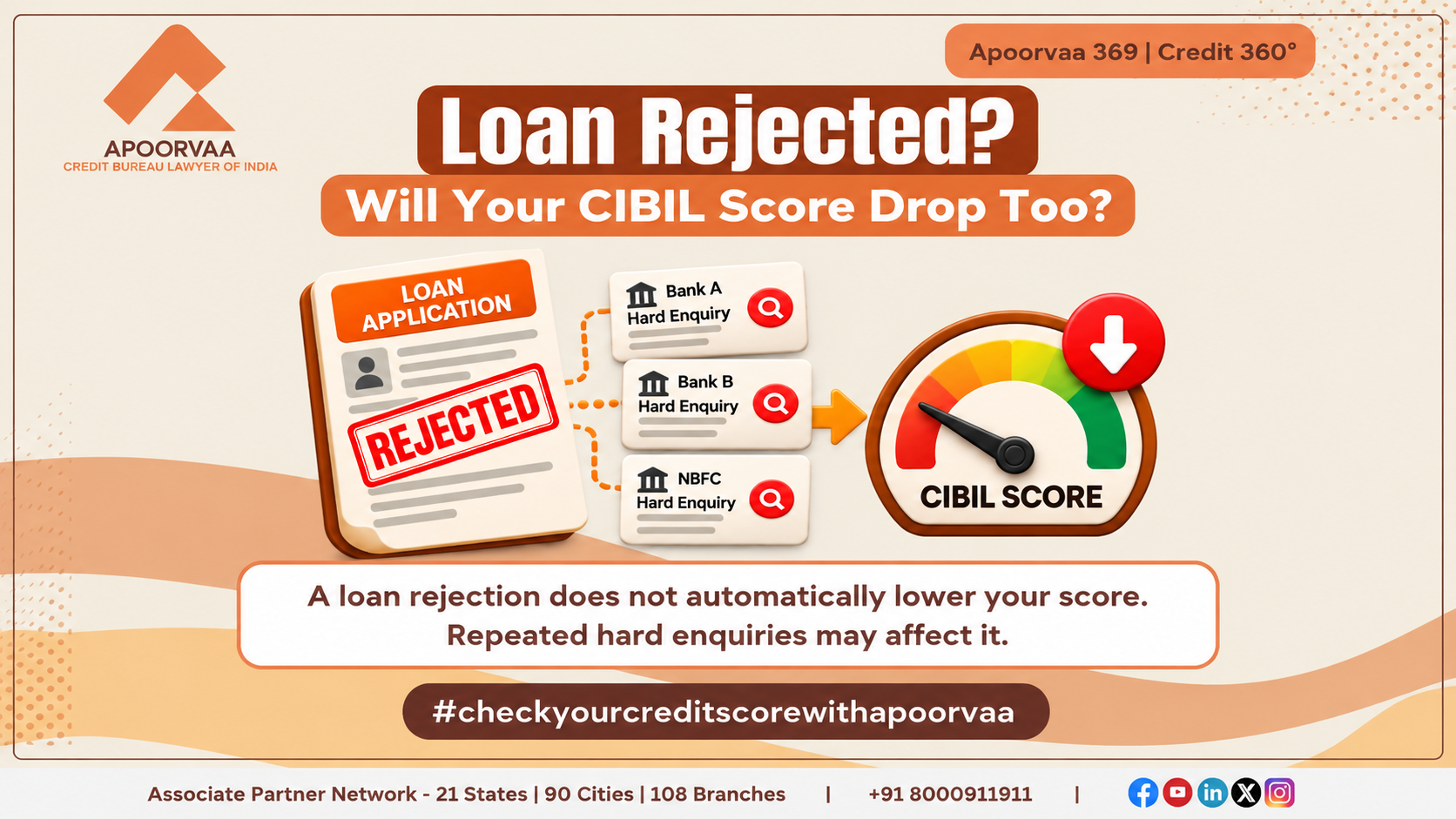
Does loan rejection affect your CIBIL Score? A rejected loan application does not automatically reduce your Score simply because the lender declined the application. However, the hard enquiry associated with that application may appear in your CIBIL Report, and repeated applications can potentially affect your credit profile.
This distinction becomes important when a customer experiences a loan rejection and immediately approaches several other banks, NBFCs, DSAs or loan consultants.
The customer may believe:
“If one bank rejected my loan, another bank may approve it. I should apply everywhere until somebody sanctions the loan.”
But if the original rejection relates to an unresolved credit-profile concern, repeatedly submitting applications may create additional lender enquiries without addressing the underlying issue.
At the same time, not every loan rejection is caused by CIBIL.
A lender may decline an application because of income, repayment capacity, existing financial obligations, eligibility criteria, documentation or its internal credit policy.
Therefore, the appropriate question after a loan rejection is not simply:
“How can I improve my CIBIL Score immediately?”
It is:
“Why was the loan rejected, and does my complete Credit Report contain any genuine concern or reporting discrepancy?”
Understanding that distinction is essential before deciding whether professional Credit Report assessment or Credit Rectification is relevant.
Does Loan Rejection Itself Create a Negative Entry in Your CIBIL Report?
A loan rejection and a negative credit-account status are different things.
Suppose a customer applies for a personal loan.
The lender accesses the customer’s CIBIL Report, evaluates the application and decides not to sanction the loan.
The credit check associated with the application may be recorded in the Enquiries section.
But the rejection itself is not a separate adverse loan-account status equivalent to:
- Overdue
- Settlement
- Write-off
These terms relate to information associated with credit accounts and their repayment or account history.
A rejected application does not automatically create a new overdue account or a settlement or write-off status.
The lender’s enquiry may be visible even when no new loan account is created.
This is why a customer should not confuse an enquiry appearing in the Credit Report with confirmation that the loan was approved or disbursed.
The enquiry reflects a lender’s access to credit information in connection with an application.
It does not independently establish the outcome of that application.
What Happens in Your CIBIL Report When You Apply for a Loan?
When a customer submits a loan or credit-card application, the concerned lender may access the customer’s credit information as part of its assessment.
That access can generate a hard enquiry.
The lender may use the CIBIL Report to understand information such as:
- Existing credit facilities
- Repayment history
- Current outstanding balances
- Previous credit behaviour
- Recent lender enquiries
The lender can then consider this information alongside other underwriting and eligibility factors.
Importantly, the lender’s decision and the credit enquiry are separate events.
A hard enquiry may arise even if the application is ultimately rejected.
What Is a Hard Enquiry in a CIBIL Report?
A hard enquiry generally occurs when a lender accesses a customer’s credit information in connection with an application for credit.
Examples include applications for a personal loan, housing loan, business loan, vehicle loan or credit card.
The enquiry may be recorded in the CIBIL Report even if the lender subsequently declines the application.
TransUnion CIBIL explains that the Enquiries section contains information about credit checks performed by lenders in connection with applications.
The enquiry information can help lenders understand recent credit-seeking activity.
A hard enquiry does not mean that the customer has failed to repay a loan.
It indicates that credit information was accessed in connection with a credit application.
That distinction matters because a customer may see multiple enquiries and incorrectly assume that each enquiry represents a rejected or defaulted loan account.
An enquiry and a loan-account repayment status are different categories of information.
Does One Hard Enquiry Significantly Reduce Your CIBIL Score?
Not necessarily.
One of the most common misconceptions is that a single loan application will automatically cause a major CIBIL Score reduction.
TransUnion CIBIL explains that an individual enquiry generally has a minimal impact, while multiple enquiries within a short period may affect the Score.
However, no responsible professional should promise a fixed-point impact.
For example, it would be inaccurate to claim:
“One hard enquiry always reduces your CIBIL Score by 10 points.”
It would also be inaccurate to claim:
“One hard enquiry can never affect your CIBIL Score.”
The Score reflects the broader credit information in the customer’s profile.
There is no publicly established universal rule under which every enquiry produces the same predetermined Score movement for every borrower.
The concern becomes more relevant when credit applications are repeated without understanding the original rejection reason.
Why Multiple Loan Applications May Affect Your CIBIL Score
Consider a customer whose loan application is rejected by a bank.
The customer immediately approaches another bank.
That application is also rejected.
The customer then shares documents with several DSAs and loan consultants, hoping to obtain approval from another lender.
If separate lenders access the customer’s CIBIL Report in connection with these applications, multiple hard enquiries may be generated.
Repeated applications within a short period can potentially affect the credit profile.
But there is no fixed number of enquiries that automatically produces a particular Score reduction.
For example:
Three enquiries do not automatically mean a specific number of points will be lost.
Ten enquiries do not guarantee that the Score will fall by a particular amount.
The impact depends on the broader credit information and the scoring model.
The more important concern is that repeated applications may continue while the original reason for rejection remains unidentified.
Can Applying Through Multiple DSAs or Loan Consultants Generate Multiple Hard Enquiries?
Potentially, yes.
A DSA or loan consultant may assist a customer in approaching lenders.
But the number of intermediaries contacted does not necessarily equal the number of hard enquiries generated.
The relevant factor is whether the customer’s application is submitted to lenders that subsequently access the customer’s credit information.
For example, one consultant may facilitate an application with one lender.
Another arrangement may involve applications being submitted to several lenders.
If those lenders separately check the customer’s CIBIL Report, multiple enquiries may appear.
Therefore:
Sharing documents with one intermediary does not necessarily mean that only one lender enquiry will occur.
This distinction is particularly important when a customer has already experienced rejection and is seeking credit urgently.
Repeated submissions without understanding the original concern may be unhelpful.
My Loan Was Rejected — Should I Immediately Apply to Another Bank?
Not without first understanding the likely reason for the original rejection.
This does not mean that a customer must never approach another lender after one application is declined.
Different lenders may have different eligibility criteria and underwriting policies.
However, approaching several lenders without understanding why the earlier application failed may result in additional enquiries while leaving the underlying problem unchanged.
Consider three situations.
Situation 1: Genuine Credit-History Concern
The customer’s CIBIL Report contains an actual overdue amount.
The first lender considers that information relevant and rejects the application.
The customer then approaches several other lenders without understanding or addressing the overdue.
The underlying credit information remains the same, while additional enquiries may be generated.
Situation 2: Possible Credit-Reporting Discrepancy
The customer’s Credit Report contains account information that appears inconsistent with the actual lender records or subsequent account developments.
In this situation, the customer may need to understand whether a genuine reporting discrepancy exists.
Repeated loan applications do not themselves correct inaccurate credit information.
Situation 3: Non-Credit Eligibility Concern
The customer’s Credit Report may not contain an obvious reporting discrepancy.
However, the customer may not meet the lender’s income, repayment-capacity or other eligibility requirements.
In this situation, Credit Rectification may not address the actual reason for rejection.
The correct response depends on the actual problem—not merely on the fact that a loan was rejected.
Why Understanding the Original Loan Rejection Reason Matters
A loan rejection can arise from several different factors.
Some are connected with the Credit Report.
Others relate to the lender’s assessment of the application.
These categories should be distinguished before a customer concludes that CIBIL is the problem.
- Existing Overdue Amounts
A customer may have an unresolved overdue amount associated with an existing credit facility.
Even if the customer is paying another loan regularly, the complete Credit Report may still contain relevant repayment concerns.
A genuine overdue should not automatically be described as a reporting error simply because it may affect a fresh application.
- Settlement or Write-Off Information
A Credit Report may contain settlement or write-off information associated with previous credit facilities.
Such information may be relevant to a lender’s assessment, depending on the circumstances and the lender’s credit policy.
However, the presence of these entries does not establish that every lender must automatically reject the application.
It also does not establish that the information is inaccurate.
- Guarantor-Related Credit Exposure
A customer may have provided a guarantee for another borrower’s credit facility.
If repayment problems arise on that account, the relationship may be relevant to the customer’s broader credit profile.
A genuine Guarantor relationship should not automatically be treated as an unknown loan or a Credit Report error.
However, if the account information itself is inaccurate, that becomes a separate reporting concern.
- Income and Repayment Capacity
A customer may have a good CIBIL Score but insufficient repayment capacity for the requested loan amount.
Existing monthly obligations, income and the size of the requested facility may be relevant to the lender’s assessment.
A loan rejection arising from repayment-capacity concerns is not automatically a CIBIL error.
- Lender Eligibility and Documentation
Different lenders may have different eligibility requirements.
An application may also be affected by incomplete or inconsistent supporting information.
Therefore, the fact that a loan was rejected does not independently establish that the customer’s Credit Report is inaccurate.
Can a Good CIBIL Score Still Lead to Loan Rejection?
Yes.
A good CIBIL Score can be a positive factor in credit evaluation, but it is not a guarantee of approval.
A lender may consider:
- The complete credit profile
- Existing obligations
- Income and repayment capacity
- Requested loan amount
- Internal credit policy
- Supporting documentation
Therefore, a customer with a good Score may still face rejection for reasons unrelated to a Credit Report error.
Similarly, a customer with a lower Score should not automatically assume that inaccurate reporting is the cause.
A lending decision and the accuracy of the Credit Report are two separate questions.
Why the Complete CIBIL Report Matters After Loan Rejection
After a loan rejection, customers often focus only on the CIBIL Score.
But the Score alone cannot establish why a particular lender declined an application.
The complete Credit Report provides additional context through account-level information and recent enquiries.
For example, a customer may have:
- Multiple recent lender enquiries
- An existing overdue amount
- Historical settlement or write-off information
- A guaranteed credit facility
- An account-level reporting discrepancy
These situations should not be treated as identical.
Nor should every loan rejection be attributed to one of these factors without understanding the lender’s actual assessment.
The complete Credit Report can help identify potential credit-profile concerns, but it does not replace the lender’s own explanation of its credit decision.
The objective is to distinguish a genuine credit-history concern from an inaccurate reporting issue and from a non-credit eligibility problem.
This distinction determines whether professional Credit Report assessment or Credit Rectification is relevant.
Loan Rejection and Credit Rectification: When Is Professional Review Relevant?
A rejected loan application does not automatically establish that the customer’s CIBIL Report contains an error.
This distinction is particularly important when customers approach a Credit Rectification service after receiving a rejection from a bank or NBFC.
Some customers have genuine credit-history concerns.
Others may have inaccurate or outdated account information.
And some may have no identifiable Credit Report discrepancy but may not meet the lender’s eligibility requirements.
These situations require different interpretations.
The first objective should be to identify whether the problem is related to credit reporting at all.
A professional Credit Report assessment can help distinguish potential reporting discrepancies from genuine credit obligations and historical information.
However, it cannot guarantee that a lender will approve a fresh application.
Genuine Negative Credit History vs Incorrect Credit Reporting
One of the most important distinctions in Credit Rectification is the difference between information that is unfavourable and information that is inaccurate.
Consider two examples.
Example 1: Genuine Overdue Information
A customer has an actual unpaid overdue amount.
The lender has accurately reported the account information.
The customer applies for a new loan, and the application is rejected.
In this situation, the overdue may be a genuine credit-history concern.
The fact that it may affect a fresh application does not automatically make the reporting incorrect.
Example 2: Potentially Inaccurate Account Information
A customer has repaid a credit facility, but the information appearing in the CIBIL Report seems inconsistent with the lender’s records or subsequent account developments.
In this situation, the concern may involve the accuracy or updating of the reported information.
The issue requires assessment before it can be classified as a genuine reporting discrepancy.
A negative entry is not necessarily an incorrect entry.
Equally, an entry should not be assumed correct merely because it appears in a Credit Report.
This distinction is central to responsible Credit Rectification.
Can Settlement, Write-Off or Overdue Information Cause Repeated Loan Rejections?
Such information may be relevant when lenders assess a customer’s credit profile.
However, there is no universal rule that every customer with a settlement, write-off or overdue entry must automatically be rejected by every lender.
The decision depends on the lender’s credit policy, the complete credit profile and other eligibility factors.
For example, two customers may have similar CIBIL Scores but different account histories.
One may have an unresolved overdue amount.
Another may have a historical settlement.
A third may have a genuine write-off-related entry.
The significance of these entries depends on the circumstances and the lender’s assessment.
The correct approach is therefore not to assume that every adverse entry can be removed.
Instead, the account information needs to be understood accurately.
If the reporting is genuine, it should not be represented as an error simply because it may affect loan eligibility.
If the reporting is inaccurate, that is a separate Credit Rectification concern.
Can Guarantor-Related Credit Information Affect a Fresh Loan Application?
Potentially, yes.
A customer may have provided a guarantee for another borrower’s credit facility.
The customer may believe:
“I am not paying the EMI, so this loan should not matter when I apply for my own loan.”
That assumption may be incorrect.
A genuine guarantee can create legal liability. Section 128 of the Indian Contract Act, 1872 provides that the liability of a surety is co-extensive with that of the principal debtor unless the contract provides otherwise.
If repayment problems arise on a guaranteed facility, the information may become relevant to the guarantor’s broader credit profile.
However, the treatment of that exposure in a particular lending decision depends on the lender’s assessment and policies.
It is also important to distinguish a genuine Guarantor relationship from an incorrectly reported ownership classification.
A genuine guarantee is not automatically a Credit Report error.
But inaccurate account information associated with that guarantee may require separate assessment.
Can Repeated Hard Enquiries Be Removed Through Credit Rectification?
This is a common question after multiple loan rejections.
A customer may notice several enquiries in the CIBIL Report and conclude:
“These enquiries are reducing my Score. I want all of them removed.”
However, a genuine hard enquiry associated with an actual credit application should not automatically be treated as an error.
If a customer applied to a lender and the lender legitimately accessed the customer’s credit information in connection with that application, the enquiry may accurately reflect the event.
The fact that the loan was rejected does not, by itself, make the enquiry incorrect.
A different question arises when an enquiry appears unfamiliar or potentially inaccurate.
For example, the customer may not recognize the lender or the circumstances associated with the enquiry.
Such cases may require assessment to understand whether the information is accurate.
Credit Rectification should not be presented as guaranteed deletion of legitimate hard enquiries.
The objective should be to identify and address genuine reporting discrepancies.
Does Checking Your Own CIBIL Report Create Another Hard Enquiry?
No.
Checking your own CIBIL Score or Report does not reduce your CIBIL Score.
This is different from a lender accessing credit information in connection with a loan or credit-card application.
Therefore, customers should not avoid understanding their own complete Credit Report because they fear that every report check will create another hard enquiry.
The important distinction is:
Customer checking their own report: Does not reduce the CIBIL Score.
Lender checking the report in connection with a credit application: May generate a hard enquiry.
This distinction becomes particularly relevant after a loan rejection.
My Loan Was Rejected — Should I Immediately Apply to Another Bank?
A customer should first understand the likely reason for the original rejection.
This does not mean that approaching another lender is always inappropriate.
Different lenders may apply different eligibility and underwriting policies.
However, repeated applications without understanding the original concern may create additional enquiries while leaving the underlying issue unresolved.
Consider the following situations.
| Customer’s Situation | What Needs to Be Understood |
| Genuine overdue information | Whether the existing credit obligation is affecting the profile |
| Historical settlement or write-off | Whether the reported information is accurate and relevant to the lender’s assessment |
| Possible Credit Report discrepancy | Whether account information is inconsistent with the actual lender records |
| Good CIBIL Score but loan rejected | Whether income, repayment capacity or lender eligibility criteria were relevant |
| Multiple recent hard enquiries | Whether repeated applications are creating additional credit-seeking activity |
| Guarantor-related concern | Whether the account relationship and reported information are accurate |
The correct response depends on the actual problem.
Changing the lender does not automatically change the customer’s underlying credit profile.
Why Taking Another Loan Just to Improve CIBIL May Not Solve the Problem
Some customers are advised to take a small loan, repay a few EMIs and then apply for the credit facility they originally wanted.
But taking another loan solely to improve the CIBIL Score is not a guaranteed solution.
A new application may create another hard enquiry.
If sanctioned, the new loan can also add another credit obligation.
And a few regular EMI payments do not guarantee that historical credit concerns will stop being relevant within a fixed period.
For example, taking a new loan does not automatically correct inaccurate information associated with an older account.
Similarly, regular repayment on a new facility does not erase a genuine settlement or write-off merely because the customer has started paying another loan on time.
A new loan should not be treated as a universal shortcut for resolving an unidentified credit-profile problem.
Why a Good CIBIL Score May Still Be Insufficient for Loan Approval
A good CIBIL Score can support a credit application, but it does not guarantee approval.
A lender may consider the customer’s:
- Complete Credit Report
- Existing credit obligations
- Income and repayment capacity
- Requested loan amount
- Employment or business profile
- Supporting documentation
- Other eligibility and underwriting criteria
Therefore, a customer with a good Score may still face rejection for reasons unrelated to inaccurate credit reporting.
This is why professional Credit Report assessment should not automatically be positioned as the solution to every rejected application.
If the underlying concern is lender eligibility rather than a reporting discrepancy, correcting the Credit Report may not address that concern.
Why Your Complete CIBIL Report Matters More Than the Rejection Itself
A loan rejection is an outcome.
The complete Credit Report may help provide context about some of the credit-related factors considered during the application.
For example, it may contain:
Recent lender enquiries
Existing outstanding balances
Overdue information
Historical repayment problems
Settlement or write-off information
Guaranteed credit facilities
Potentially inaccurate account details
However, the Credit Report cannot independently establish every reason for a lender’s rejection.
The lender may also have considered information outside the bureau report.
Therefore, the appropriate objective is to understand both the customer’s reported credit profile and, where available, the lender’s explanation of its decision.
The root cause matters more than the number of rejected applications.
Frequently Asked Questions
- Does loan rejection automatically reduce the CIBIL Score?
No. A rejection does not itself create a separate negative loan-account status. However, a hard enquiry associated with the application may appear in the report and potentially affect the Score.
- Will a hard enquiry appear even if the loan is rejected?
Yes. If the lender accessed the customer’s credit information in connection with the application, the enquiry may be recorded even if the loan was not sanctioned.
- Does one hard enquiry cause a major Score reduction?
Not necessarily. The impact of an individual enquiry is generally minimal, but no universal fixed-point impact can be guaranteed.
- Can applying to several banks reduce the CIBIL Score?
Multiple applications may result in multiple lender enquiries. Repeated hard enquiries within a short period can potentially affect the Score.
- Does applying through a DSA automatically create a hard enquiry?
Not merely by speaking with a DSA. An enquiry may arise when a lender accesses the customer’s credit information in connection with an application.
- Can a genuine hard enquiry be deleted because the loan was rejected?
A legitimate enquiry does not become inaccurate simply because the application was rejected. Potentially incorrect or unrecognized enquiries require separate assessment.
- Does checking my own CIBIL Report affect the Score?
No. Checking your own CIBIL Score or Report does not reduce your Score.
- Can settlement, write-off or overdue information affect loan eligibility?
Such information may be relevant to a lender’s assessment, depending on the circumstances and its credit policy. It does not establish automatic rejection by every lender.
- Can my loan be rejected even with a good CIBIL Score?
Yes. Lenders may also assess income, repayment capacity, existing obligations, documentation and their own eligibility criteria.
- Will Credit Rectification guarantee approval of my next loan?
No. Correcting inaccurate credit information does not guarantee a particular Score or loan approval. The final decision remains with the lender.
Apoorvaa’s Approach: Identify the Root Cause Before Credit Rectification
At Apoorvaa – Credit Bureau Lawyer of India, a loan rejection should not automatically be treated as proof of a CIBIL error.
The first distinction is whether the customer has a genuine credit-history concern, an inaccurate reporting issue or a non-credit eligibility problem.
For example, an actual overdue amount is different from an incorrectly reported overdue.
A genuine settlement is different from account information that does not reflect the actual lender records.
A legitimate hard enquiry is different from a potentially inaccurate or unrecognized enquiry.
And a rejection caused by insufficient repayment capacity is different from a rejection potentially connected with credit-reporting discrepancies.
These differences matter.
Professional Credit Rectification begins with identifying what is actually wrong—not promising to remove every unfavourable entry.
Final Takeaway
Loan rejection does not automatically reduce your CIBIL Score.
However, the hard enquiry associated with an application may appear in your Credit Report, and repeated applications can potentially affect your credit profile.
Before approaching several more banks, NBFCs or loan consultants, understand why the original application was rejected.
The issue may involve genuine credit history.
It may involve inaccurate credit reporting.
Or it may be connected with the lender’s income, repayment-capacity or eligibility requirements.
The objective should not be to submit the maximum number of applications.
It should be to understand the root cause before making the next credit decision.
Professional Credit Report Assessment
If your loan application has been rejected and you suspect that overdue information, settlement, write-off, guarantor-related account information, multiple enquiries or another reporting discrepancy may be affecting your credit profile, professional assessment can help identify whether a genuine Credit Rectification concern exists.
Apoorvaa – Credit Bureau Lawyer of India provides Credit Report assessment and Credit Rectification services for individuals and businesses.
📞 +91 8000 911 911
Apoorvaa – Credit Bureau Lawyer of India
Credit Rectification does not guarantee deletion of correctly reported credit information, a particular CIBIL Score or approval of any loan. Lending decisions remain subject to the concerned lender’s assessment and policies.
Related Credit Education