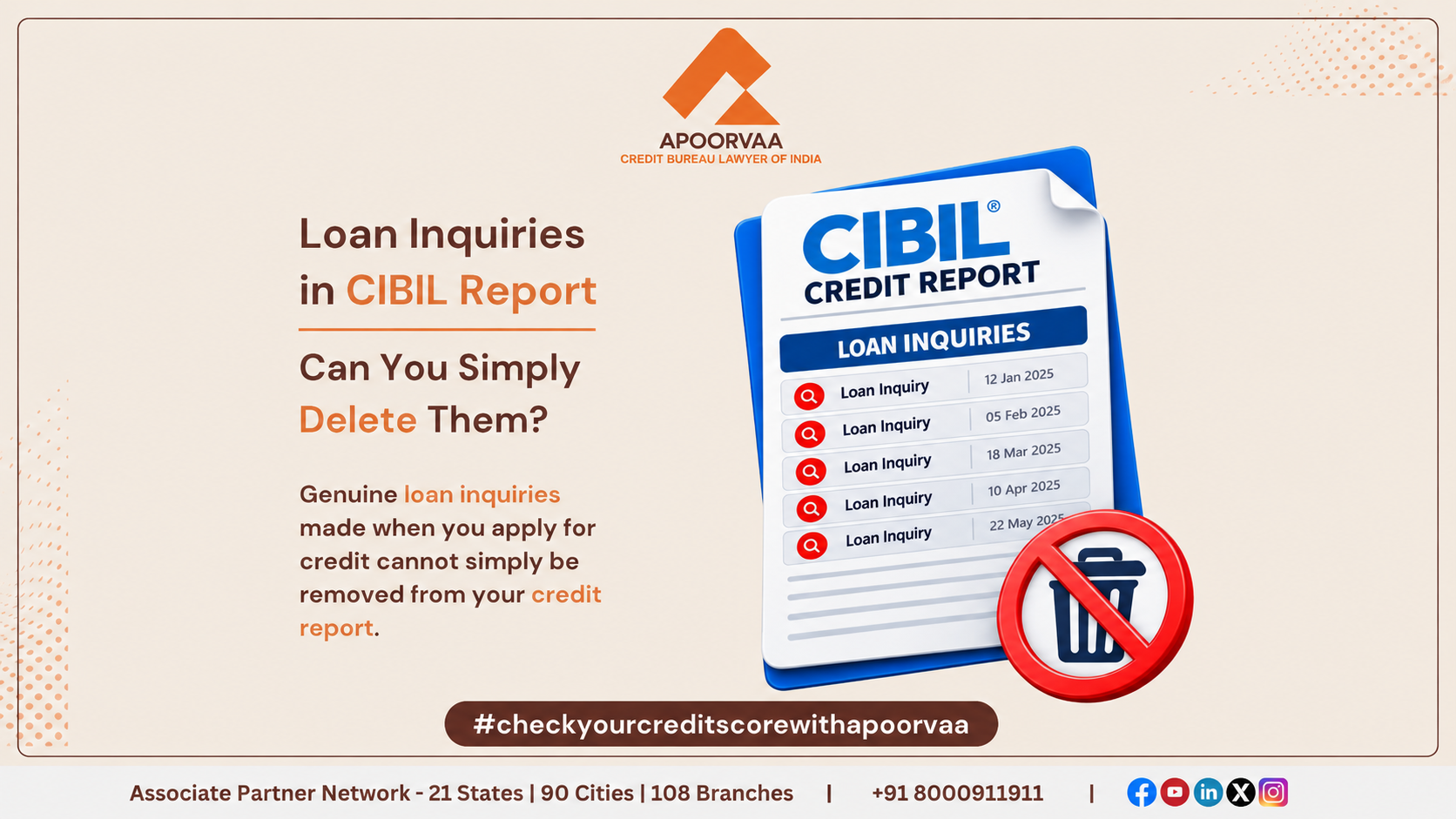
CIBIL Enquiries appear when banks or other credit institutions access your CIBIL Report, generally while processing an application for a loan or credit card. If you have applied with multiple lenders, several enquiries may therefore appear in your credit report. A genuine enquiry arising from an actual credit application cannot simply be deleted because you later want fewer enquiries in your report.
However, there is an equally important second part to this subject:
A genuine enquiry and an incorrect or unrecognised enquiry are not the same thing.
If you genuinely applied for credit and the lender accessed your report, the enquiry should not be treated as an error merely because:
- Your application was rejected.
- You ultimately did not take the loan.
- You applied with several lenders.
- You now want to improve your credit profile.
- You want only one enquiry to remain.
But if an enquiry appears that you did not initiate or authorise, or the enquiry information itself is inaccurate or duplicated, that requires a different approach.
CIBIL specifically provides a dispute mechanism covering inaccuracies and duplication in the Enquiries section.
Understanding this distinction is the starting point for correctly handling CIBIL Enquiries.
What Are CIBIL Enquiries?
When you apply for a loan, the lender does not decide whether to sanction the facility simply from the information written in your application form.
The lender may evaluate:
- Your credit history
- Existing credit facilities
- Repayment behaviour
- Current outstanding obligations
- Credit score
- Recent applications for credit
- Income eligibility
- Repayment capacity
- Other parameters under its credit policy
As part of this assessment, the credit institution may request your CIBIL Report.
CIBIL states that an enquiry is created every time a credit institution requests the consumer’s CIBIL Report. Importantly, CIBIL also clarifies that enquiries appearing in the report are not themselves credit facilities availed by the consumer.
That distinction is fundamental.
CIBIL Enquiry ≠ Loan Account
Suppose you apply for a personal loan with five different banks.
All five institutions access your CIBIL Report.
Only one bank finally sanctions the loan.
Your credit profile can still contain enquiries relating to the different credit applications even though you ultimately obtained only one loan.
Therefore:
5 enquiries do not necessarily mean 5 loans.
An enquiry indicates that a lender accessed your credit information in connection with a credit assessment.
A loan account represents an actual credit facility reported in your credit profile.
These are different sections and should not be confused.
What Does the Enquiries Section of a CIBIL Report Show?
The Enquiries section provides a history of lenders checking your credit profile in connection with loan or credit-card applications.
According to CIBIL’s current guidance, each enquiry entry typically contains information such as:
- Lender’s name
- Date of enquiry
- Type of credit applied for
CIBIL currently explains that the Enquiries section records lender checks made while processing loan or credit-card applications during the previous 36 months.
This section can therefore answer two important questions:
How frequently have I recently applied for credit?
and
Do I recognise the applications associated with these enquiries?
The second question becomes especially important when reviewing a report for possible inaccuracies.
Can Genuine CIBIL Enquiries Be Removed?
This is one of the most common questions we receive.
Suppose you urgently need a ₹10 lakh personal loan.
You approach Bank A.
Then Bank B.
Then Bank C.
You also approach two NBFCs and several other lenders.
Eventually your CIBIL Report shows 10 enquiries.
You later realise that multiple enquiries may not be desirable and ask:
“Can I keep one enquiry and remove the remaining nine?”
If all 10 enquiries genuinely resulted from credit applications made or authorised by you, the fact that you now want fewer enquiries does not make the other nine inaccurate.
This is where the difference between Credit Rectification and credit-history deletion becomes extremely important.
Credit Rectification should address information that is:
Incorrect.
Inaccurate.
Duplicated.
Not belonging to the consumer.
or otherwise requires appropriate verification and correction.
It should not be used to artificially remove accurate information merely because that information has become inconvenient.
What If the Loan Was Never Sanctioned?
A very common question is:
“Bank ne loan reject kar diya. Phir enquiry CIBIL mein kyun rahegi?”
Because an enquiry and a sanctioned loan represent different events.
Consider this sequence:
Step 1: You apply for a personal loan.
Step 2: The lender accesses your CIBIL Report.
Step 3: An enquiry is created.
Step 4: The lender evaluates your application.
Step 5: The lender decides not to sanction the loan.
The fact that Step 5 resulted in rejection does not mean Step 2 never happened.
The enquiry reflects the credit check associated with the application, not whether the application ultimately resulted in disbursement.
CIBIL itself describes credit application history as reflecting enquiries made with banks or financial institutions and expressly notes that this does not mean the consumer actually availed a loan or credit card.
Therefore:
Loan sanctioned → genuine enquiry may appear.
Loan rejected → genuine enquiry may still appear.
Loan not ultimately taken → the earlier legitimate enquiry does not automatically become inaccurate.
What If You Don’t Recognise an Enquiry?
This is where the analysis changes completely.
Suppose you check your CIBIL Report and see:
XYZ Bank – Personal Loan Enquiry
But you believe:
“Maine XYZ Bank mein kabhi loan apply hi nahi kiya.”
Do not automatically conclude that the enquiry must be genuine.
But also don’t immediately conclude that it is fraud.
First investigate.
Ask yourself whether you recently:
- Applied through a DSA
- Submitted details through an online loan marketplace
- Used a fintech lending platform
- Applied through an intermediary
- Applied for Buy Now Pay Later or another credit product
- Authorised a platform to process your application with lending partners
CIBIL itself notes that an unfamiliar enquiry can sometimes relate to a third-party marketplace working with banks or financial institutions. It also recognises that an unrecognised enquiry can potentially require investigation for unauthorised activity.
Therefore, the right sequence is:
Identify → Verify → Establish whether it was authorised → Dispute if genuinely inaccurate.
Genuine Enquiry vs Incorrect Enquiry
For Credit Rectification purposes, we should separate these two situations clearly.
Situation 1: Genuine CIBIL Enquiry
You applied for credit.
The lender legitimately accessed your report.
The enquiry accurately reflects the application.
Later, you decide that you do not want that enquiry appearing.
That does not make it a reporting error.
Situation 2: Incorrect or Unrecognised Enquiry
You did not make or authorise the relevant credit application, or specific enquiry information appears inaccurate or duplicated.
That may require verification and an appropriate dispute.
CIBIL permits consumers to dispute information in the Enquiry section, including inaccuracies and duplicate enquiries.
This distinction should be established before any rectification process begins.
Can CIBIL Delete an Enquiry Directly?
Another misconception is:
“CIBIL mein dispute raise karenge aur CIBIL enquiry delete kar dega.”
The process is not that simple.
CIBIL states that it is not authorised to delete or modify records appearing in a Credit Information Report without written confirmation from the respective credit institution. When a dispute is raised, the matter is taken up with the concerned bank or credit institution for verification.
Therefore, raising a dispute does not guarantee deletion.
The lender’s verification matters.
If the institution confirms that the enquiry genuinely resulted from your credit application, the enquiry should not be expected to disappear merely because you disputed it.
If the information is found to be incorrect, appropriate correction can follow through the dispute process.
Why Multiple CIBIL Enquiries Matter
A borrower should not become afraid of every genuine enquiry.
Applying for credit when you actually need credit is a normal financial activity.
The concern is repeated applications for credit within a short period.
CIBIL explains that lenders can use the Enquiries section to understand how frequently a consumer is applying for credit and whether multiple applications are occurring close together. It also notes that repeated enquiries over a short period can affect the CIBIL Score.
Consider two borrowers.
Borrower A
Needs a home loan.
Checks their credit profile.
Understands eligibility.
Approaches an appropriate lender.
Submits a planned application.
Borrower B
Needs an urgent personal loan.
Applies with 12 lenders within a few days hoping:
“Kahin se toh approval aa jayega.”
These represent very different credit-seeking patterns.
This is why the solution to excessive enquiries is often not:
“How do I delete them?”
The better question is:
“How do I avoid unnecessary enquiries going forward?”
Loan Rejected? Don’t Immediately Apply Everywhere
This is one of the most practical lessons borrowers should understand.
If Bank A does not sanction your loan, immediately applying with another ten lenders may not solve the original problem.
First determine why the application did not proceed.
Review:
- CIBIL Score
- Complete CIBIL Report
- Existing loan obligations
- Current EMI burden
- Recent payment history
- DPD
- Outstanding balances
- Credit utilisation
- Existing enquiries
- Income eligibility
- Negative account statuses
- Any genuine reporting discrepancies
The problem may not even be the CIBIL Score alone.
A lender may reject an application based on its own eligibility criteria and credit policy.
Therefore, repeatedly applying without understanding the underlying issue can create additional enquiries while leaving the original problem unresolved.
Checking Your Own CIBIL Report Is Different
Some consumers become so concerned about enquiries that they stop monitoring their own report.
They believe:
“Main khud CIBIL check karunga toh bhi enquiry lagegi.”
That should not be confused with a lender accessing your report in connection with a new credit application.
CIBIL itself encourages consumers to review their credit history regularly and notes that monitoring the report can help avoid unexpected issues when applying for credit.
Checking your report before an important application can actually help you identify:
- Unknown enquiries
- Unknown loan accounts
- Incorrect account information
- Existing payment problems
- High outstanding balances
- Other credit-report issues
Responsible self-monitoring is therefore part of good credit management.
Don’t Pay for a Promise to Delete Genuine Enquiries
If someone tells you:
“Aapke CIBIL mein 15 enquiries hain. Hum sab remove karwa denge.”
do not evaluate that claim only on the basis of whether you want the enquiries gone.
Ask:
“Are these enquiries actually inaccurate?”
If the enquiries genuinely arose from applications made or authorised by you, they should not be represented as reporting errors merely to get them deleted.
A professional Credit Rectification process should first determine:
What is accurate?
What is inaccurate?
What requires verification?
What can legitimately be disputed?
That is fundamentally different from promising:
“Whatever is negative, we will remove it.”
How Apoorvaa Analyses CIBIL Enquiries
When a consumer approaches Apoorvaa – Credit Bureau Lawyer of India because several CIBIL Enquiries appear in the credit report, the first step is not to promise removal.
The first step is to understand why each enquiry is appearing.
A proper review should separate enquiries into three broad situations:
- Genuine enquiries arising from credit applications actually made or authorised by the consumer.
- Unrecognised enquiries where the consumer does not remember applying with the institution.
- Potentially incorrect or duplicate enquiries that require verification with the concerned credit institution.
Only after this distinction is established can the appropriate course of action be determined.
Step 1: Review the Complete Enquiries Section
Every enquiry should be reviewed individually.
The analysis should consider:
- Name of the credit institution
- Date of enquiry
- Type of credit
- Enquiry amount, where reported
- Applications made around the same period
- Whether a DSA or intermediary was involved
- Whether an online lending or fintech platform was used
Looking only at the number of enquiries is not sufficient.
Suppose a report contains 12 enquiries.
If all 12 resulted from genuine applications, that is one situation.
If eight are genuine but four cannot be connected with any application made or authorised by the consumer, that is a completely different situation.
Step 2: Check Applications Made Through DSAs and Digital Platforms
Consumers sometimes say:
“Maine toh sirf ek jagah documents diye the, phir 5 banks ki enquiries kaise aa gayi?”
This needs investigation.
The consumer may have provided information through a:
- DSA
- Loan marketplace
- Fintech platform
- Digital lending portal
- Credit intermediary
Depending on the process and consent given, the application may have been considered by lending partners.
Therefore, an unfamiliar lender name does not automatically prove that an enquiry is incorrect.
The application journey should first be reconstructed:
Where were the documents submitted?
What consent was provided?
Which lenders or lending partners were involved?
When were the enquiries generated?
Only then should an enquiry be classified as genuinely unrecognised.
Step 3: Separate Genuine Enquiries from Disputable Enquiries
This is one of the most important principles of Credit Rectification.
Suppose the borrower knowingly applied with six banks.
All six accessed the credit report.
Later, the borrower wants five enquiries removed.
Those enquiries should not be converted into disputes merely because they are now inconvenient.
Now consider another situation.
The borrower finds an enquiry from a lender and, after reviewing previous applications and authorisations, genuinely cannot establish any connection with it.
That enquiry deserves verification.
The principle is simple:
Accurate information → should not be artificially challenged.
Potentially inaccurate information → should be verified and appropriately disputed.
What Should You Do About an Unrecognised CIBIL Enquiry?
If an enquiry genuinely appears unfamiliar, preserve the latest CIBIL Report and note the relevant enquiry details.
Then:
- Verify your recent credit applications.
Check whether you applied directly or through an intermediary.
- Contact the concerned credit institution.
Ask the institution to verify the application or authorisation against which your credit information was accessed.
- Raise an appropriate CIBIL dispute where required.
CIBIL permits consumers to dispute inaccuracies in the Enquiries section.
- Keep records of your communications.
Maintain emails, complaint numbers and responses received from the institution and credit bureau.
- Review the updated report.
If the institution confirms that the enquiry was incorrectly reported or did not belong to you, the appropriate correction can be processed through the reporting framework.
The important point is that raising a dispute does not itself guarantee deletion. The disputed information needs to be verified.
Understanding the Dispute Process and the 30-Day Framework
Consumers should also understand that credit-report disputes are not necessarily instant.
Under the RBI’s credit-information framework, complaints relating to correction or updating of credit information are subject to an overall 30-calendar-day resolution framework, with responsibilities divided between the credit institution and the credit information company.
This should not be interpreted as:
“Every disputed enquiry must disappear within 30 days.”
The framework relates to resolution of the complaint—not guaranteed deletion of the disputed information.
If verification establishes that the enquiry is accurate, raising a dispute does not convert accurate information into inaccurate information.
If the enquiry is established to be incorrect, the appropriate correction should follow.
What If You Have Too Many Genuine CIBIL Enquiries?
This is where many consumers look for the wrong solution.
Suppose your report contains 15 enquiries and all 15 genuinely resulted from credit applications made by you.
The answer is not:
“Find someone who can delete 14.”
Instead, change your credit-application behaviour going forward.
Stop Applying Randomly
If several lenders have already declined your application, another series of applications may generate further enquiries without addressing the reason for rejection.
Review Your Complete Credit Profile
Look beyond the enquiries.
Check:
- Payment history
- DPD
- Current overdue amounts
- Credit-card utilisation
- Existing loan burden
- Settlement or write-off related reporting
- Credit history
- Other negative account information
Understand Your Eligibility
Credit approval is not based only on the CIBIL Score.
Income, existing EMI obligations, repayment capacity, lender policy, type of employment or business and other eligibility criteria can also matter.
Apply Selectively
Once you understand your credit and financial position, approach an appropriate lender instead of submitting applications indiscriminately.
The most effective way to control unnecessary enquiries is to prevent unnecessary applications.
CIBIL Enquiry vs Unknown Loan Account: Don’t Confuse Them
These two problems require different analysis.
Unknown CIBIL Enquiry
A lender appears to have accessed your credit information, but you do not recognise the associated application.
This requires verification of the enquiry.
Unknown Loan Account
An actual loan or credit facility appears in your credit report that you claim you never took.
This is potentially more significant because an account has been associated with your credit profile.
The account information, ownership, KYC and lender records may need to be investigated.
Therefore:
Unknown enquiry ≠ Unknown loan account.
Both deserve attention, but the rectification process should be based on the actual type of reporting issue.
Common Mistakes Consumers Make With CIBIL Enquiries
- Disputing Every Enquiry
A dispute should have a genuine basis. Accurate enquiries should not be challenged simply because they are unwanted.
- Assuming a Rejected Loan Makes the Enquiry Invalid
The enquiry represents the lender’s credit check. Loan rejection does not automatically invalidate that check.
- Applying Everywhere After One Rejection
This can create additional enquiries without resolving the original eligibility or credit issue.
- Ignoring DSA or Fintech Applications
An unfamiliar lender name may sometimes be connected with an application submitted through an intermediary.
- Assuming Every Enquiry Reduces the Score by a Fixed Number
There is no responsible basis for treating every enquiry as a guaranteed fixed-point deduction.
- Confusing an Enquiry With a Loan
A credit enquiry does not itself establish that a loan was sanctioned or disbursed.
- Paying for Guaranteed Enquiry Deletion
Be cautious when someone promises to remove all genuine enquiries irrespective of how they originated.
Practical CIBIL Enquiry Review Checklist
If you are concerned about CIBIL Enquiries, use this sequence:
✔ Download and review your latest complete CIBIL Report.
✔ Identify every enquiry appearing in the report.
✔ Match the lender and date with your previous applications.
✔ Check whether you used a DSA, fintech or loan marketplace.
✔ Separate recognised enquiries from genuinely unrecognised ones.
✔ Verify unfamiliar enquiries with the concerned institution.
✔ Raise a dispute where there is a genuine reporting or ownership issue.
✔ Maintain records of complaints and responses.
✔ Check the report again after the dispute process is completed.
✔ Do not raise false disputes against genuine enquiries.
✔ Avoid unnecessary new loan applications.
The correct sequence is:
Review → Identify → Verify → Dispute where justified → Monitor
Frequently Asked Questions About CIBIL Enquiries
Can genuine CIBIL Enquiries be deleted?
A genuine enquiry arising from a credit application made or authorised by you should not be treated as an error simply because you want it removed.
Can I remove enquiries if my loan was rejected?
Loan rejection does not automatically make the enquiry incorrect. The enquiry represents the credit check performed in connection with the application.
What if I have 10 genuine enquiries?
Do not try to convert genuine enquiries into false disputes. Avoid unnecessary new applications, review your complete credit profile and understand your eligibility before applying again.
What if an enquiry does not belong to me?
First verify whether it could have resulted from an application made through a DSA, marketplace, fintech or other intermediary. If you genuinely did not make or authorise the application, take it up with the concerned institution and use the appropriate dispute process.
Can CIBIL directly remove an incorrect enquiry?
CIBIL’s dispute mechanism allows enquiry-related inaccuracies to be raised, but reported information is verified with the concerned credit institution. A dispute should not be understood as automatic deletion.
Will an enquiry disappear if the loan was never disbursed?
Not merely for that reason. An enquiry records the lender’s access to your credit information during the credit-assessment process; it is different from an actual loan account.
Can multiple loan enquiries affect my CIBIL Score?
Frequent credit applications and resulting enquiries can form part of the overall credit profile. However, avoid claims that every enquiry reduces the score by a fixed number of points.
Should I stop checking my own CIBIL Report?
No. Reviewing your own credit report for monitoring purposes should not be confused with repeatedly applying for new credit.
Final Thoughts
The question “Can CIBIL Enquiries be removed?” cannot be answered responsibly without first determining whether the enquiry is genuine.
If you applied for or authorised the credit application and the lender legitimately accessed your credit report, the enquiry should not be treated as an error merely because you no longer want it there.
If an enquiry is genuinely unrecognised, inaccurate or duplicated, it deserves verification and, where justified, an appropriate dispute.
That gives us a clear distinction:
Genuine enquiry → Accept the accurate credit history and manage future applications responsibly.
Incorrect enquiry → Verify the facts and follow the appropriate rectification process.
Credit Rectification should be about accuracy, not artificial deletion of genuine credit history.
Concerned About Enquiries in Your CIBIL Report?
If your CIBIL Report contains multiple or unfamiliar enquiries, the first step should not be to search for someone promising to delete them.
The first step should be to determine:
Which enquiries are genuine?
Which enquiries do you recognise?
Which enquiries require verification?
Is there actually a reporting discrepancy that can be disputed?
At Apoorvaa – Credit Bureau Lawyer of India, our Credit Rectification approach begins with analysis of the credit report and identification of the actual issue.
Where an enquiry is genuine, we do not treat accurate information as an error merely because it is negative or inconvenient.
Where information genuinely appears inaccurate or requires verification, the appropriate process can be followed with the concerned credit institution and credit bureau.
Understand the report first. Rectify only what genuinely requires rectification.