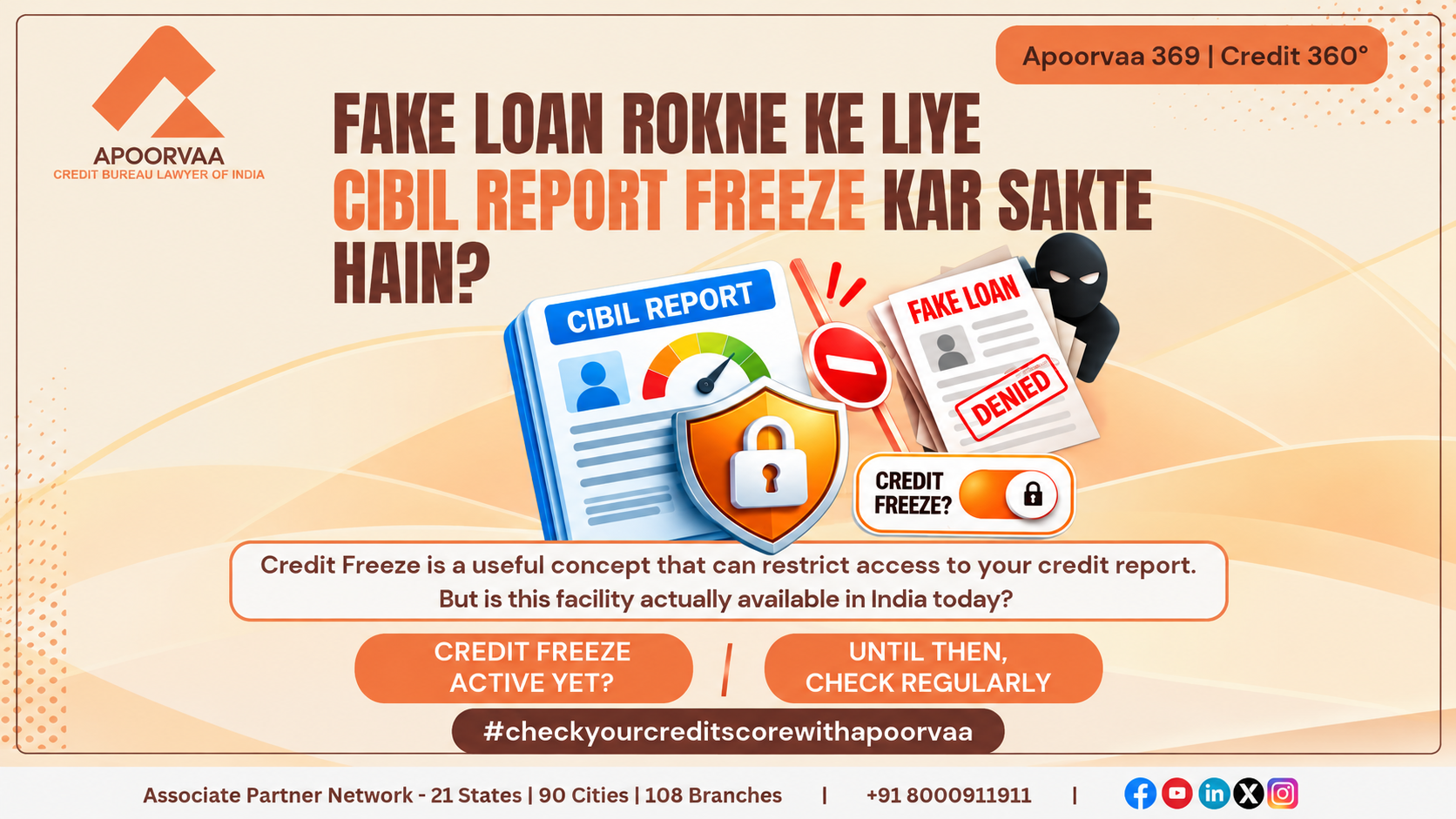
“Can you really press one button and freeze CIBIL Report so that no lender can access it?”
The idea sounds like an effective solution to an increasingly serious concern.
Imagine that somebody obtains your personal information and attempts to apply for a loan or credit card in your name.
What if you could simply log in to your credit-bureau account, activate a freeze and restrict access to your Credit Report until you genuinely wanted to apply for credit?
This concept is generally known as a Credit Freeze.
Recent discussions around Credit Freeze have created significant curiosity among Indian consumers, particularly because of concerns involving fake loans, identity misuse and unfamiliar enquiries appearing in Credit Reports.
But there is an important distinction between:
A useful credit-security concept
and
A facility that is officially available and operational for consumers.
Based on the current official TransUnion CIBIL consumer resources reviewed as of now, we could not verify an active consumer-facing facility that allows an individual to simply press a “Freeze CIBIL Report” button and block lenders from accessing the CIBIL Report.
What can currently be verified includes facilities such as Credit Report access, credit monitoring, alerts and dispute mechanisms.
Therefore, consumers should not follow speculative instructions for activating a CIBIL Credit Freeze unless the facility and procedure can be confirmed from official sources.
- Can You Freeze Your CIBIL Report in India Right Now?
If you search online for:
Freeze CIBIL Report
CIBIL Credit Freeze
How to Lock CIBIL Report
or
Stop Lenders from Checking CIBIL
you may come across articles, videos and posts discussing the concept.
But a discussion about Credit Freeze does not itself establish that a consumer-facing CIBIL Freeze facility is currently operational.
As of now, the official CIBIL consumer resources we reviewed confirm mechanisms relating to:
- Accessing the CIBIL Report
- Monitoring the credit profile
- Alerts for specified changes
- New enquiry alerts
- New account alerts
- Certain personal-information changes
- Dispute mechanisms for potentially inaccurate credit information
However, we could not verify from those current official CIBIL consumer resources a simple consumer control that allows an individual to switch their CIBIL Report into a frozen state and thereby block lender access.
This distinction matters.
Credit monitoring is not the same as Credit Freeze.
An alert about a new enquiry is not the same as preventing that enquiry.
A dispute about an unknown account is not the same as stopping that account from being opened in the first place.
These are separate functions within consumer credit management.
- What Is a Credit Freeze?
At a conceptual level, a Credit Freeze is a mechanism designed to restrict specified access to a consumer’s credit information.
Suppose a fraudster obtains enough personal information to attempt a loan application using another person’s identity.
A lender evaluating that application may obtain credit information as part of its underwriting and verification process.
If an applicable Credit Freeze prevents the relevant new-credit access, it could potentially create an additional barrier to the fraudulent application.
That is why Credit Freeze can be an important consumer-protection concept.
However, the exact effect depends entirely on how the framework is designed.
A Credit Freeze should therefore not automatically be described as:
“Nobody can ever see your Credit Report.”
or
“Activate Credit Freeze and no fake loan can ever happen.”
The actual answer would depend on questions such as:
- Which entities are restricted?
- What type of credit-report access is restricted?
- Are there permitted exceptions?
- Does it affect existing lenders?
- Does it apply only to new-credit applications?
- Does the consumer need to freeze each bureau separately?
- How can legitimate access be restored?
Unless an Indian framework officially defines these points, activation steps and protection claims should not be invented.
- CIBIL Is One Credit Information Company — Not the Entire Credit-Bureau System
This distinction becomes particularly important when discussing Credit Freeze.
Many consumers commonly say:
“Check my CIBIL.”
But India has four Credit Information Companies:
TransUnion CIBIL
Experian
Equifax
CRIF High Mark
Therefore, a consumer’s broader credit profile should not automatically be treated as one single “CIBIL file.”
Different CICs maintain credit information received through their respective reporting ecosystems.
This creates an important question for any future Credit Freeze framework:
If I freeze one Credit Report, what happens to the reports maintained by the other CICs?
Consumers should not assume that a facility offered by one CIC automatically applies across all four.
Similarly, information describing a Credit Freeze concept on one bureau’s website should not automatically be treated as proof that an identical facility exists on CIBIL.
A meaningful nationwide consumer-controlled freeze mechanism would need clarity on whether:
Each CIC must be frozen separately
or
A coordinated mechanism operates across the Indian credit-information ecosystem.
Until such a framework is officially established, this distinction should remain clear.
- Credit Freeze vs CIBIL Alerts: What’s the Difference?
This is one of the most important distinctions in today’s discussion.
Credit Freeze
Conceptually:
Restricts specified access to the Credit Report.
Its principal purpose would be preventive, subject to the rules and exceptions of the applicable framework.
Credit Monitoring
Credit monitoring helps a consumer observe changes in the credit profile.
Its role is primarily:
Detection and awareness.
Monitoring should not be represented as preventing the underlying activity.
Credit Alerts
TransUnion CIBIL currently describes alerts for eligible subscribed consumers relating to specified changes in their credit profile.
These can include events such as:
New enquiry added
New account added
Certain changes in personal information
Changes in credit-related information
For example, if a new enquiry appears, an alert may help bring it to the consumer’s attention.
But:
The alert did not necessarily stop the enquiry.
It notified the consumer about the activity.
Credit Report Dispute
A dispute becomes relevant when potentially inaccurate information has already been identified.
For example:
“I never applied for this loan.”
“This account does not belong to me.”
“I don’t recognise this enquiry.”
The information may then require verification through the concerned lender and Credit Information Company framework.
Therefore, the four concepts should remain separate:
Credit Freeze → Restrict
Credit Monitoring → Observe
Credit Alert → Notify
Credit Report Dispute → Investigate / Correct
For consumers worried about fake loans, understanding this distinction is more useful than simply searching for a “Freeze” button.
- Can a Credit Freeze Prevent Fake Loans?
A properly designed Credit Freeze could potentially create an additional barrier against certain types of fraudulent new-credit activity.
Consider a simplified example.
A fraudster obtains another person’s personal information.
↓
A fraudulent loan application is submitted.
↓
The lender attempts to access credit information as part of its credit assessment.
↓
If the applicable credit report is subject to an effective freeze that restricts that specific access, the lender may be unable to proceed with the credit-information check in the normal manner.
Conceptually, this could strengthen consumer protection.
But this example should not be interpreted as proof that:
Credit Freeze = Complete Fake Loan Protection
Financial and identity fraud can involve multiple systems.
It may involve misuse of:
- PAN information
- Identity documents
- KYC records
- Contact details
- Banking information
- Digital credentials
- Other personal data
A credit-access restriction addresses a particular part of the credit ecosystem.
Its actual protection depends on the scope of the official framework.
Therefore, even if an Indian Credit Freeze facility becomes available, consumers should understand exactly what it restricts before treating it as complete fraud protection.
- What Does CIBIL Currently Offer to Detect Suspicious Activity?
Although we could not verify a consumer-facing Freeze CIBIL Report facility as of now, CIBIL does provide mechanisms that can help consumers monitor their credit information.
One relevant mechanism is CIBIL Alerts for eligible subscribed consumers.
Alerts may help bring specified changes to the consumer’s attention.
New Enquiry Added
A new credit enquiry can appear when a lender accesses credit information in connection with relevant credit activity.
If you recently applied for a:
Home Loan
Personal Loan
Business Loan
Vehicle Loan
or
Credit Card
the enquiry may be familiar.
But if you did not make an application and cannot connect the enquiry with any legitimate credit activity, it deserves verification.
An unfamiliar enquiry does not automatically prove fraud.
But it should not automatically be ignored either.
New Account Added
This is particularly important.
Suppose your Credit Report suddenly contains:
Lender: ABC Finance
Account Type: Personal Loan
Loan Amount: ₹5,00,000
But you never borrowed from that institution.
That is materially different from simply seeing an unfamiliar enquiry.
An unknown credit account can require investigation into:
- The reporting lender
- Account ownership
- Application information
- KYC association
- Account opening details
- Outstanding amount
- Reporting history
The objective is to establish whether the account:
Actually belongs to the consumer
Has been incorrectly associated with the consumer
or
May involve identity misuse or another reporting issue
Personal Information Changes
Consumers should also pay attention to unfamiliar changes in reported personal information.
An unexpected address, contact detail or other identifying information may deserve further examination, particularly when it appears alongside unfamiliar credit activity.
The important point is:
Credit monitoring helps detect. It does not guarantee prevention.
- Unknown Enquiry vs Unknown Loan: Do Not Treat Them as the Same Problem
From a Credit Report analysis perspective, this distinction is essential.
Unknown Enquiry
An unfamiliar enquiry means that credit information appears to have been accessed in connection with an activity that the consumer does not immediately recognise.
It requires verification.
But:
Unknown Enquiry ≠ Proof That a Loan Was Disbursed
The consumer should first establish:
- Which institution made the enquiry?
- When was it made?
- Was any credit application submitted around that time?
- Could it relate to a genuine application through an authorised channel?
- Is there a corresponding credit account?
Unknown Loan or Credit Account
An unknown loan is a different level of concern.
Here, an actual credit facility is appearing in the Credit Report.
For example:
You never took the loan.
You don’t recognise the lender.
The account number is unfamiliar.
An outstanding balance is being reported.
Repayment history is appearing against the account.
This requires account-level investigation.
The question is no longer merely:
“Who checked my report?”
It becomes:
“Why is this credit facility being reported against my credit profile?”
That difference is critical when analysing suspected fake-loan cases.
- The Four-Bureau Monitoring Framework
For consumers concerned about suspicious credit activity, we recommend thinking beyond only the credit score.
A useful monitoring framework is:
Bureau 1 → TransUnion CIBIL
Bureau 2 → Experian
Bureau 3 → Equifax
Bureau 4 → CRIF High Mark
Within each available Credit Report, examine four areas:
- Enquiries
Do you recognise the lenders and credit applications?
- Accounts
Do you recognise every reported loan and credit card?
- Personal Information
Do the identifying details correspond with you?
- Account Information
Do the ownership, balances, status and repayment details correspond with your actual credit facilities?
This creates a more meaningful credit-monitoring approach than checking only:
“What is my CIBIL Score?”
A score is important.
But a score alone cannot tell you whether every enquiry, account and identifying detail appearing in the underlying Credit Report actually belongs to you.
- Why Information May Need to Be Checked Across More Than One Bureau
A consumer may assume:
“My CIBIL Report is correct, so everything must be fine.”
That conclusion may be too broad.
Credit Information Companies receive data through their respective reporting systems, and information may not necessarily appear identically across every bureau at exactly the same point in time.
For example, a consumer may need to understand whether:
An unfamiliar enquiry appears in one report or multiple reports
An unknown account is being reported consistently across CICs
Account status differs between reports
Personal information differs
A correction has propagated consistently
This is where four-bureau Credit Report analysis becomes particularly relevant.
The objective is not to create unnecessary fear.
It is to establish a more complete factual picture.
Because when the concern is:
“This loan is not mine.”
or
“I never made this enquiry.”
the analysis should go deeper than simply checking whether the credit score has changed.
- Monitoring Does Not Mean Fraud Prevention
This point deserves emphasis.
Regularly checking your CIBIL Report—or reports from all four CICs—does not itself stop someone from attempting identity misuse.
Similarly:
Receiving an alert does not necessarily mean the suspicious activity was prevented.
Monitoring provides visibility.
Alerts provide notification.
Disputes provide a mechanism for investigation of potentially inaccurate reported information.
A genuine Credit Freeze, if officially available under a defined framework, would serve a different function.
This is why consumers should avoid statements such as:
“I check my CIBIL every month, so nobody can take a fake loan in my name.”
The more accurate statement is:
“Regular credit monitoring may help me identify suspicious credit activity earlier.”
That distinction is important for responsible credit awareness.
- What If You See an Enquiry You Never Made?
An unfamiliar enquiry is often the first thing that creates concern.
A consumer checks the Credit Report and finds the name of a bank, NBFC or another credit institution that they do not remember approaching.
The immediate reaction may be:
“Someone has taken a fake loan in my name.”
But an unknown enquiry and an unknown loan are not the same thing.
An enquiry indicates that credit information was accessed in connection with a credit-related purpose. It does not, by itself, establish that a loan was approved or disbursed.
Therefore, the first step should be verification.
Look at:
Lender Name → Enquiry Date → Type of Credit → Your Actual Applications
Ask:
- Did I apply to this lender?
- Did I apply through a loan platform, DSA or another authorised channel?
- Did I make any credit-card or loan application around this date?
- Is there a corresponding account appearing in my Credit Report?
If the enquiry genuinely cannot be connected with any application or credit activity initiated by you, it deserves further investigation with the concerned institution and, where appropriate, the relevant Credit Information Company.
The correct approach is:
Unknown Enquiry → Verify First
Not:
Unknown Enquiry → Automatically Assume Fake Loan
- What If a Fake or Unknown Loan Appears in Your Credit Report?
This is more serious.
Suppose a consumer finds:
Lender: XYZ Finance
Account Type: Personal Loan
Sanctioned Amount: ₹4,00,000
Outstanding: ₹3,20,000
But the consumer says:
“I have never taken this loan.”
Now the issue requires account-level examination.
The analysis should establish what is actually being reported against the consumer’s credit profile.
Important information may include:
- Reporting lender
- Account number or available masked account details
- Account type
- Ownership information
- Date opened
- Sanctioned amount / credit limit
- Current balance
- Account status
- Repayment history
- Date reported
- Personal information associated with the report
The next question is not simply:
“How do we delete this from CIBIL?”
The correct question is:
“Why is this account being associated with this consumer?”
Possible situations need to be distinguished.
The account could genuinely belong to the consumer but not be immediately recognised.
There could be a reporting or mapping discrepancy.
Or the facts could indicate potential identity misuse or fraudulent credit activity.
Each situation requires a different response.
Professional Credit Rectification begins with establishing those facts—not promising deletion before the account has been investigated.
- One Unknown Loan Should Lead to a Wider Credit-Profile Review
If a genuinely unfamiliar account appears in one Credit Report, checking only that single account may not provide the complete picture.
The consumer should understand the broader credit profile.
A structured four-bureau review can examine:
TransUnion CIBIL
Experian
Equifax
CRIF High Mark
The objective is to understand:
Where does the unknown account appear?
Is the same lender reporting across multiple CICs?
Are the account details consistent?
Are there unfamiliar enquiries associated with the account?
Is there unexpected personal information?
Are there other unknown accounts?
This does not mean that all four reports will necessarily contain identical information.
That is precisely why comparison can be useful.
An account appearing differently—or not appearing at all—across CICs can become relevant when establishing the reporting trail.
- Why the Reporting Lender Matters in an Unknown-Loan Case
Consumers sometimes believe that CIBIL itself creates loan-account information.
That is not the correct way to understand the credit-reporting ecosystem.
Credit institutions furnish credit information to Credit Information Companies.
Therefore, when an unfamiliar account appears, the reporting lender becomes a critical part of the investigation.
The consumer may need clarity on questions such as:
Does the lender actually have an account corresponding to the consumer?
What information was used when the facility was originated?
What account details have been furnished to the CIC?
Does the information correspond with the consumer’s actual records?
The Credit Information Company also has an important role in the applicable dispute and correction framework.
But the underlying credit information cannot simply be rewritten without verification through the relevant process.
That is why legitimate Credit Rectification is fundamentally different from a promise to:
“Remove any negative account from CIBIL.”
The objective should be accuracy.
- What If the Unknown Loan Is Affecting Your Credit Score?
An unfamiliar account may contain:
- Outstanding balance
- Overdue amount
- Adverse repayment history
- Written-off or settlement-related information
- Other negative account information
If that account does not actually belong to the consumer, the consequences can extend beyond simply seeing an unfamiliar lender name.
It may affect the overall credit profile considered by future lenders.
However, two important promises should never be made.
First:
Correction of an inaccurate account does not guarantee a specific increase in the credit score.
Second:
Correction does not guarantee approval of the next loan application.
Credit scores depend on the information and scoring methodology applicable to the report, while lenders make credit decisions using their own underwriting policies and multiple factors.
Therefore, the professional objective should be:
Correct Credit Information
—not—
Guaranteed Score Increase
or
Guaranteed Loan Approval
- When Does Professional Credit Report Analysis Become Relevant?
There is an important difference between:
Checking your credit score
and
Analysing a disputed credit profile.
Suppose the consumer says:
“This loan is not mine.”
A professional review may need to understand:
Which bureau is reporting it?
↓
Which lender furnished it?
↓
What account information is being reported?
↓
Does it appear across other CICs?
↓
Is there a related enquiry?
↓
Does the personal information correspond?
↓
Are there other reporting inconsistencies?
This is where four-bureau Credit Report analysis can become valuable.
The purpose is not to manufacture a dispute.
It is to establish whether there is a genuine credit-information accuracy issue.
Our approach at Apoorvaa remains:
Identify → Compare → Verify → Rectify Where Justified
- Credit Rectification Is Not the Same as Fraud Investigation
This distinction is also important.
A Credit Report may reveal information that raises suspicion of identity misuse.
But a Credit Information Company is not a substitute for the police, cybercrime authorities or other competent agencies where an actual fraud offence may have occurred.
Credit Rectification focuses on the accuracy of credit information being reported.
If an account is genuinely fraudulent, the consumer may need to pursue more than one track depending on the facts:
Credit-information verification/correction
and, where appropriate,
Fraud reporting or law-enforcement action.
Consumers should therefore avoid treating a CIBIL dispute as the complete solution to every identity-fraud case.
- Why a Consumer-Controlled Credit Freeze Could Be Valuable in India
Today, much of the consumer response to suspicious credit activity is reactive.
An enquiry appears.
An alert is received.
An unknown account is discovered.
The consumer then investigates.
A properly designed Credit Freeze could potentially add a preventive layer before certain new-credit access occurs.
From a consumer-protection perspective, that deserves serious consideration.
Imagine a consumer who is not planning to take any new loan for the next six months.
Conceptually, a secure freeze mechanism could allow the consumer to restrict specified new-credit access during that period.
When genuinely applying for credit, the consumer could then use the officially prescribed mechanism to restore or temporarily permit access.
That could give consumers greater control.
But this remains a discussion of what such a framework could provide.
It should not be presented as an activation process that has already been verified for CIBIL.
- What Would an Effective Indian Credit Freeze Framework Need to Clarify?
If a broader consumer Credit Freeze facility is introduced, several questions would require clear official answers.
Does It Cover All Four CICs?
Would a consumer need to approach:
TransUnion CIBIL,
Experian,
Equifax,
and CRIF High Mark
separately?
Or would one instruction apply across the ecosystem?
This is one of the most important questions.
Which Access Is Actually Restricted?
Would the freeze apply only to new-credit applications?
Would existing lenders retain permitted access for account or portfolio management?
Would any statutory or other permitted access remain available?
How Would Consumers Authenticate Themselves?
Any freeze/unfreeze mechanism would itself need strong security.
The process should therefore come from official instructions rather than speculative claims about OTPs, app buttons or screenshots.
How Would Genuine Loan Applications Work?
Suppose your report is frozen and you later apply for a home loan.
How would you temporarily permit access?
How long would the change take?
Would access be opened to everyone or only for a particular purpose?
These operational details matter.
Would Consumers Receive Confirmation?
A robust framework should make it clear whether the freeze has actually become effective.
Without such confirmation, a consumer might mistakenly believe protection is active when it is not.
- A Freeze Should Not Replace Credit Monitoring
Even if a Credit Freeze becomes available, consumers should not stop reviewing their Credit Reports.
Why?
Because a freeze would address only the scope defined by its official framework.
Credit Reports would still contain information worth monitoring.
Consumers should continue reviewing:
Enquiries
Accounts
Personal Information
Account Status
Outstanding Balances
Repayment History
Reporting Accuracy
The stronger approach would therefore be:
Preventive Control + Monitoring + Alerts + Accuracy Review
rather than treating any one tool as complete protection.
Frequently Asked Questions
- Can I Freeze CIBIL Report right now?
As of now, we could not verify an active consumer-facing CIBIL facility from the official consumer resources reviewed that allows an individual to simply activate a Credit Freeze and block lender access.
Consumers should check current official information before relying on any activation instructions found online.
- Is CIBIL Alert the same as Credit Freeze?
No.
An alert can notify an eligible consumer about specified changes such as a new enquiry or new account.
A genuine Credit Freeze would involve restricting specified access to the Credit Report.
- Will checking my Credit Report regularly stop fake loans?
No.
Monitoring does not itself prevent identity theft or fraudulent applications.
Its benefit is that suspicious enquiries, unknown accounts or other unexpected information may be detected earlier.
- I found an unknown enquiry. Does that mean somebody took a loan in my name?
Not necessarily.
An enquiry does not prove that a loan was sanctioned or disbursed.
However, an enquiry you genuinely cannot connect to any credit application should be verified.
- What if a loan I never took appears in my CIBIL Report?
The underlying account and reporting trail should be investigated.
This may involve the reporting lender and the relevant Credit Information Company. Where the facts suggest fraud or identity misuse, other appropriate reporting or legal channels may also become relevant.
- Can an unknown loan be corrected?
If credit information is established to be inaccurate, it can be pursued through the applicable lender/CIC correction framework.
The objective should be correction of inaccurate information—not deletion of legitimate credit history.
- If I freeze CIBIL in the future, will Experian, Equifax and CRIF High Mark also be frozen?
That should not be assumed.
Any official framework would need to specify whether a freeze operates separately at each CIC or across multiple CICs.
- Should I check all four Credit Reports?
Where the concern involves an unknown loan, suspicious enquiry, identity-related issue or reporting discrepancy, reviewing information across the four CICs can provide a broader understanding of what is being reported.
My Perspective
The discussion around Freeze CIBIL Report highlights a larger issue in India’s credit ecosystem.
Consumers are increasingly aware of their credit scores.
But credit security requires consumers to understand much more than the score.
A consumer should know:
Who has enquired into the credit profile?
Which accounts are being reported?
Whether every account actually belongs to them?
Whether personal information is accurate?
Whether information is consistent across the credit-bureau ecosystem?
A consumer-controlled Credit Freeze could potentially add another important layer to this framework.
But until a specific facility is officially confirmed, we should not turn a useful concept into an imaginary product.
Nor should we publish speculative steps telling consumers:
“Go to Profile → Click Freeze → Enter OTP.”
If those steps cannot be verified, they should not be presented as fact.
For now, the responsible approach is:
Monitor what is actually being reported.
Investigate what you do not recognise.
Compare where necessary across the four CICs.
Rectify information where documentary facts establish that reporting is inaccurate.
And if a genuine consumer-controlled Credit Freeze mechanism is officially introduced, understand its exact scope before relying on it for fraud protection.
Final Takeaway
Can a Credit Freeze be a useful consumer-protection concept?
Yes.
Can we currently verify a simple consumer-facing CIBIL button that allows an individual to freeze the CIBIL Report and prevent lender access?
As of now, we could not verify such a facility from the official CIBIL consumer resources reviewed.
What consumers can do today is equally important.
Don’t monitor only your credit score.
Monitor:
Enquiries
New Accounts
Personal Information
Account Information
And where appropriate, understand the information appearing across:
TransUnion CIBIL | Experian | Equifax | CRIF High Mark
Remember:
Credit Freeze ≠ Credit Monitoring
Credit Alert ≠ Credit Freeze
Unknown Enquiry ≠ Automatically Fake Loan
Unknown Loan = Requires Investigation
Monitoring ≠ Guaranteed Fraud Prevention
Credit Rectification = Accuracy-Based Correction Where Justified
That is a more responsible way to protect and understand your credit profile.
Found an Unknown Loan or Suspicious Enquiry in Your Credit Reports?
If a loan, credit card, enquiry or other account information appears in your Credit Report and you genuinely do not recognise it, the first step is to understand exactly what has been reported.
Apoorvaa provides professional four-bureau Credit Report analysis and Credit Rectification assistance for individuals and businesses where credit information requires investigation and, where justified, correction.
Our approach is:
Identify → Compare → Verify → Rectify Where Justified
📞 8000 911 911
Apoorvaa – Credit Bureau Lawyer of India
Credit Rectification does not guarantee removal of accurately reported information, prevention of fraud, any particular increase in a credit score or approval of a future loan application.
Related Credit Education