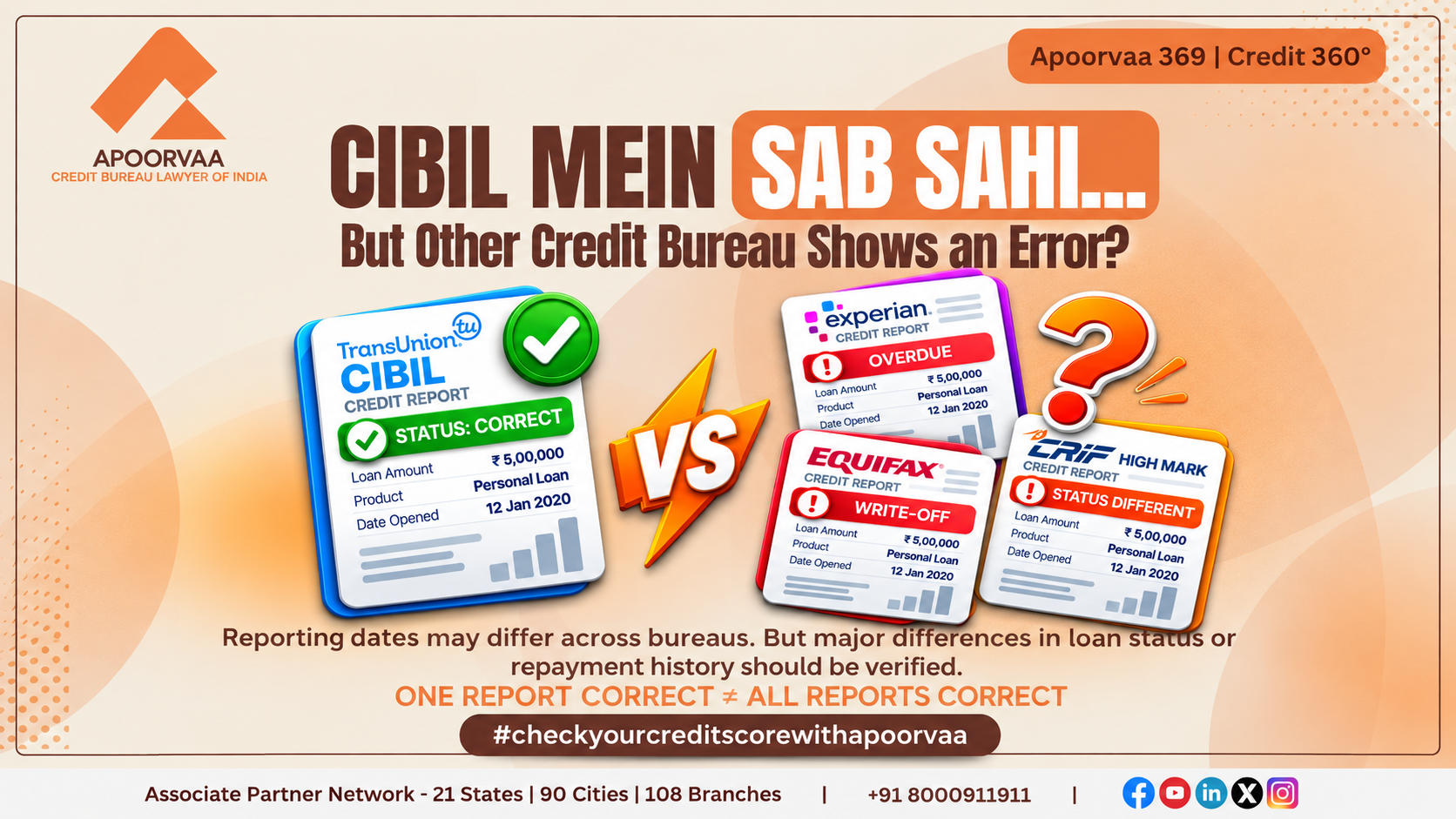
“My CIBIL Report is correct, but Experian, Equifax or CRIF High Mark shows different information for the same loan. What should I do?”
This is not simply a question about having four credit bureaus.
The real issue is data consistency.
A borrower may find that the same identifiable loan is correctly reflected in TransUnion CIBIL, while another Credit Report shows an old Current Balance, an overdue amount, different repayment history or a materially different account status.
For example:
CIBIL: Closed | Current Balance ₹0
Experian: Current Balance still showing
CIBIL: No overdue
Equifax: Overdue reflected
CIBIL: Updated account information
CRIF High Mark: Older information still appearing
These examples do not automatically prove that the other bureau is wrong.
But when the underlying information for the same loan differs materially, the reason should be established.
Different Score vs Different Account Data: They Are Not the Same Problem
The first distinction is between a credit-score difference and a credit-data difference.
Your TransUnion CIBIL, Experian, Equifax and CRIF High Mark scores do not necessarily have to be identical.
Different scores alone should therefore not be treated as proof of inaccurate reporting.
But consider this:
One report says the loan is Closed with ₹0 balance, while another says it is Active with an outstanding Current Balance.
That is no longer simply a scoring issue.
Similarly, if one report shows no overdue while another shows a significant overdue for the same identifiable account, the underlying account information needs to be examined.
For Credit Rectification purposes, this distinction is fundamental.
Different score = not automatically an error.
Materially different account information = requires verification.
Why Can the Same Loan Look Different Across Credit Bureaus?
One possible explanation is the reporting/update position.
Banks, NBFCs and other Credit Institutions furnish credit information to Credit Information Companies under RBI’s credit-information reporting framework.
Under the current framework effective from 1 July 2026, credit information is reported using reference dates of the 9th, 16th, 23rd and last day of the month, or at shorter mutually agreed intervals, subject to the applicable submission requirements.
This more frequent reporting framework is important.
However, it does not mean that every field in every bureau report downloaded at a particular moment will necessarily appear identical.
For example, a recent:
- Loan closure
- Payment
- Balance reduction
- Account-status update
may be reflected in one report while another report is still displaying an earlier data position.
Therefore, reporting dates should be examined before concluding that there is an error.
But there is an equally important rule:
“Different reporting date” should not become a universal explanation for materially conflicting information.
What If CIBIL Shows Closed but Another Bureau Shows Outstanding?
This is a common type of cross-bureau discrepancy that needs proper comparison.
Suppose the loan was closed.
Your latest CIBIL Report shows:
Status: Closed
Current Balance: ₹0
But Experian, Equifax or CRIF High Mark continues to show an outstanding balance.
The first comparison should include:
Date Reported / Date Updated
Is one report reflecting an older data position?
Actual Loan Closure Date
When was the account genuinely closed?
Current Balance
What does the lender’s verified account position show?
Account Status
Does the lender consider the account closed?
If the second bureau report clearly reflects an earlier reporting position, the difference may be temporary.
But if the lender’s verified records establish closure and materially outdated information continues to be reflected, the discrepancy may require further examination.
The purpose is not to copy CIBIL’s information into another report merely because CIBIL looks correct.
The purpose is to establish the accurate account position.
What If One Bureau Shows Write-Off or Overdue but CIBIL Does Not?
A materially different adverse status requires greater attention.
For example:
CIBIL: No overdue / normal account status
while:
Another bureau: Overdue or materially adverse account status
This should not be treated as a normal “different bureau, different result” situation without verification.
At the same time, the adverse information should not automatically be declared incorrect.
Professional analysis should establish:
- Whether both entries relate to the same loan
- Whether account identifiers and key details correspond
- Whether the reporting periods are comparable
- What the lender’s account history establishes
- Whether one report contains older information
- Whether the material inconsistency continues
Only after establishing the underlying facts can we determine whether Credit Rectification is actually required.
Why Repayment-History Differences Need Careful Review
Repayment history is different from a credit score.
If the same loan shows materially different repayment behaviour across bureau reports, the underlying account history should be checked.
It would be too broad to say:
“DPD can never differ between bureaus.”
It would also be incorrect to dismiss a material difference by saying:
“Every bureau maintains its own DPD.”
The relevant question is:
What repayment history accurately represents the loan for the period being compared?
Where the reported history materially conflicts with verified lender records, the discrepancy deserves closer examination.
Account Missing From One Bureau vs Conflicting Information
These are two separate situations.
Account Missing
A loan appears in CIBIL but does not appear in another Credit Report.
The issue is the absence of the account from that report.
Account Present but Conflicting
The same loan appears across reports, but important fields differ materially.
For example:
CIBIL: Closed
Another bureau: Active
or:
CIBIL: ₹0 overdue
Another bureau: ₹60,000 overdue
This is a data-consistency issue.
The distinction matters because the analysis—and potentially the rectification requirement—is different.
Which Account Fields Should Be Compared Across the Four Reports?
When a material difference is identified, comparing only the credit scores is not enough.
The same identifiable loan should be examined using relevant account-level information, including:
Lender/Credit Institution
Are you comparing the same credit relationship?
Loan/Product Type
Personal loan, home loan, vehicle loan, credit card or another facility?
Date Opened
Do the accounts correspond chronologically?
Sanctioned/High Credit Amount
Does the amount help establish that it is the same facility?
Current Balance and Amount Overdue
Are materially different amounts being reflected?
Account Status
Is one report showing Closed while another shows Active or an adverse status?
Repayment History
Does the reported payment behaviour materially differ?
Date Reported/Updated
Are you actually comparing similar data positions?
The objective is not to find small visual differences between four report formats.
The objective is to identify material information that could change how the credit account is understood.
Why One Correct CIBIL Report Is Not the End of the Analysis
Consumers commonly say:
“My CIBIL is correct, so my credit record is correct.”
But TransUnion CIBIL is one Credit Information Company.
If materially inaccurate information exists in Experian, Equifax or CRIF High Mark, a correct CIBIL Report does not automatically resolve that issue.
Similarly, another bureau should not automatically be labelled wrong simply because its information is less favourable than CIBIL.
The correct question is:
Which information accurately represents the underlying credit account?
That is the foundation of professional four-bureau Credit Report analysis.
How Can You Tell Whether It Is a Reporting Delay or a Genuine Discrepancy?
The key is to compare the same account, relevant reporting dates and verified account position.
If a loan was recently closed or paid and one report reflects an earlier data position, the difference may be temporary.
But if comparable reporting periods show materially conflicting information—such as ₹0 overdue in one report and a significant overdue in another—the issue deserves closer examination.
A reporting delay may explain older information.
It should not automatically be used to explain every materially different balance, repayment history or account status.
What Is the Lender’s Role When Credit Bureau Information Is Different?
The lender or concerned Credit Institution is important because account information originates within the credit-reporting ecosystem through information furnished by Credit Institutions.
RBI requires Credit Institutions to take steps to ensure that credit information furnished by them is updated, accurate and complete.
Therefore, if the same loan appears differently across bureaus, the underlying lender records can help establish:
- The actual Current Balance
- Whether any overdue exists
- The correct account status
- The relevant repayment history
- Whether the loan is genuinely closed
- What information should accurately represent the account
This is why the question should not simply be:
“Which bureau should I ask to change?”
First establish:
“What is the correct information?”
What Is the Role of the Credit Information Company?
TransUnion CIBIL, Experian, Equifax and CRIF High Mark operate as Credit Information Companies within India’s credit-information framework.
Where information appearing in a Credit Report is disputed, the respective CIC provides mechanisms for investigation and correction.
However, where the disputed information originates from a Credit Institution, the lender’s verification can be important before lender-furnished information is modified.
This distinction matters because Credit Rectification is not simply about asking a bureau to:
“Make this report the same as my CIBIL Report.”
The objective is to ensure that the report reflects the accurate underlying account information.
What If the Difference Is Related to Account Matching?
Sometimes the issue may not be limited to balance or status.
The first question may be whether the information has been correctly associated with the consumer and whether the entries being compared actually represent the same credit facility.
Relevant identifiers and account details should therefore be examined before concluding that there is a cross-bureau discrepancy.
At the same time, an unusual account should not automatically be labelled identity theft or fraud without supporting evidence.
First establish the account relationship.
Then determine whether the problem concerns ownership, attribution or inaccurate account information.
When Does Four-Bureau Credit Rectification Become Relevant?
Professional four-bureau analysis becomes particularly useful when a material inconsistency continues after the account and reporting position have been verified.
For example:
CIBIL: Closed
Another bureau: Outstanding continues to appear
or:
CIBIL: No overdue
Another bureau: Material overdue continues
or:
One bureau: Normal account status
Another bureau: Materially adverse status
The purpose of professional analysis is not to raise disputes merely because four reports are not visually identical.
At Apoorvaa – Credit Bureau Lawyer of India, the objective is to understand:
Is this the same account?
Are comparable reporting periods being examined?
What does the verified account position show?
Which information is materially inconsistent?
Does the information genuinely require Credit Rectification?
This account-level approach helps separate a temporary reporting difference from an actual credit-data discrepancy.
Frequently Asked Questions
- My CIBIL Report is correct but Experian is wrong. What should I do?
First compare the same account, reporting/update dates and lender records. If the information in Experian is materially inconsistent with the verified account position, it may require further examination and rectification.
- Why does Equifax show an overdue when CIBIL shows zero?
One report may reflect a different reporting position, or there may be a genuine data discrepancy. The actual overdue position should be verified before concluding which information is incorrect.
- CRIF High Mark shows my loan as active but CIBIL shows closed. Which is correct?
The bureau name alone cannot answer this. Check the actual closure position and relevant reporting dates. The accurate lender/account records should establish the correct status.
- Can my credit scores be different even if all account information is correct?
Yes. Different credit scores do not automatically indicate incorrect underlying credit information.
- Should all four Credit Reports contain exactly the same information?
The formats and scores do not need to be identical. However, material factual information relating to the same account should accurately represent the underlying credit relationship.
- Do I need Credit Rectification every time two bureau reports differ?
No. First determine whether the difference is caused by timing, report presentation or a genuine account-data discrepancy. Rectification should focus on verified inaccuracies.
My Perspective
When a consumer says:
“My CIBIL is correct but another bureau is wrong,”
I do not believe the first step should be to automatically copy CIBIL’s information into the other report.
The first step is to establish the actual account position.
Different scores are one thing.
Different reporting dates can sometimes explain another.
But materially conflicting facts about the same loan—such as balance, overdue, repayment history or account status—deserve proper examination.
A four-bureau review should therefore answer one fundamental question:
Is the borrower’s actual credit relationship being represented accurately?
That is far more important than deciding which bureau gives the most favourable result.
Final Takeaway
If CIBIL is correct but Experian, Equifax or CRIF High Mark shows different information, don’t assume that every difference is an error.
But don’t ignore a material inconsistency either.
First distinguish:
Different Credit Score
from
Different Underlying Account Data
Then compare the account, relevant reporting dates and verified lender information.
If a material discrepancy remains, professional four-bureau Credit Report analysis can help identify what genuinely requires rectification.
Professional Four-Bureau Credit Report Assessment & Rectification
Is one Credit Report showing a different Current Balance, overdue, repayment history, account status or closure position for the same loan?
Apoorvaa provides professional four-bureau Credit Report assessment and Credit Rectification for individuals and businesses where material credit-information discrepancies require account-level examination.
📞 8000 911 911
Apoorvaa – Credit Bureau Lawyer of India
Credit Rectification does not guarantee deletion of accurately reported information, an increase in any credit score or future loan approval.
Related Credit Education