
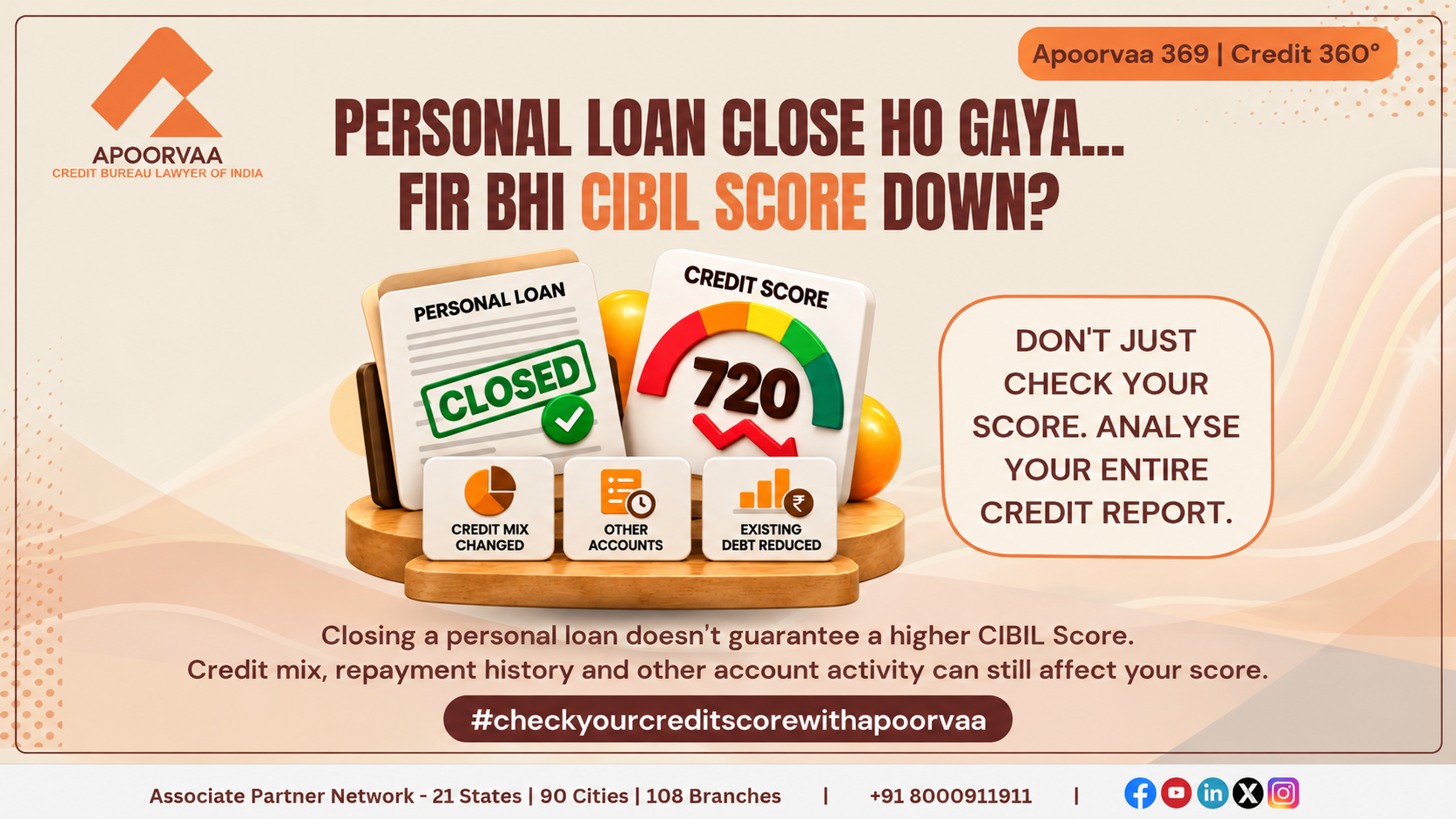
“I have completely repaid my personal loan, so why is my CIBIL Score still decreasing?”
This is a common concern among borrowers who have successfully repaid their personal loans but notice an unexpected decline in their CIBIL Score.
A borrower may complete every EMI, clear the outstanding amount and receive confirmation that the personal loan has been closed. Naturally, they expect their credit score to improve.
But a CIBIL Score dropped after personal loan closure does not necessarily mean that closing the loan caused the decline.
Credit scoring considers the borrower’s overall credit profile, including repayment behaviour, credit utilisation, account information, credit history and recent enquiries.
The important question is not simply whether the personal loan was closed, but what changed across the credit report during the same period.
- Why Did My CIBIL Score Drop After Closing a Personal Loan?
A personal loan is only one component of a consumer’s credit profile.
When that loan closes, its account status and outstanding balance change. At the same time, other loans and credit cards may continue to generate updated information.
For example, consider a borrower who:
- Fully repays a personal loan.
- Has an active credit card with increasing outstanding balances.
- Recently applied for another loan.
- Has a separate credit account reporting a delayed payment.
The score may decline after the personal loan closes, but these other developments may also be relevant.
It would be incorrect to conclude that the loan closure itself caused the score reduction without examining the wider credit profile.
Loan Closure and Score Movement Are Not Automatically a Cause-and-Effect Relationship.
- Does Repaying a Personal Loan Automatically Increase Your CIBIL Score?
No.
Full repayment reduces an existing debt obligation and represents successful completion of the loan, assuming the borrower has satisfied the lender’s requirements.
However, CIBIL Scores are not calculated using a simple formula where every loan closure adds a fixed number of points.
Depending on the overall credit profile, the score may rise, fall or remain relatively stable after closure.
TransUnion CIBIL’s scoring methodology is proprietary. Consequently, the precise contribution of an individual account change to a particular score movement may not be identifiable.
A financially positive action does not guarantee an immediate increase in a credit score.
- What Changes in Your Credit Profile When a Personal Loan Closes?
Loan closure can change several reported account details.
| Credit-profile information | Possible change following full closure |
| Account Status | Active account becomes closed |
| Current Balance | Outstanding amount becomes zero |
| Active Credit Accounts | One fewer active loan account |
| Outstanding Debt | Total reported debt reduces |
| Credit Mix | Composition of active accounts may change |
These changes should not automatically be interpreted as negative.
For example, reducing outstanding debt may improve the borrower’s financial position, even if the credit score does not immediately increase.
Similarly, a closed personal loan can remain visible in the credit report as part of the borrower’s historical credit information.
Closed Loan Visible in CIBIL ≠ Incorrect Reporting.
The relevant issue is whether the account details accurately reflect the loan’s actual repayment and closure position.
- Can Credit Mix Affect Your CIBIL Score After Loan Closure?
Credit mix refers to the combination of credit facilities within a consumer’s profile.
These may include secured loans, unsecured loans and revolving credit facilities such as credit cards.
A personal loan is generally an unsecured instalment loan.
When it closes, the composition of the borrower’s active credit accounts may change.
Credit mix is relevant to credit-profile assessment, but a change in credit mix does not automatically mean the CIBIL Score must decrease.
The overall credit history and other account information remain important.
For example, closing the only active personal loan does not necessarily harm the score merely because fewer active accounts remain.
It would therefore be misleading to advise consumers to retain unnecessary debt simply to preserve a particular credit mix.
- Other Credit Accounts That May Influence Your Score
A declining CIBIL Score after personal loan closure may coincide with changes elsewhere in the credit report.
Credit-Card Utilisation
If outstanding credit-card balances rise substantially relative to sanctioned credit limits, this may affect the borrower’s credit profile.
However, revolving credit-card utilisation should not be confused with the repayment progress of an instalment loan.
Overdue Payments or Repayment Delays
A missed EMI or overdue payment on another credit facility can influence the credit history independently of the closed personal loan.
Recent Credit Enquiries
Applications for new credit facilities may generate enquiries that are relevant to credit assessment.
Newly Reported Accounts
A newly opened loan or credit card may change the composition and characteristics of the overall credit profile.
Updated Information on Existing Facilities
Changes in balances, repayment records and account status may also contribute to the information considered in scoring.
The presence of any one factor does not prove that it caused a specific score reduction.
A complete Credit Report analysis is more informative than examining the closed personal loan in isolation.
- Full Loan Closure vs Settlement: Why the Difference Matters
Full repayment and settlement have different meanings in credit reporting.
Fully Repaid and Closed: The borrower has satisfied the amount due, and the lender has completed the loan closure.
Settled: The lender has accepted an agreed payment arrangement that may involve receiving less than the total amount payable.
A settled account can carry different implications for future credit assessment compared with a fully repaid and closed account.
Therefore, where a borrower believes the personal loan has been completely repaid, the reported account information should accurately reflect the lender’s records.
However, a score decline alone is not evidence that the lender has incorrectly classified the account.
- What If the Bank Has Not Updated Your Personal Loan Closure in CIBIL?
One important distinction is the difference between the date a personal loan is repaid and the date its closure appears in the CIBIL Report.
A borrower may complete the final repayment and receive closure confirmation from the lender, while the latest credit report still reflects an earlier account position.
This does not automatically indicate incorrect reporting.
Understanding RBI’s Credit-Information Reporting Framework
Under the Reserve Bank of India’s fortnightly credit-information reporting framework, effective from 1 January 2025, credit institutions are required to update credit information as of the 15th and last day of each month, or at shorter intervals where agreed.
The framework also prescribes timelines for submission and processing of credit information.
Consequently, three dates are particularly relevant:
- Final Repayment Date: When the borrower completed the payment obligations.
- Lender’s Reporting Date: The date up to which the lender’s account information has been reported.
- Credit Report Date: When the consumer obtained the latest credit report.
These dates help determine whether the report reflects information from before or after the loan closure.
A recently closed loan may still appear active if the relevant update has not yet been reflected.
However, if the lender has confirmed full repayment and closure but the credit report continues to show inaccurate information beyond the applicable reporting timelines, further examination may be appropriate.
A reporting delay is not necessarily a reporting error.
Can a Closed Personal Loan Remain in the CIBIL Report?
Yes.
Closing a loan does not automatically remove its historical account information.
A fully repaid personal loan may continue to appear with its repayment history and closure details.
The mere presence of a closed account should not be confused with an outstanding liability.
The important consideration is whether the reported information accurately represents the account.
- How to Interpret a Falling CIBIL Score After Loan Repayment
A CIBIL Score is a numerical summary derived from credit information. It should not be interpreted without considering the underlying report.
Suppose a borrower observes the following:
| Credit Report | CIBIL Score | Personal Loan Status |
| Earlier Report | 765 | Active |
| Latest Report | 748 | Closed |
<em>Illustrative example only.</em>
The borrower may conclude that closing the personal loan caused a 17-point reduction.
However, the two reports establish only that the score and loan status changed between reporting dates.
They do not establish why the score changed.
Other information may have changed during the same period, including credit-card balances, payment records, new accounts or credit enquiries.
Why Comparing Two Credit Reports Matters
Comparing an earlier report with the latest report can help identify material changes across the borrower’s credit profile.
For example, it may reveal that a personal loan was correctly closed while another account reported an overdue balance.
Alternatively, the comparison may show no obvious account-level discrepancy, despite a lower score.
That does not necessarily mean the report is incorrect.
The precise scoring formula is proprietary, and the exact contribution of each factor to a particular score movement may not be available to consumers or credit-report reviewers.
A report comparison can identify relevant changes, but it cannot always establish the exact mathematical cause of a score decline.
- Ordinary Score Fluctuation vs Genuine Credit-Report Discrepancy
Not every unexpected score movement requires Credit Rectification.
It is important to distinguish between two different situations.
Situation A: Score Declines Despite Accurate Reporting
The personal loan is correctly shown as closed, the outstanding balance is zero, and other account information accurately reflects the lender’s records.
The score nevertheless decreases.
In this situation, the score movement alone does not establish an error.
Situation B: Loan Information Does Not Match the Lender’s Records
The lender has confirmed full repayment and closure, but the credit report continues to show an incorrect outstanding balance, inaccurate account status or another material inconsistency after the relevant reporting period.
This may indicate a genuine reporting discrepancy requiring verification.
| Ordinary score movement | Potential reporting discrepancy |
| Score changes despite accurate account information | Reported details may conflict with lender records |
| No specific inaccurate field identified | A specific account-level inconsistency is identifiable |
| Does not automatically require rectification | May require investigation and correction |
Credit Rectification is concerned with inaccurate credit information, not simply an undesirable score.
- When Does Your Credit Report Need Professional Review?
Professional Credit Report analysis can be useful when a borrower has repaid a personal loan but cannot understand the subsequent changes in their credit profile.
A professional assessment may help evaluate:
- Whether the personal loan’s closure information is consistent with lender records.
- Whether outstanding balances and account status appear accurate.
- Whether other credit facilities contain relevant changes.
- Whether reporting dates explain an apparent delay.
- Whether a genuine discrepancy requires further verification or Credit Rectification.
At Apoorvaa – Credit Bureau Lawyer of India, our approach focuses on examining credit-information accuracy and identifying potential contributing factors within the overall credit profile.
The objective is not to claim that one particular account caused a precise score decrease.
It is to help consumers understand their reported credit information and assess whether corrective action is justified.
Professional analysis cannot guarantee a specific CIBIL Score increase or future loan approval.
Frequently Asked Questions
- Why is my CIBIL Score decreasing even after I fully repaid my personal loan?
Your score considers multiple aspects of your credit profile. Changes in other accounts, credit-card utilisation, repayment records or enquiries may be relevant. The closure itself is not necessarily responsible.
- Does closing a personal loan negatively affect credit mix?
Closing a loan may change the composition of active credit accounts, but that does not automatically mean your score will decrease.
- How long does it take for personal loan closure to appear in CIBIL?
Updates depend on the lender’s reporting cycle and applicable submission and processing timelines. There is no universal guarantee that the change will appear on a particular day after repayment.
- Is a zero-outstanding closed personal loan supposed to disappear from CIBIL?
No. Accurate historical information about a closed loan may remain visible in the credit report.
- Can Apoorvaa guarantee an increase in my CIBIL Score after Credit Rectification?
No. Genuine inaccuracies may be corrected through the applicable process, but a specific score increase cannot be guaranteed.
My Perspective
As a professional working in credit-bureau law and Credit Rectification, I believe one of the most common misunderstandings is the assumption that completing a financial obligation must immediately produce a higher credit score.
Repaying a personal loan and calculating a CIBIL Score are two different processes.
Loan repayment changes the borrower’s financial obligations and account information. Credit scoring evaluates the broader reported credit profile.
When a score decreases after loan closure, the correct question is not simply, “Why did closing my loan reduce my score?”
The more useful question is:
“What changed in my overall credit report, and is that information accurate?”
This distinction helps borrowers avoid confusing normal score movements with genuine credit-reporting discrepancies.
Final Takeaway
If your CIBIL Score dropped after personal loan closure, remember that successful repayment does not guarantee an immediate or continuous score increase.
A declining score may coincide with changes in credit mix, utilisation, repayment information or other credit facilities.
It may also occur without any identifiable reporting error.
LOAN CLOSED ≠ GUARANTEED SCORE INCREASE
A LOWER SCORE DOES NOT AUTOMATICALLY MEAN INCORRECT REPORTING.
UNDERSTAND YOUR COMPLETE CREDIT REPORT, NOT JUST YOUR SCORE.
Has Your CIBIL Score Dropped After Personal Loan Closure?
Have you fully repaid your personal loan but noticed an unexpected decline in your CIBIL Score?
Apoorvaa provides professional Credit Report analysis to help consumers understand account-level information, examine potential reporting discrepancies and assess whether Credit Rectification is appropriate.
Purchase your Credit Report and get it professionally analysed by Apoorvaa.
Call: 8000 911 911
Apoorvaa – Credit Bureau Lawyer of India
Professional Credit Report analysis and Credit Rectification do not guarantee a specific score increase or loan approval.
Related Credit Education