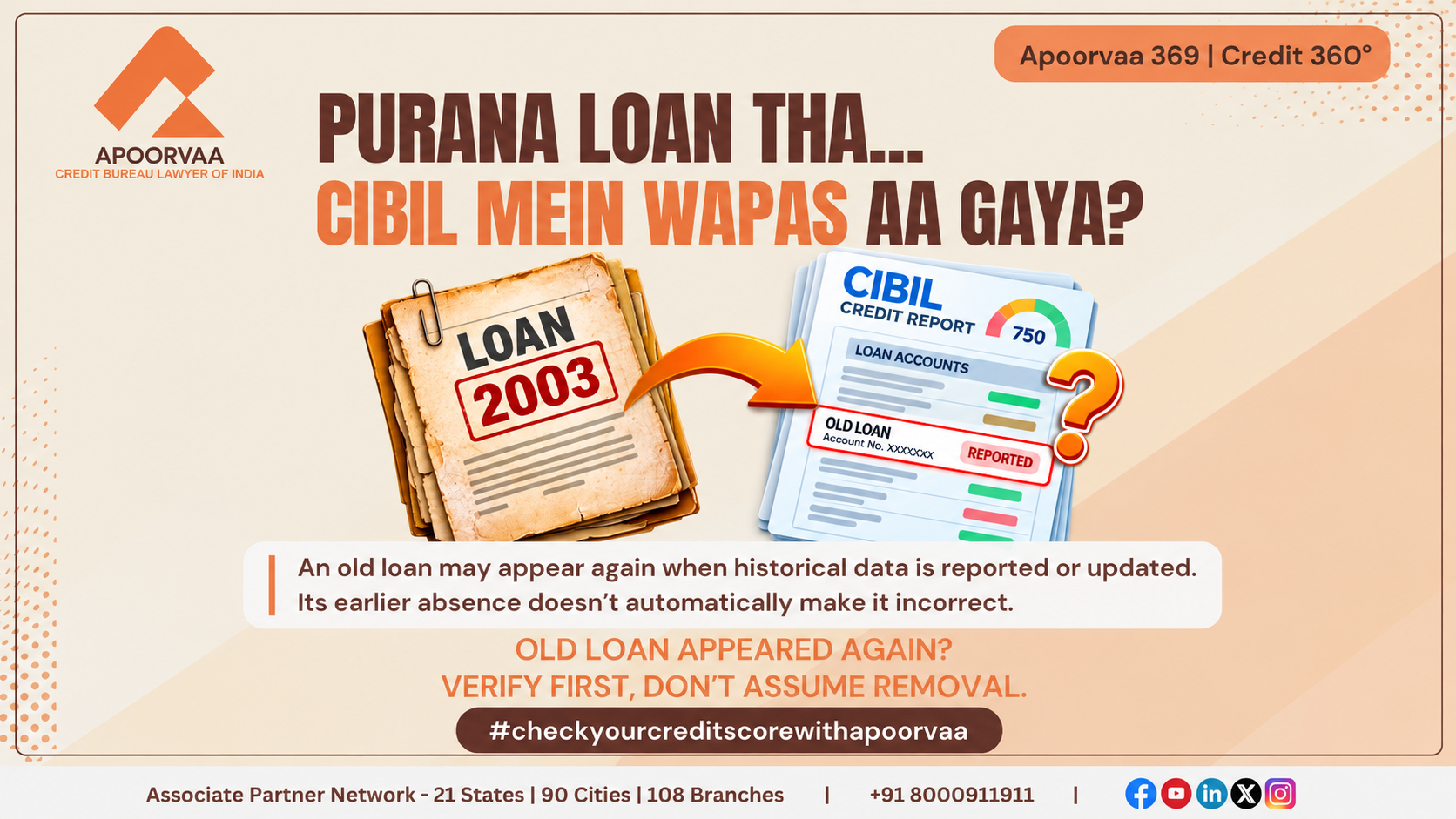
“I took a loan many years ago. It was not appearing in my CIBIL Report earlier, but now it has suddenly appeared. Can I get it removed?”
This situation can be confusing—especially when the loan is 10, 15 or even 20 years old.
A borrower may believe:
“If this loan was missing from my Credit Report for so many years, the lender cannot report it now.”
That should not be assumed.
At the same time, the opposite assumption is also risky:
“If an old loan has appeared in CIBIL, every detail being reported must be correct.”
That should not be assumed either.
When an old loan appears in a CIBIL Report after years, the professional approach is to establish the complete account history and determine whether the information now being reported accurately represents the credit relationship.
The key issue is accuracy—not merely the age of the loan.
Why Can an Old Loan Appear in a CIBIL Report After Years?
Credit Reports contain credit information furnished within India’s credit-information reporting ecosystem by banks, NBFCs and other eligible Credit Institutions.
An old credit relationship does not become fictitious merely because the borrower did not notice it in a previous Credit Report.
Therefore, the previous absence of an account does not, by itself, establish that:
- The loan never existed
- The outstanding amount was automatically waived
- The account was permanently removed
- The borrower has no continuing connection with the loan
- The information can never subsequently appear
- The borrower automatically has a right to deletion
Historical account information may become relevant within the credit-information system.
However, this does not mean that an old account appearing today should be accepted without verification.
The correct question is:
“What exactly is being reported, and is it accurate?”
Old Genuine Loan vs Wrong Loan Reporting: Understand the Difference
This is the first distinction we make when analysing an old loan.
Situation 1: You Recognise the Loan
You recognise:
- The loan type
- Approximate sanctioned amount
- Original lender
- Period when the loan was taken
- Other account details
You may even confirm:
“Yes, this was my loan, but I did not fully repay it.”
In this situation, the age of the loan or its previous absence from your report does not automatically make it a wrong account.
The next step is to understand its present reporting position.
Situation 2: You Do Not Recognise the Loan
You say:
“I never took this loan.”
or:
“These account details have no connection with me.”
Now the issue is different.
This may require examination of account ownership or data attribution.
It should not be treated merely as an old-loan issue.
The distinction matters because:
“My old loan has appeared”
and
“An unknown loan has appeared against my name”
are fundamentally different Credit Report concerns.
What If the Loan Was Unpaid Many Years Ago?
Suppose a borrower confirms:
“I took this loan in 2003, but I did not completely repay it.”
Years later, the account appears in the latest Credit Report.
The borrower may want to dispute it solely because:
“It wasn’t showing earlier.”
But earlier non-visibility alone does not establish that the underlying credit relationship or historical information is inaccurate.
Instead, the account needs to be examined for questions such as:
What amount was originally sanctioned?
How much was repaid?
What happened after payments stopped?
What balance is being reported now?
What account status is being reflected?
Who is currently associated with reporting the account?
Has the financial asset subsequently been transferred or assigned?
This is much more meaningful than attempting to remove the account merely because it is old.
What If the Old Loan Was Already Paid or Closed?
Now consider a different situation.
You recognise the old loan, but your records establish that it was fully paid and closed.
Your latest Credit Report nevertheless shows:
Current Balance remaining
or
Amount Overdue
or an account status that does not correspond with the verified closure position.
Here, the problem is not that an old loan has appeared.
The issue is whether the information currently being reported about that old loan is accurate.
This distinction is extremely important for Credit Rectification.
A genuine loan can still contain inaccurate account-level information.
Therefore:
Genuine account ≠ every reported field is automatically accurate.
Why Can a Different Lender or ARC Name Appear Against an Old Loan?
Sometimes the old loan is recognisable, but the institution appearing in the Credit Report is unfamiliar.
For example:
“I remember taking this loan from a bank, but now another institution is connected with the account.”
Depending on the circumstances, financial assets can be transferred, assigned or acquired by another eligible entity.
In the case of stressed financial assets, an Asset Reconstruction Company (ARC) may also become relevant.
An ARC is a regulated entity that can acquire stressed financial assets from eligible lenders under the applicable regulatory framework.
Therefore, an ARC or another institution appearing in connection with an old loan does not automatically mean:
“This loan is not mine.”
But neither should every unfamiliar lender name automatically be explained as an ARC transfer.
The actual relationship should be established from the account history.
This is why the borrower should distinguish:
“I recognise the loan but not the current institution name”
from:
“I do not recognise this loan at all.”
What Account-Level Information Should Be Examined?
When an old loan appears after years, looking only at the credit score is not enough.
The account itself should be understood.
Relevant information can include:
Credit Institution/Lender Name
Who is currently associated with the account?
Account Type
Does the loan product match the facility you remember?
Date Opened
Does the timeline correspond with the original loan?
Sanctioned/High Credit Amount
Does the amount help identify the facility?
Current Balance
What amount is presently being reflected?
Amount Overdue
Is an overdue being reported?
Account Status
Does the report show Active, Closed, Settled, Written-off or another applicable status?
Repayment History
What payment behaviour is being reflected?
Date Reported/Updated
When was the account information last updated?
These fields help determine whether the report is showing an accurate historical credit relationship or a material account-level discrepancy.
Does an Old Loan Automatically Qualify for CIBIL Removal?
No such conclusion should be drawn merely from the age of the account.
Similarly, filing a dispute should not be understood as an automatic mechanism for deleting a genuine account.
Where information furnished by a Credit Institution is questioned, the accuracy of that information needs to be established.
This means professional Credit Rectification should not begin with:
“How can we remove this old loan?”
It should begin with:
“What is accurate, what is inaccurate, and what does the account history actually establish?”
If the loan genuinely belongs to the borrower and the information is accurate, age alone does not turn it into an error.
But if the ownership, balance, overdue, account status, lender relationship or repayment information is materially inaccurate, that creates a different Credit Report issue.
Why the Complete Account History Matters
An old loan appearing after years can involve several layers:
Original borrowing → repayment history → unpaid/closed position → possible transfer or assignment → present reporting institution → current Credit Report information
Looking at only one field can therefore lead to the wrong conclusion.
At Apoorvaa, the objective of professional account-level analysis is not to search for a shortcut to remove every old account.
The objective is to understand whether the information appearing today accurately represents the borrower’s actual credit relationship.
That distinction protects consumers from two mistakes:
Trying to dispute accurate information simply because it is old
and
accepting inaccurate information simply because the loan itself was genuine.
Old Debt and Credit Report Accuracy Are Two Different Questions
When an old loan appears in a Credit Report, borrowers often focus only on how many years have passed.
But two separate questions need to be understood:
How old is the underlying debt or credit relationship?
and
Is the information currently appearing in the Credit Report accurate?
These should not automatically be treated as the same legal issue.
The age of a loan does not by itself establish that every reference to the account must be removed from a Credit Report.
Similarly, the existence of an old genuine loan does not give anyone a licence to report inaccurate information about it.
Therefore, when analysing an old account, the focus should remain on the accuracy of the information actually being reported.
What If the Old Loan Has Been Transferred or Assigned?
An old credit account may have changed hands after the original borrowing.
Depending on the circumstances and applicable regulatory framework, financial assets may be transferred or assigned to another eligible entity. Stressed financial assets may also be acquired by an Asset Reconstruction Company (ARC).
This can explain why a borrower remembers one institution while another institution later becomes relevant to the account.
However, a transfer or assignment does not mean that every field subsequently appearing in the Credit Report should automatically be assumed correct.
The account may still need to be examined for:
- Current Balance
- Amount Overdue
- Account status
- Repayment history
- Ownership/account attribution
- Relevant reporting information
The transfer explains a possible relationship between institutions.
It does not eliminate the requirement for accurate credit information.
Who Is Responsible for the Information Being Reported?
Credit information operates through an ecosystem involving the Credit Institution and the Credit Information Company.
The relevant Credit Institution furnishes account information within the regulated credit-information framework.
The Credit Information Company—such as TransUnion CIBIL—maintains and presents credit information received within that framework.
Where lender-furnished information is disputed, verification from the concerned Credit Institution may therefore be necessary before that information can be corrected.
This is why simply raising a dispute does not automatically result in deletion.
The objective should be:
Verify the account → establish the accurate information → identify any material discrepancy → determine whether rectification is required.
When Does an Old Loan Require Professional Credit Rectification?
Not every old loan appearing in a Credit Report requires rectification.
Professional examination becomes more relevant when there is a material question about the information being reported.
For example:
You never took the reported loan.
The loan was paid or closed, but an outstanding balance continues to appear.
The reported account status materially conflicts with the verified account position.
The institution currently associated with the account cannot be connected with the original credit relationship.
Repayment history materially differs from available account records.
Account ownership or attribution itself is questionable.
In these situations, the issue is not simply:
“This loan is very old.”
It is:
“There may be materially inaccurate credit information connected with this account.”
That distinction determines whether Credit Rectification is actually relevant.
Can an Old Negative Loan Be Removed Just Because It Affects Your Credit Profile?
Credit Rectification should not be presented as a mechanism for deleting accurate information simply because that information is negative.
If a genuine unpaid or otherwise adverse credit account is accurately reported, the fact that it affects the borrower’s credit profile does not itself make the information incorrect.
Conversely, if the account is genuine but a material field is inaccurate, the borrower should not assume:
“Because the loan was mine, I cannot question anything being reported.”
A genuine loan can still contain an inaccurate balance, status, repayment history or other account information.
Professional analysis therefore focuses on accuracy at the account level, not merely whether the account is positive or negative.
Frequently Asked Questions
- Can a 15- or 20-year-old loan appear in my CIBIL Report?
The age of the loan alone does not establish that information connected with the credit relationship can never appear. The important question is whether the account and the information currently being reported are accurate.
- The loan disappeared earlier and has now come back. Is that automatically a CIBIL error?
No. Previous absence alone does not prove that its present appearance is incorrect. The account history and current reporting information should first be verified.
- What if I never repaid the old loan?
If you recognise the loan, the account should be examined for its actual repayment history, present balance, status and current reporting relationship. Age alone should not be treated as a basis for automatic deletion.
- What if I already paid and closed the loan?
If verified records establish closure but materially inconsistent balance, overdue or status information is being reported, the discrepancy may require further examination.
- Why is an ARC or another lender appearing instead of my original bank?
Depending on the circumstances, a financial asset may have been transferred, assigned or acquired by another eligible entity, including an ARC in applicable stressed-asset situations. The actual account relationship should be established rather than assumed.
- Can Apoorvaa remove every old negative account?
No. Professional Credit Rectification should focus on information that can be established as inaccurate or otherwise requires correction. Accurate negative information should not be represented as automatically removable.
My Perspective
When someone approaches us and says:
“This loan was not showing for 15 years. Now it has suddenly appeared. Please remove it.”
I believe the first step should not be removal.
The first step should be understanding the complete account history.
Was the loan genuinely taken?
Was it paid or left unpaid?
Was it subsequently transferred or assigned?
Who is associated with reporting it today?
And most importantly:
Does the information currently appearing in the Credit Report accurately represent what actually happened?
An old account should neither be disputed merely because it is old nor accepted blindly merely because the original loan was genuine.
The correct approach is account-level verification followed by rectification where a genuine discrepancy can be established.
Final Takeaway
If an old loan suddenly appears in your CIBIL Report after years, don’t focus only on how old the account is.
Focus on whether the information is accurate.
Remember:
Old does not automatically mean wrong.
Previously absent does not automatically mean removable.
A genuine loan does not automatically mean every reported field is correct.
And an unfamiliar lender or ARC name does not automatically mean that the loan is not yours.
The complete credit relationship needs to be understood before deciding whether the account requires Credit Rectification.
Professional Credit Report Assessment & Rectification
Has an old loan suddenly appeared in your CIBIL or another Credit Report?
Is the lender name, Current Balance, overdue, repayment history, account status or ownership information unclear or inconsistent with your records?
Apoorvaa provides professional Credit Report assessment and Credit Rectification for individuals and businesses where account-level credit information requires detailed examination.
📞 8000 911 911
Apoorvaa – Credit Bureau Lawyer of India
Credit Rectification does not guarantee deletion of accurately reported information, an increase in any credit score or future loan approval.
Related Credit Education