
When customers approach us for Credit Rectification, one statement is extremely common:
“Sir, I need to correct my CIBIL.”
Sometimes the bank manager has told them:
“First correct your CIBIL, then we will reconsider the loan.”
Sometimes an old Write-Off, Settlement, overdue amount or another issue is appearing in the credit report.
And sometimes the customer has already worked on the CIBIL Report and believes:
“Now my complete credit problem is resolved.”
But there is an important question that every customer dealing with a serious credit-report issue should understand:
Is correcting only CIBIL enough?
India’s credit-information ecosystem is not limited to CIBIL.
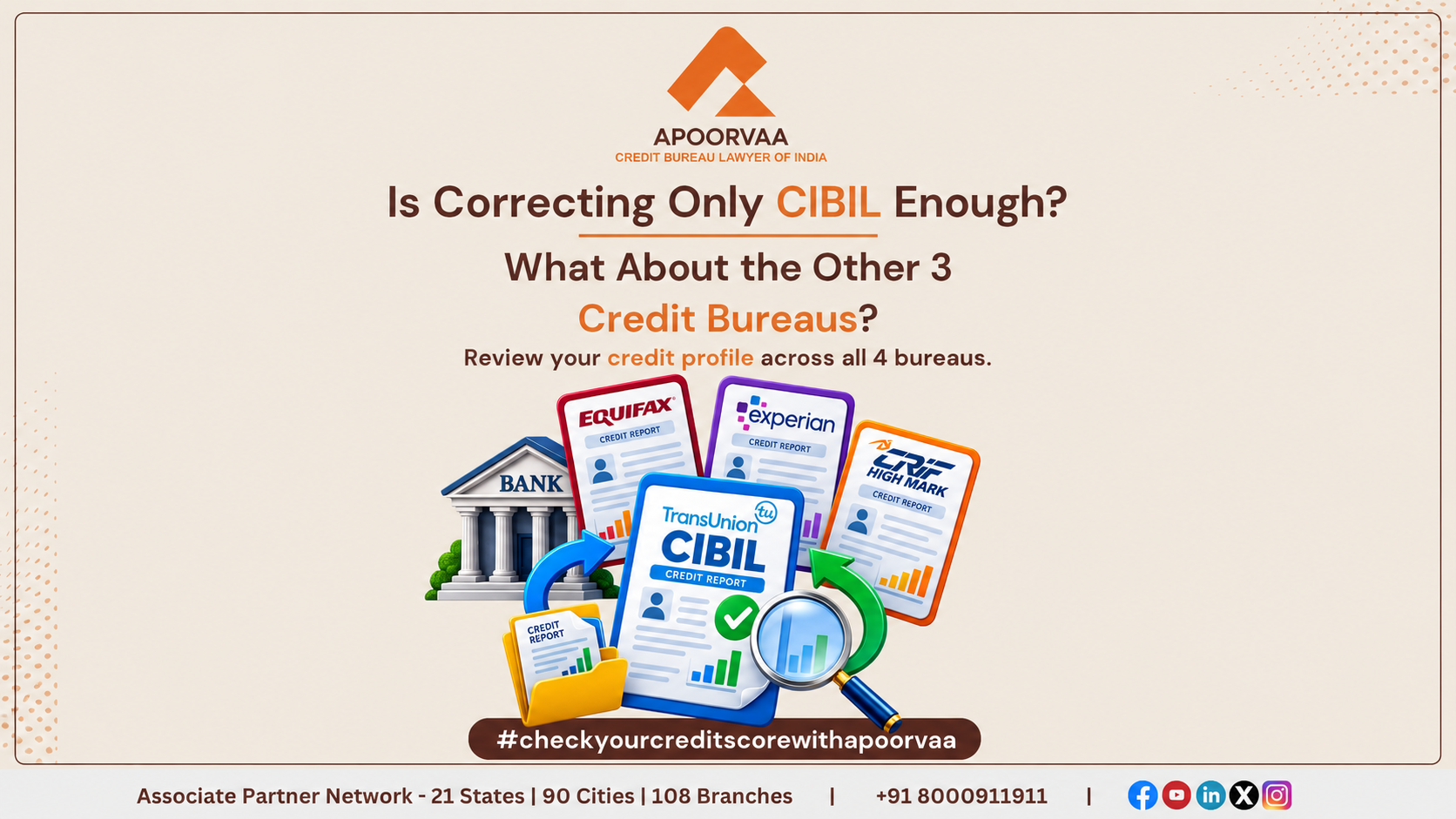
There are four Credit Information Companies operating in India:
TransUnion CIBIL
Equifax
Experian
CRIF High Mark.
Therefore, when dealing with Credit Rectification, customers should understand the difference between correcting one credit report and understanding their overall credit profile across the credit-bureau ecosystem.
Why Do Customers Focus Almost Entirely on CIBIL?
CIBIL has become the most recognised credit-bureau name in India.
Because of this, customers commonly use “CIBIL” to describe almost every credit-related issue:
Low score = CIBIL problem
Write-Off = CIBIL problem
Settlement = CIBIL problem
Loan rejection = CIBIL problem
But technically, CIBIL is one of India’s four Credit Information Companies.
This distinction matters particularly when a customer has an old or complicated credit issue.
If the objective is simply:
“I want today’s bank to reconsider my loan,”
the customer may concentrate only on whatever report that lender has discussed.
But if the objective is:
“I want my overall credit profile to remain healthy for my future financial requirements,”
then the thinking needs to be broader.
One Loan Account Can Be Reported Across the Credit-Bureau Ecosystem
Suppose you took a personal loan from a bank several years ago.
Due to financial difficulties, the account eventually carried a Write-Off-related status.
Today you want to deal with that old issue because you need a new loan.
There is still only:
One customer
One lender
One underlying loan account
But credit institutions operate within India’s broader credit-information reporting framework.
RBI’s framework recognises the four CICs and provides for credit information to form part of the lending and credit-appraisal ecosystem.
Therefore, when an important historical credit account is involved, it can be useful to understand how that account is being reflected across the relevant bureau reports.
“My Bank Asked Me to Correct Only CIBIL”
This is something we hear regularly.
A customer says:
“My bank manager checked CIBIL and told me that once this account is corrected, my loan can move ahead.”
For that particular loan requirement, the customer’s immediate priority is understandable.
But Credit Rectification should also be viewed from a longer-term perspective.
Today you may be applying to one bank.
Six months later, you may approach another lender.
Two years later, you may require:
A home loan
Business finance
Loan against property
Vehicle finance
Working capital
or another credit facility.
Your future lender may be different.
Its internal credit policy may be different.
The type and amount of finance may also be completely different.
Therefore, instead of thinking only:
“Which bureau is today’s bank checking?”
a stronger question is:
“Is my overall credit profile properly understood for my future financial requirements?”
Does Every Bank Check All Four Credit Bureaus?
Not necessarily.
This is an important point because customers frequently misunderstand it.
It would not be correct to say:
“Every bank checks all four bureau reports for every loan.”
RBI material notes that Credit Information Reports are part of the credit-appraisal ecosystem, while individual lenders can have their own credit policies and assessment processes.
So customers should not assume that every lender will follow exactly the same bureau-checking pattern.
But this actually strengthens the case for broader credit awareness.
You may know which report is relevant to your current lender.
You cannot necessarily predict which lender or credit-assessment process will become relevant to you several years from now.
If CIBIL Is Corrected, Are Equifax, Experian and CRIF High Mark Automatically Corrected?
This is one of the most important questions in today’s topic.
A customer may see the required update in the CIBIL Report and conclude:
“My work is completed everywhere.”
That should not automatically be assumed.
TransUnion CIBIL, Equifax, Experian and CRIF High Mark are separate Credit Information Companies.
Therefore, where a significant credit-report issue has been addressed, the customer should understand what is actually being reflected in the relevant reports rather than assuming that one updated report automatically proves the position across all four.
The principle is simple:
Verify rather than assume.
What If CIBIL Is Fine but Another Bureau Shows a Problem?
This is where Credit Rectification can become more complicated than customers initially expect.
Imagine:
CIBIL shows one account position.
But:
Experian or CRIF High Mark appears to show something different.
The immediate reaction may be:
“The other bureau is wrong. Remove it.”
But that is not necessarily the right conclusion.
The difference first needs to be understood.
A different score does not automatically mean an error.
A different report presentation does not automatically mean an error.
And every negative-looking entry is not automatically eligible for correction.
The real question is whether there is a material issue in the underlying credit information that genuinely requires attention.
That distinction is central to professional Credit Rectification.
Why This Matters for Write-Off, Settlement and Old Outstanding Issues
Multi-bureau awareness becomes particularly relevant when customers have significant historical issues such as:
Write-Off
Settled
Post Write-Off Settled
Old Current Balance
Overdue information
Unknown loan accounts
or other complicated credit-report concerns.
For example, suppose a customer had an old Write-Off account.
Years later, the underlying issue has been dealt with and the customer sees the expected change in one bureau report.
The customer should not automatically conclude:
“Everything is now fine everywhere.”
Where the issue was significant, understanding the broader reporting position provides greater clarity about the customer’s overall credit health.
Four Credit Bureaus Do Not Mean Four Separate Bank Liabilities
This is another misconception customers sometimes have.
If the same loan appears in four bureau reports, that does not mean:
Four bureaus = Four separate bank dues.
The underlying financial obligation relates to the concerned lender and account.
The credit bureaus maintain credit information relating to that borrowing relationship.
Therefore, customers need to distinguish between:
The underlying lender/account issue
and
How information relating to that account is being reflected by the credit bureaus.
Understanding this distinction is particularly important when dealing with older Write-Off, Settlement or outstanding-account cases.
Credit Rectification Should Not Mean “Just Increase My CIBIL Score”
Suppose a customer says:
“My CIBIL Score is 680. Please make it 750.”
That is not the right way to understand Credit Rectification.
The score is generated from the customer’s credit information and scoring methodology.
Professional Credit Rectification should therefore focus on the underlying credit-report issue, where one genuinely exists.
The objective should not simply be:
“Make one bureau score higher.”
The better objective is:
“Understand what is affecting my credit profile and whether there is a legitimate issue requiring rectification.”
This becomes even more important when multiple bureau reports are involved.
Credit Reporting Is Becoming More Frequent
India’s credit-reporting framework is becoming increasingly technology-driven and more frequently updated.
As credit information is reported more frequently, customers have greater reason to treat their credit profile as an ongoing financial record, rather than something to examine only when a loan application is rejected.
This also makes verification increasingly important.
When an important account-level issue has been worked upon, the customer’s focus should ultimately be on:
What is actually reflecting in the latest credit information?
—not simply on what someone has verbally told them.
Don’t Wait Until Your Next Loan Becomes Urgent
One pattern we repeatedly see in Credit Rectification is that customers discover old problems only when they urgently require fresh finance.
A home purchase is waiting.
Business funding is required.
A property transaction is approaching.
A loan application has already been submitted.
Only then does an old credit-report issue become urgent.
The account itself may be several years old.
But the customer never examined the broader credit position until the new loan became necessary.
This is why customers with known historical credit issues should consider understanding their credit profile before the next major borrowing requirement becomes urgent.
The Better Question Is Not “Which Bureau Will My Bank Check?”
If you have had a significant credit issue, asking:
“Which bureau does my bank check?”
may help with today’s immediate requirement.
But it is not necessarily the best long-term credit-health question.
A stronger question is:
“Is there any genuine unresolved issue in my overall credit profile that may affect my future borrowing?”
That shifts the customer’s thinking from:
Today’s loan
to
Long-term credit health.
And that is a more sustainable way to approach Credit Rectification.
Why Multi-Bureau Credit Rectification Requires the Right Understanding
When customers hear that India has four credit bureaus, the immediate reaction can be:
“Then I should simply correct the same thing in all four reports.”
But Credit Rectification is not always that simple.
The important question is not merely:
“Which bureau is showing a problem?”
It is:
“What is the underlying credit issue, and how is that issue currently being reflected across the relevant credit reports?”
This distinction matters because different-looking information does not automatically mean incorrect information.
Similarly, an issue appearing in one bureau should not automatically be approached without understanding the actual lender account behind it.
That is why professional Credit Rectification requires analysis before action.
Not Every Difference Across Four Bureaus Is an Error
Suppose a customer downloads reports from:
TransUnion CIBIL
Equifax
Experian
CRIF High Mark
and notices differences.
The scores may not be the same.
The report layouts may be different.
Some information may be presented differently.
The customer may immediately conclude:
“Three reports are wrong because they don’t match my CIBIL Report.”
That would be an incorrect way to assess the situation.
The four bureaus are separate Credit Information Companies, and differences in scoring or presentation can exist.
What deserves greater attention is a material difference in the underlying credit information.
For example, if an important old account appears to carry significantly different information across reports, the customer may need to understand why.
Professional assessment therefore focuses on the substance of the credit issue, rather than simply trying to make four reports look visually identical.
A Good Score in One Bureau Does Not Answer Everything
Another mistake is comparing only scores.
A customer may say:
“My CIBIL Score is good, so why should I check anything else?”
But as we have discussed in our earlier credit-education articles, a score is only one part of a credit profile.
Suppose your score is healthy, but an old account continues to carry a significant negative status.
The better question is not:
“How high is my score?”
It is:
“What does my latest credit information reflect about the account that was creating the problem?”
This becomes particularly important for customers who have previously dealt with:
Write-Off
Settlement
Post Write-Off Settled
Old Current Balance
Overdue
Unknown accounts
or other significant credit-report issues.
Credit Rectification Should Address a Genuine Problem
Customers sometimes believe that professional Credit Rectification means:
“Remove everything negative from my credit reports.”
That is not the right expectation.
A genuine historical repayment issue does not automatically become inaccurate because it is affecting the customer’s present credit profile.
Similarly, an actual outstanding obligation cannot simply be treated as a reporting error because a new loan is required.
On the other hand, there can be situations where the customer has:
Potentially inaccurate information
An account they do not recognise
Information that does not appear consistent with the actual account position
or
A previously addressed issue that still requires further understanding
These situations may justify professional assessment.
The role of Credit Rectification is therefore not to make a report artificially positive.
It is to identify what genuinely requires attention.
Why “Correct CIBIL First, We’ll See the Others Later” May Be Short-Term Thinking
A customer may be under pressure because a loan is already waiting.
Naturally, the immediate reaction is:
“Let us fix whatever this bank is asking for first.”
That may address today’s immediate concern.
But consider what happens after the loan.
Six months later, the customer wants another credit facility.
Two years later, the customer changes banks.
A few years later, the customer needs substantial business funding.
If another unresolved bureau-related issue then becomes relevant, the customer may once again have to deal with an old problem under time pressure.
This is why customers with significant historical credit issues should think about future credit readiness, not merely today’s loan sanction.
Multi-Bureau Credit Health Is About Consistency, Not Identical Scores
The objective should not be to make:
CIBIL Score = Equifax Score = Experian Score = CRIF High Mark Score
That is neither the right expectation nor the purpose of Credit Rectification.
The bureaus can have their own scoring methodologies.
The more important objective is that the customer’s material credit information appropriately reflects the underlying credit position.
That is a much more meaningful definition of multi-bureau credit health.
Why Customers Need to Verify the Result
Suppose a customer has been working on a significant credit-report issue.
Eventually, someone says:
“Your work is completed.”
The customer should be able to ask:
“What is reflecting now?”
Credit Rectification should have an outcome that can be verified.
At Apoorvaa – Credit Bureau Lawyer of India, we believe customers should understand the result of the work performed on their credit profile.
Where an issue involves multiple bureaus, the customer should not simply be left with the statement:
“CIBIL is corrected, so don’t worry about anything else.”
The relevant updated credit information should provide the customer with clarity about the present position.
How Apoorvaa Looks at Multi-Bureau Credit Issues
At Apoorvaa, we do not begin with the assumption that:
Every bureau difference is an error.
Nor do we believe that every customer requires exactly the same Credit Rectification approach.
The first objective is to understand the actual credit-report concern.
A customer with an unknown account may have a very different issue from a customer with an old genuine Write-Off.
A customer whose account information appears inconsistent across bureaus may have a different concern from someone whose genuine bank dues remain unresolved.
Similarly, a customer whose CIBIL Report has already been updated may still want clarity about what is reflecting in the broader credit profile.
The professional value lies in understanding these differences correctly.
Not in applying one standard solution to every credit report.
Why We Encourage Customers to Understand Their Updated Reports
Credit Rectification should not be something that happens completely outside the customer’s understanding.
A customer should know:
What was the original issue?
Which account was creating the concern?
What is the current position?
What is now reflecting in the updated credit information?
Where appropriate, customers should also independently access their reports through the respective official credit-bureau platforms.
At Apoorvaa, we encourage this.
Because a customer who can understand and verify their updated credit profile has much greater clarity than someone who has simply been told:
“Your CIBIL is fixed.”
Don’t Confuse Credit Rectification With Loan Approval
Even if a genuine credit-report issue is appropriately rectified across the relevant bureau reports, one important distinction remains:
Credit Rectification does not guarantee loan approval.
A lender may consider many factors beyond credit-bureau information.
These can include income, repayment capacity, existing liabilities, business or employment profile, security, loan product and the lender’s internal credit policy.
Therefore, professional Credit Rectification should not be sold with a promise such as:
“We will correct all four bureaus and your loan will definitely be approved.”
That would create the wrong expectation.
Credit Rectification deals with legitimate credit-report issues.
Loan sanction remains the lender’s decision.
Weekly Reporting Makes Credit Awareness More Relevant
With credit-information reporting moving to a weekly cycle from July 1, 2026, India’s credit ecosystem is becoming more frequently updated.
For customers, this makes verification and ongoing credit awareness increasingly important.
Rather than thinking about the credit report only when a bank rejects a loan, customers with known historical issues can benefit from understanding their position earlier.
The purpose is not to check four reports every week.
It is to avoid discovering an important unresolved credit issue only when the next loan becomes urgent.
Think Beyond Today’s Bank
A customer’s financial journey can continue for decades.
Today, you may need a ₹5 lakh personal loan.
Later, you may require a home loan.
Your business may eventually require substantial working capital.
You may need a loan against property.
Or your financial requirements may change completely.
It is impossible to know today:
Which lender you will approach
Which credit policy will apply
or
Which credit information will become relevant to that assessment.
This is why the stronger objective is not:
“Make my report suitable for Bank A today.”
It is:
“Maintain a properly understood credit profile for my future financial requirements.”
When Should You Consider Professional Multi-Bureau Assessment?
Professional assessment may become useful when your credit profile involves an issue such as:
- An old Write-Off or Settled-related account
- A significant account appearing differently across bureau reports
- An unknown loan or credit facility
- Old outstanding information that you do not understand
- A previously addressed account that still appears problematic
- Multiple historical credit issues
- A complicated credit profile before an important borrowing requirement
The objective should not be to create unnecessary work across four bureaus.
The objective should be to understand whether a genuine Credit Rectification requirement exists and where professional attention is actually needed.
Frequently Asked Questions
How many credit bureaus are there in India?
India has four Credit Information Companies: TransUnion CIBIL, Equifax, Experian and CRIF High Mark.
Is correcting only my CIBIL Report enough?
It depends on the underlying credit issue. If you have had a significant account-level problem, it can be useful to understand what the relevant information reflects across your broader credit profile rather than assuming that one updated report establishes the position everywhere.
Does every bank check all four credit bureaus?
Not necessarily. Lenders can have different credit-assessment policies and processes.
If CIBIL is corrected, will Experian, Equifax and CRIF High Mark automatically show the same thing?
This should not simply be assumed. Where an important credit issue is involved, the relevant updated information should be verified.
Why are my scores different across the four bureaus?
Different bureaus can use different scoring methodologies. Different scores alone do not necessarily indicate an error.
Does the same loan appearing in four reports mean I owe four different amounts?
No. The underlying credit facility remains with the concerned lender. The bureaus maintain credit information relating to that account.
Does every negative entry need to be removed from all four reports?
No. Genuine historical information should not automatically be treated as inaccurate. A professional assessment should distinguish genuine credit history from a legitimate rectification issue.
Should I check other bureaus if my CIBIL Score is already good?
If you have had a significant historical credit issue, understanding your broader credit profile can provide additional clarity. A good score alone does not necessarily explain every account-level detail.
Can Credit Rectification guarantee my next loan?
No. Credit Rectification can address legitimate credit-report issues. The lender independently decides whether to approve a loan.
A Broader Approach to Credit Rectification
For customers dealing with an important historical credit issue, the goal should not simply be:
“Correct my CIBIL.”
A better objective is:
Understand the underlying account → understand the broader credit-report position → address genuine issues where required → verify what is ultimately reflecting.
This does not mean that every customer needs unnecessary rectification work across four bureaus.
It means that one bureau should not automatically be treated as the customer’s entire credit identity.
At Apoorvaa – Credit Bureau Lawyer of India, our approach is to help customers understand complicated credit-report issues and determine where genuine Credit Rectification may be required.
We believe professional Credit Rectification should be evidence-based, understandable and verifiable—not simply a promise to increase a score or “fix CIBIL.”
Because today’s objective may be one loan.
But the real objective should be a healthier credit profile for your future financial requirements.
Related Credit Education
- Good CIBIL Score but Loan Rejected? Check Your Complete Credit Profile
- CIBIL Rectification? How to Verify Your Report Is Corrected
- CIBIL Problem Not Resolved? Find the Root Cause First
Need Help Understanding Your Credit Profile Across the Four Bureaus?
If you have an old Write-Off, Settlement, outstanding account, unknown loan or another complicated credit-report issue, focusing only on the score may not provide the complete picture.
Apoorvaa – Credit Bureau Lawyer of India assists customers in understanding complex credit-report issues and provides professional Credit Rectification assistance where a genuine rectification requirement exists.
Helpline: +91 8000 911 911