“The loan is mine, but I never took a loan from the lender shown in my CIBIL Report. Is the report wrong?”
This is a situation that can immediately create doubt.
You remember taking a loan from one bank or financial institution.
But when you check your CIBIL Report today, the credit account appears with the name of another institution.
You may think:
“I never took any loan from this lender. Why is its name appearing against my account?”
The answer requires careful examination.
A different lender name does not automatically mean that your CIBIL Report is wrong.
Loan exposures can, depending on the circumstances, be transferred or assigned between eligible entities. Financial institutions may also undergo mergers or acquisitions. In the case of certain stressed financial assets, the exposure may be transferred to an Asset Reconstruction Company (ARC) under the applicable regulatory framework.
As a result, the institution currently connected with an old credit account may sometimes be different from the institution that originally sanctioned the loan.
However, this should not be interpreted in the opposite direction either.
The fact that loan transfers are possible does not mean every unfamiliar lender appearing in a Credit Report is automatically correct.
The complete account relationship needs to be established.
- Why Can a Different Lender Appear in Your CIBIL Report?
The lender from whom you originally received the loan and the institution subsequently connected with that credit exposure may not always remain the same.
India’s regulatory framework recognises the transfer of loan exposures between eligible entities.
Depending on the circumstances, this may involve:
- Transfer or assignment of a loan exposure
- Sale or transfer of a loan portfolio
- Merger or acquisition involving financial institutions
- Transfer of eligible stressed financial assets
- Acquisition of a stressed financial asset by an ARC
These are not all the same transaction.
They have different legal and regulatory implications.
But from a consumer’s perspective, they help explain an important point:
The name you remember from the original loan agreement may not necessarily be the only institution that later becomes relevant to that account.
Therefore, lender-name mismatch should trigger verification, not an automatic conclusion of incorrect reporting.
- What Does Loan Transfer or Assignment Mean?
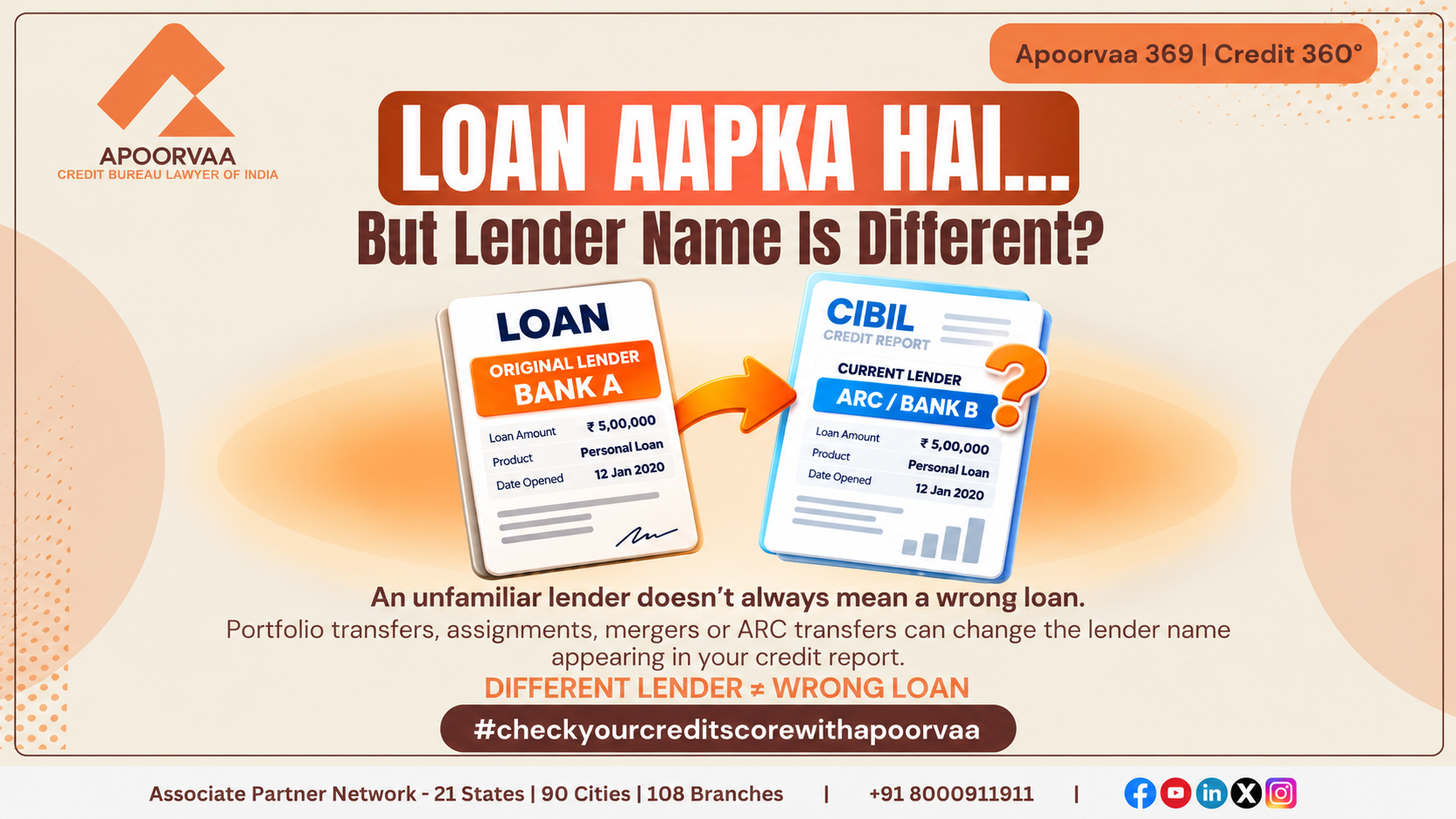
Consider a simple example.
You obtained a loan from:
Bank A
Bank A originally sanctioned and disbursed the credit facility.
Later, subject to the applicable legal and regulatory framework, the relevant loan exposure is transferred to another eligible institution.
You did not apply for a fresh loan from the subsequent institution.
You did not receive a second disbursement.
But the institution connected with the credit exposure has changed.
This is why the statement:
“I never took a loan from this institution”
does not always answer the real question.
The better question is:
“Did this institution subsequently acquire or otherwise become legitimately connected with the loan that I originally took?”
That distinction is fundamental when analysing a different lender in a CIBIL Report.
- What Is an Asset Reconstruction Company (ARC)?
An Asset Reconstruction Company, commonly known as an ARC, is an entity registered with the Reserve Bank of India under the applicable SARFAESI framework to carry on securitisation or asset reconstruction business.
In practical terms, ARCs play a role in acquiring and resolving stressed financial assets.
Suppose a borrower originally obtained a loan from a bank.
The account subsequently became stressed.
Subject to the applicable regulatory framework, the relevant financial asset may later be transferred to an ARC.
The borrower may never have approached that ARC for a fresh loan.
Nevertheless, the ARC can subsequently have a legitimate relationship with the existing credit exposure.
This distinction is important because consumers sometimes see an ARC’s name and immediately say:
“I never took any loan from this company, so this account is not mine.”
That conclusion may be premature.
The ARC may not be the original lender, but it may be connected with the subsequently acquired financial asset.
- Why Can an ARC Name Appear Against an Old Loan?
RBI’s regulatory framework specifically brings ARCs within the credit-information reporting ecosystem.
ARCs are required to become members of Credit Information Companies and furnish requisite credit information.
This is significant because a borrower’s credit history does not simply disappear when an eligible stressed loan is transferred from the original lending institution to an ARC.
Therefore, when an ARC legitimately acquires a financial asset, its name may become relevant to the subsequent credit-information reporting associated with that exposure.
But remember:
ARC appearing in the report does not automatically mean every old loan was transferred to an ARC.
And:
Different lender name does not automatically mean ARC transfer.
The actual transaction and account history should establish what occurred.
- Does a Different Lender Name Mean the CIBIL Report Is Wrong?
Not necessarily.
The lender name should not be examined in isolation.
Suppose you see an unfamiliar institution against an account.
Before concluding that it is a wrong loan, compare the other material account information with the loan you actually remember.
Loan/Product Type
Was the original facility a personal loan, home loan, business loan, vehicle loan, credit card or another type of credit?
Does the reported product broadly correspond?
Date Opened
Does the account-opening date correspond with the period when you obtained the original credit facility?
Sanctioned/High Credit Amount
Does the amount correspond with the credit facility you remember?
Current Balance
What balance is currently being reported?
Does it correspond with your understanding of the account, or does it require further verification?
Amount Overdue
Is an overdue amount being reported?
If yes, does the underlying account history support it?
Account Status
What is the current reported position of the account?
Ownership and Other Account Information
Does the remaining information establish that the account is connected with you?
The objective is not to find one matching field and immediately accept the entire account.
Instead, the relevant fields should be considered together to understand whether the reported account corresponds with the credit facility you recognise.
- Loan Transfer vs Wrong Loan Reporting: How Are They Different?
This distinction should be made before any Credit Rectification action is considered.
Situation 1: “The loan is mine, but I don’t recognise the lender.”
You recognise the loan.
The product corresponds.
The amount broadly corresponds.
The opening date makes sense.
But another institution’s name now appears.
Here, the first issue is:
Can the current institution be connected with the original credit facility through a legitimate subsequent transaction or institutional change?
Situation 2: “I never took this loan.”
Now imagine that you do not recognise:
the lender,
the loan product,
the amount,
the opening date,
or the underlying borrowing relationship.
That is not simply a lender-name issue.
It may involve an account ownership concern requiring separate verification.
This is why these statements should never be treated as interchangeable:
“I don’t recognise this lender.”
and
“I don’t recognise this loan.”
From a Credit Report analysis perspective, they can represent two very different problems.
- Can a Merger or Acquisition Also Change the Lender Name?
Yes, institutional changes can also be relevant.
Banks and other financial institutions may undergo mergers, amalgamations, acquisitions or restructuring.
As a result, a borrower may remember the name that existed when the loan was originally sanctioned while encountering a different institutional name years later.
This is another reason why the original lender name should not be the only test used to determine whether an account belongs to a consumer.
At the same time, the existence of mergers and acquisitions should not become a generic explanation for every unfamiliar lender.
If that is believed to be the reason for the name difference, the actual institutional relationship should support it.
Do not assume the transaction. Establish it.
- Does a Valid Loan Transfer Mean All Account Information Is Correct?
No.
This is one of the most important points in professional Credit Report analysis.
Suppose it is established that Bank A legitimately transferred the relevant exposure to another eligible institution.
That may explain why the new institution’s name appears.
But it does not automatically establish that:
the Current Balance is correct,
the Amount Overdue is correct,
the account status is correct,
the ownership information is correct,
or every other reported field is accurate.
These are separate questions.
For example:
The lender relationship may be correct, but the balance may require verification.
Or:
The transfer may be legitimate, but the account status may not correspond with the underlying records.
Therefore:
A legitimate lender change explains the lender relationship. It does not automatically validate every field in the account.
This is why Apoorvaa’s approach to Credit Report assessment focuses on account-level analysis, not merely the name of the institution appearing in the report.
- What If the Original Lender and Another Institution Both Appear?
Consumers can also become concerned when apparently related credit information appears under more than one institution.
The immediate reaction may be:
“One loan is showing twice.”
Again, that should not be concluded only from the similarity of the entries.
The accounts should be compared using relevant information such as:
- Opening date
- Product type
- Sanctioned/high credit amount
- Account status
- Current Balance
- Relevant ownership information
- Other account identifiers available in the report
There may be a legitimate explanation connected with the history of the exposure.
Alternatively, there may be an inconsistency requiring further examination.
The important point is:
Do not count accounts only by lender names. Understand the relationship between the reported accounts.
- Who Is Responsible for Reporting After the Loan Changes Hands?
Credit reporting involves more than one participant.
The original lender may have originated the loan.
A subsequent assignee, acquiring institution or ARC, depending on the transaction, may later become relevant to the credit exposure and its reporting.
The Credit Information Company, such as TransUnion CIBIL, receives and processes credit information within the regulated credit-information framework.
RBI requires Credit Institutions to take steps to ensure that credit information furnished by them is updated, accurate and complete.
The current regulatory framework also requires credit information to be updated on a fortnightly basis—as on the 15th and last day of every month—or at shorter mutually agreed intervals.
Therefore, when a lender name changes, professional analysis should not begin by automatically blaming one participant.
It should establish:
Who originated the loan?
Did the exposure subsequently move?
Who is currently connected with the exposure?
Which institution is furnishing the relevant information?
Does the reported account information correspond with the underlying records?
Only then can we determine whether the unfamiliar lender name has a legitimate explanation or whether there is an actual Credit Report discrepancy.
- What If You Cannot Establish Any Connection With the New Lender?
This is where an unfamiliar lender name can move from a simple explanation issue to a potential Credit Report discrepancy.
Suppose you recognise the original loan.
You remember the original lender, loan product, sanctioned amount and approximate opening date.
But another institution now appears in connection with the account, and you cannot establish how that institution became connected with your loan.
In such a situation, the lender name should not simply be accepted.
The relevant account history needs to establish whether there was:
- A transfer or assignment of the loan exposure
- A merger, acquisition or institutional change
- A transfer of a stressed financial asset to an ARC
- Another legitimate change in the creditor/account relationship
- Or an actual reporting inconsistency
The important principle is:
An unfamiliar lender does not automatically prove an error—but a lender relationship that cannot be established should not simply be ignored either.
This is where detailed account-level examination becomes important.
- What If You Recognise the Lender Change but Other Account Details Are Wrong?
Consider another situation.
You establish that your old loan was legitimately transferred to another institution.
So the new lender name makes sense.
But the Credit Report shows a Current Balance that does not correspond with your records.
Or perhaps the account status, Amount Overdue, ownership information or another field appears inconsistent.
The fact that the lender relationship is legitimate does not resolve these separate discrepancies.
Each material field needs to stand on its own accuracy.
This means Credit Report analysis should separate two questions:
Question 1: Is the institution legitimately connected with this loan?
Question 2: Is the information being reported for the loan accurate?
The answer to the first question can be yes, while the answer to the second may still require verification.
That distinction prevents a consumer from either wrongly disputing a legitimate lender or overlooking another genuine reporting problem.
- What If the Same Loan Appears Under Two Different Lenders?
This situation can create immediate concern.
A consumer sees an account under the original lender and another apparently similar account under a subsequent institution.
The first thought may be:
“My one loan has become two loans in CIBIL.”
But two entries should not automatically be classified as duplicate reporting merely because they appear related.
The accounts should first be compared.
Important information may include:
Date opened: Are the dates identical or related?
Loan/product type: Do both entries describe the same type of credit facility?
Sanctioned/high credit amount: Are the amounts consistent?
Current Balance: What is being reported against each entry?
Account status: Is one account shown as closed, transferred or otherwise differently reported?
Reporting institution: Can the relationship between the two institutions be established?
Other relevant account identifiers: Do they help connect or distinguish the accounts?
Only after comparing the relevant information should the consumer conclude whether the entries represent legitimate reporting connected with the account’s history or a potential duplication/inconsistency.
Two lender names do not automatically mean two loans—and they do not automatically mean correct reporting either.
Verification comes first.
- Who Should Correct the Information If It Is Actually Wrong?
Once a genuine discrepancy is identified, the next question is:
“Who will correct it—the lender or CIBIL?”
The answer requires understanding the roles of both participants.
Role of the Credit Institution
Credit Institutions furnish credit information to Credit Information Companies.
RBI’s credit-information framework requires Credit Institutions to take necessary steps to ensure that the credit information furnished by them is updated, accurate and complete.
If the information requiring correction originates from the records or reporting of the concerned Credit Institution, that institution’s verification becomes important.
Role of the Credit Information Company
TransUnion CIBIL operates as a Credit Information Company and provides a dispute mechanism for consumers who find inaccurate information in their Credit Reports.
Where lender-furnished information is disputed, the concerned institution may need to verify the information before it is modified.
Therefore, it is too simplistic to say:
“CIBIL will correct everything.”
It is equally simplistic to say:
“CIBIL has absolutely no role; only the bank can do anything.”
Credit Rectification operates within a connected Credit Institution–Credit Information Company framework.
The source and nature of the disputed information determine what verification is required.
- Should You Raise an Ownership Dispute Just Because the Lender Name Is Different?
Not necessarily.
This is a particularly important distinction.
TransUnion CIBIL’s dispute framework distinguishes an ownership dispute—where a consumer states that a particular account does not belong to them—from disputes concerning information within an account.
Suppose you clearly recognise the loan.
You remember taking it.
The loan amount corresponds.
The product corresponds.
The opening date corresponds.
And you subsequently establish that the institution now appearing in the report legitimately acquired or became connected with that loan.
In that situation, saying:
“This account does not belong to me”
may not accurately describe the problem.
If another account field is wrong, that specific discrepancy should be identified.
On the other hand, if you genuinely do not recognise the underlying loan relationship at all, account ownership becomes a different concern.
Credit Rectification should address the actual discrepancy—not simply the field that initially looks unfamiliar.
- What Is the Current RBI Timeline for Credit Information Rectification?
Where credit information genuinely requires updation or rectification, RBI has established a complaint-resolution and compensation framework.
Under the applicable framework, an eligible complaint concerning updation or rectification of credit information should be resolved within an overall period of 30 calendar days from the date of initial filing.
Within this overall period, the concerned Credit Institution gets 21 calendar days to send updated credit information to the Credit Information Company after being informed of the inaccuracy.
This leaves the Credit Information Company with the remaining period within the overall 30-calendar-day framework.
RBI also provides for compensation of ₹100 per calendar day where an eligible complaint remains unresolved beyond the prescribed period, subject to the applicable conditions and exclusions.
However, this should not be misunderstood.
Seeing an unfamiliar lender does not automatically create a valid rectification claim.
First, it must be established whether the information is actually inaccurate.
A legitimate transfer does not become an error merely because the borrower did not know about the subsequent lender relationship.
- Why Documentary Verification Matters
A Credit Report gives you the reported information.
But determining whether that information is accurate may require comparison with underlying records.
Depending on the nature of the issue, relevant records may help establish:
- The original credit facility
- Original lender
- Loan/product type
- Sanctioned amount
- Account opening date
- Subsequent account history
- Transfer or assignment relationship
- Current creditor/reporting institution
- Payments and balances
- Closure or settlement information, where applicable
The objective is not to submit every document available.
It is to establish the factual relationship between:
the loan you originally took,
the institution currently appearing,
and
the information presently reported in the Credit Report.
That is especially important where the consumer recognises the loan but does not recognise the lender.
- Can You Ask for the Account to Be Deleted Because the Lender Is Unfamiliar?
An unfamiliar lender name by itself is not a basis to promise deletion of the account.
If the loan genuinely belongs to the consumer and the current institution has a legitimate connection with that credit exposure, the account does not become incorrect merely because the institution’s name is unfamiliar.
Similarly, Credit Rectification should not be promoted as:
“We will remove the lender you don’t recognise.”
The correct question is:
Is the information accurate?
If the lender relationship is legitimate, it should be understood.
If a particular field is inaccurate, that field should be examined.
If the entire account does not belong to the consumer, that becomes a separate ownership issue.
And if the relationship between the loan and the current institution cannot be established, further investigation may be appropriate.
The objective of Credit Rectification is accuracy—not deletion for the sake of deletion.
- Why Checking Only the Lender Name Can Lead to the Wrong Conclusion
A Credit Report is an interconnected record.
Looking at only one field can sometimes create a misleading impression.
For example:
Lender name: unfamiliar.
But:
Product: matches your old personal loan.
Date opened: matches.
Sanctioned amount: matches.
Account history: appears connected with your known facility.
That combination should prompt investigation into the lender relationship.
Now consider another example:
Lender: unfamiliar.
Product: unfamiliar.
Opening date: does not correspond with your borrowing history.
Amount: completely unknown.
Account relationship: cannot be established.
That deserves a different type of examination.
This is why professional Credit Report analysis is not simply a process of searching for unfamiliar words.
Context matters.
- Why Professional Account-Level Credit Report Analysis Matters
A consumer may look at a report and say:
“Wrong lender.”
But that phrase can describe several completely different situations.
The lender may have changed legitimately.
An ARC may have acquired a stressed financial asset.
The original institution may have merged or undergone another institutional change.
The lender relationship may be valid, while another account field is inaccurate.
Two apparently similar entries may require examination to determine whether they reflect account history or actual duplication.
Or the institution may have no established relationship with the consumer’s known loan at all.
Each situation requires a different analysis.
At Apoorvaa – Credit Bureau Lawyer of India, professional Credit Report assessment focuses on understanding the complete account-level position before determining whether Credit Rectification is required.
The objective is not simply to find something unfamiliar.
The objective is to determine:
What is being reported?
Which loan does it relate to?
Who originally granted the credit facility?
Who is currently connected with it?
Can that relationship be established?
And does the reported information correspond with the verified account history?
That is how a legitimate lender change can be separated from a genuine Credit Report discrepancy.
Frequently Asked Questions
- Loan is mine but lender name is different in CIBIL Report. Is it an error?
Not automatically. Loan transfers, assignments, mergers, acquisitions or transfers of eligible stressed assets to ARCs can result in another institution becoming relevant to an existing loan. The account relationship should be verified first.
- Why does my CIBIL Report show an ARC when I never borrowed from it?
An ARC may have subsequently acquired the relevant stressed financial asset from an eligible lender. You may therefore not have taken a fresh loan directly from the ARC even though it later became connected with your existing loan.
- What is an ARC?
An Asset Reconstruction Company is an RBI-registered company operating under the applicable SARFAESI framework for securitisation and asset reconstruction activities, including acquisition and resolution of stressed financial assets.
- Does an ARC appearing mean my loan has been waived?
No. Transfer of a financial asset to an ARC should not be confused with waiver of the borrower’s underlying obligation.
- What should I compare when the lender name is unfamiliar?
Review the loan/product type, date opened, sanctioned/high credit amount, account status, Current Balance, Amount Overdue, ownership and other relevant account information.
- What if I don’t recognise the loan at all?
That is different from recognising the loan but not the lender. If the underlying credit facility itself is unknown, the ownership of the account may require verification.
- Can the lender name be different because of a merger?
Yes. Mergers, acquisitions and other institutional changes can sometimes explain why the name associated with an older credit relationship changes. The specific institutional history should still be verified.
- If the loan transfer is genuine, can the Current Balance still be wrong?
Yes. A legitimate lender relationship does not automatically establish the accuracy of every other account field.
- Can I get an unfamiliar lender account deleted from CIBIL?
An unfamiliar lender name alone does not justify deletion. First determine whether the institution has a legitimate relationship with the loan and whether any reported information is actually inaccurate.
- How long does rectification take if the information is genuinely wrong?
RBI’s applicable framework provides an overall 30-calendar-day period for resolution of eligible complaints concerning updation or rectification of credit information, subject to the framework’s requirements.
My Perspective
A borrower remembers the institution that gave the loan.
That is natural.
But years later, the institution relevant to that credit exposure may not always be the same.
Loan exposures can move.
Stressed financial assets can be transferred to ARCs.
Financial institutions can merge or be acquired.
So when a consumer tells me:
“This loan is mine, but I never took a loan from the lender shown in my CIBIL Report,”
my first question is not:
“How do we delete it?”
The first question should be:
“Why is this institution appearing?”
If there is a legitimate connection with the original loan, understand it.
Then check whether the remaining account information is accurate.
If no relationship can be established, investigate further.
And if information is genuinely inaccurate, pursue appropriate Credit Rectification based on the verified account position.
Credit Rectification should begin with understanding the data—not with assuming that everything unfamiliar is wrong.
Final Takeaway
Loan Is Yours but Lender Name Is Different in CIBIL Report?
Don’t conclude that the account is wrong merely because you don’t recognise the lender.
First check whether the institution can be connected with your original loan through a transfer, assignment, merger, acquisition, ARC transaction or another legitimate development.
Then review the complete account.
Remember:
“I recognise the loan but not the lender”
is different from:
“I don’t recognise this loan at all.”
And even if the lender change is legitimate, every other account detail is not automatically correct.
Different lender name ≠ automatically wrong loan.
Verify the complete credit relationship before reaching a conclusion.
Professional Credit Report Assessment & Rectification
Loan is yours, but the lender name in your Credit Report looks unfamiliar?
Or do the lender, Current Balance, account status, ownership or other account details appear inconsistent?
Apoorvaa provides professional Credit Report assessment and Credit Rectification services for individuals and businesses where credit information requires detailed account-level examination.
📞 8000 911 911
Apoorvaa – Credit Bureau Lawyer of India
Credit Rectification does not guarantee deletion of accurately reported information, an increase in the CIBIL Score or future loan approval.
Related Credit Education