
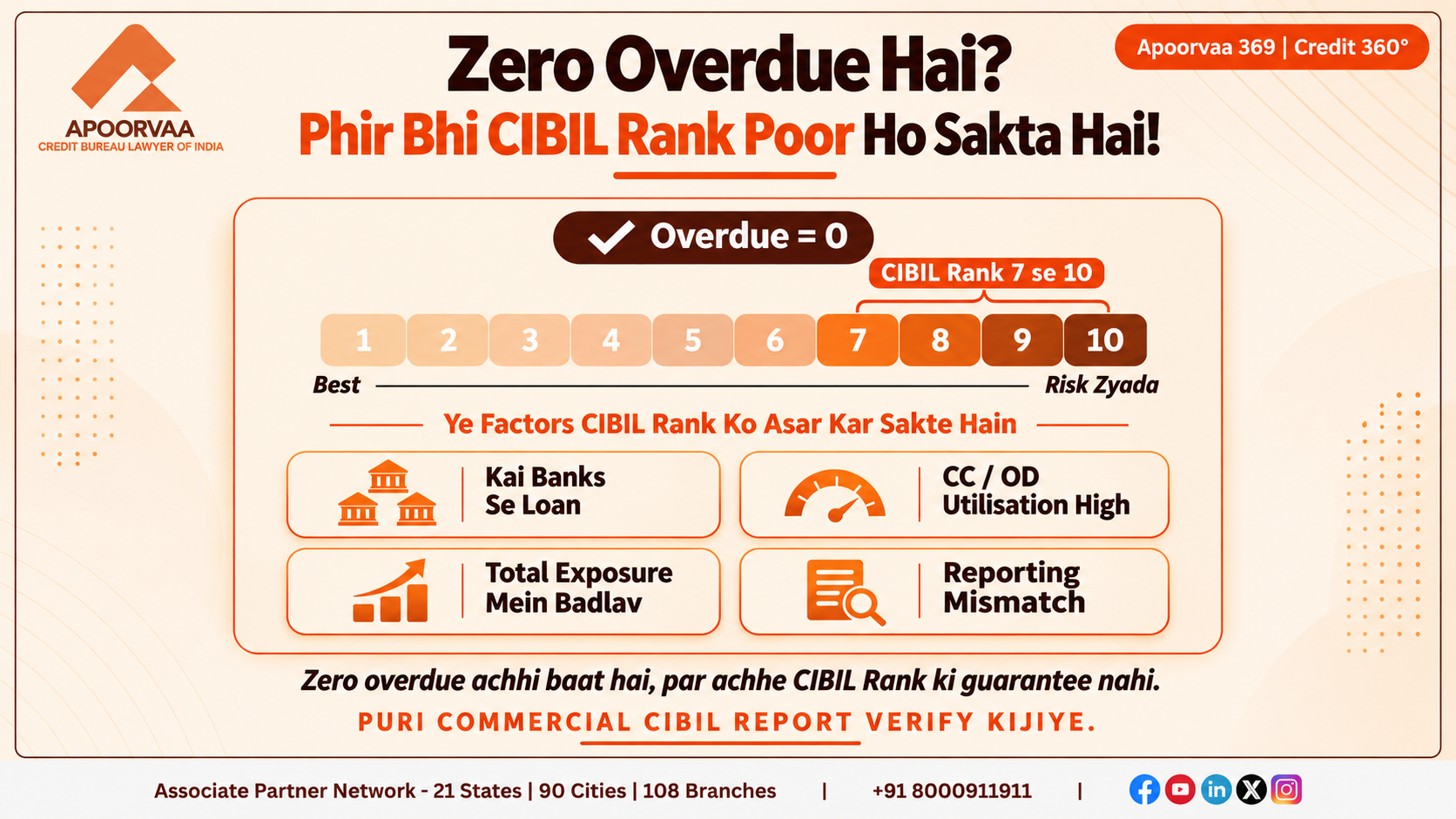
“My company has no overdue payments, so why is its CIBIL Rank still 7?”
This is a common concern among MSME owners, entrepreneurs and company directors who regularly service their business loans but discover that their company’s CIBIL MSME Rank is 7.
The business may have no overdue amount, no currently unpaid EMI and no apparent repayment problem. Yet the Commercial Credit Report shows a Rank considerably different from the Rank 1, 2 or 3 that the owner expected.
Does this mean the credit bureau has made a mistake?
Not necessarily.
Zero overdue does not automatically mean low commercial credit risk.
A company’s CIBIL Rank is a broader credit-risk indicator. Its assessment is not limited to whether an overdue amount appears in the report today.
Working-capital utilisation, past repayment behaviour, borrowing exposure and other reported credit characteristics can be relevant to understanding the company’s commercial credit profile.
For MSMEs seeking business loans, cash-credit renewals or additional working capital, this distinction is important.
- Why Is My Company’s CIBIL Rank 7 Despite Zero Overdue?
A company can have zero current overdue and still receive CIBIL Rank 7 because the Rank represents an assessment of commercial credit risk rather than a simple overdue calculation.
The current overdue amount tells us whether an unpaid obligation is reported at a particular point in time.
It does not independently explain the company’s overall borrowing position.
Consider two businesses.
Company A operates a few credit facilities with relatively moderate outstanding balances and an established repayment history.
Company B has no current overdue but operates several heavily utilised working-capital facilities, has recently increased its borrowing exposure and has historical repayment irregularities.
Both companies may show zero overdue.
However, their broader credit profiles are different.
This example illustrates why current overdue alone is insufficient to interpret commercial credit risk. It does not establish what Rank either company would receive.
TransUnion CIBIL’s detailed commercial ranking methodology is proprietary. Therefore, no single field or combination of visible fields should be presented as the confirmed explanation for Rank 7 without appropriate evidence.
- What Does CIBIL Rank 7 Mean for a Business?
The CIBIL MSME Rank, commonly known as CMR, is a commercial credit-risk indicator provided by TransUnion CIBIL for eligible MSMEs.
The Rank ranges from 1 to 10.
- CMR-1 represents the lowest relative credit risk.
- CMR-10 represents the highest relative credit risk.
- CMR-7 indicates a relatively higher assessed credit risk than lower-numbered Ranks.
A CIBIL Rank of 7 does not automatically mean that a company has an active default, an incorrect credit report or an unpaid EMI.
It also does not automatically establish that the company’s loan application will be rejected.
Banks and financial institutions may consider the Commercial Credit Report alongside financial statements, cash flows, repayment capacity, security, existing liabilities and internal lending policies.
Similarly, CMR-1, CMR-2 or CMR-3 does not guarantee loan approval or better interest rates.
CIBIL Rank vs Current Overdue: Understanding the Difference
| Particulars | Current Overdue | CIBIL MSME Rank |
| What it represents | Reported unpaid amount at a given point | Broader commercial credit-risk indicator |
| Main focus | Current payment obligation | Overall assessed commercial credit risk |
| Can it be zero? | Yes | Not applicable; Rank uses a 1–10 scale |
| Does zero overdue guarantee CMR-1? | No | No |
| Can historical repayment information matter? | Not explained by the current overdue field alone | May be relevant to the broader assessment |
| Can incorrect reporting require investigation? | Yes | Underlying credit information may require verification |
Understanding these differences helps business owners avoid treating a single overdue field as a complete measure of their company’s credit health.
- Does Zero Overdue Guarantee CIBIL Rank 1, 2 or 3?
No.
A zero overdue amount is generally a positive indicator of the company’s current reported repayment position.
However, commercial credit-risk assessment is not based exclusively on the absence of overdue amounts.
A company’s Commercial Credit Report may include information concerning:
- Term loans and business loans.
- Cash-credit and overdraft facilities.
- Outstanding balances and sanctioned limits.
- Repayment history.
- Historical overdue information and DPD.
- Account statuses.
- Changes in total borrowing exposure.
- Other relevant commercial credit information.
These details help describe the company’s credit profile.
For example, a business may have cleared a previously overdue instalment.
Its current overdue amount may now be zero, while its historical repayment record continues to reflect the earlier delay.
Another business may have no repayment delays but use almost its entire available working-capital limit.
Neither situation automatically determines a particular CIBIL Rank.
The important point is that zero overdue and low commercial credit risk are not identical concepts.
- How Can Working-Capital Utilisation Affect Commercial Credit Assessment?
Working-capital facilities are important for MSMEs because they help finance inventory, receivables and day-to-day operating requirements.
Cash credit and overdraft are common examples.
However, the level of utilisation can provide information about how extensively a company relies on its available borrowing facilities.
Example: High Cash-Credit Utilisation With Zero Overdue
Consider a manufacturing company with the following facility:
| Particulars | Amount |
| Sanctioned Cash-Credit Limit | ₹1,00,00,000 |
| Outstanding Balance | ₹95,00,000 |
| Utilisation | 95% |
| Current Reported Overdue | ₹0 |
The company may be servicing its interest obligations regularly.
Its account may also be operating within the sanctioned limit.
Nevertheless, the facility shows substantial utilisation of available credit.
Sustained high utilisation can be relevant to commercial credit assessment because it may indicate limited unused borrowing capacity.
However, utilisation alone cannot establish the company’s complete financial position or explain its exact CIBIL Rank.
What About Overdraft and Other Revolving Facilities?
The same principle can apply to overdraft and other revolving working-capital facilities.
Where a company maintains substantial outstanding balances across multiple facilities, the overall borrowing position may deserve closer examination.
For example, a business may have:
- A cash-credit facility operating near its sanctioned limit.
- An overdraft facility with high outstanding utilisation.
- Several active term loans.
- Additional recently sanctioned borrowing.
Even if all facilities are currently regular, the company’s credit exposure may be significant.
This does not automatically result in CMR-7.
It demonstrates why understanding the entire commercial borrowing profile is more useful than checking overdue amounts alone.
Is Paying Only Interest on a Cash-Credit Facility Irregular?
Not necessarily.
Cash-credit and overdraft facilities may be structured to require periodic interest servicing rather than fixed monthly principal instalments.
Where interest-only servicing is permitted by the sanctioned terms and the account is operated in accordance with those terms, the arrangement is not inherently irregular.
A business owner should not assume that paying only interest automatically creates DPD or causes a high CIBIL Rank.
Any assessment of irregularity must consider the facility agreement, applicable conditions, actual account operation and reported information.
- Can New Borrowing and Increased Credit Exposure Matter?
Business expansion often requires additional finance.
A company may obtain new machinery loans, term loans, vehicle finance or enhanced working-capital limits within a relatively short period.
These facilities may be necessary for genuine business growth.
However, the company’s total borrowing exposure and credit structure may change significantly.
Consider an MSME that already operates a cash-credit facility and subsequently obtains two additional term loans.
The business may continue paying all obligations on time.
Even so, the company’s overall credit exposure has increased.
Changes in credit exposure and borrowing patterns can be relevant to commercial credit assessment.
This does not mean that every new loan reduces a company’s CIBIL Rank.
It also does not mean that a company should avoid borrowing for legitimate business purposes.
The appropriate approach is to understand how the complete borrowing profile is represented in the Commercial Credit Report.
Why a Single Factor Cannot Explain Rank 7
A company owner may believe that high utilisation, a new loan or a historical repayment delay must be the exact reason for Rank 7.
Such conclusions should be avoided without sufficient evidence.
TransUnion CIBIL’s detailed commercial ranking methodology is proprietary.
Consequently, the precise contribution of an individual characteristic cannot necessarily be determined from the report alone.
Professional analysis can help identify relevant credit characteristics and potential reporting discrepancies, but it should not be presented as a guaranteed explanation of the ranking model.
- Why Historical DPD May Matter Even When Current Overdue Is Zero
A company may have zero current overdue but still have historical repayment irregularities reflected in its Commercial Credit Report.
This is because current overdue and historical repayment behaviour represent different aspects of the company’s credit information.
DPD stands for Days Past Due. It indicates the number of days a payment was overdue according to the applicable repayment obligation and reported account information.
For example, a business loan instalment may have been paid after its contractual due date three months ago.
The company may subsequently clear the payment, bringing its current overdue amount to zero.
However, the earlier repayment delay may remain visible in its historical credit information.
Such history can be relevant to commercial credit assessment.
Nevertheless, historical DPD should not automatically be identified as the confirmed reason for CIBIL Rank 7. The entire commercial credit profile must be considered.
Does Clearing an Overdue Remove Historical DPD?
Not necessarily.
Clearing an overdue amount updates the current repayment position, but it does not automatically erase an accurately reported historical delay.
If historical repayment information is genuinely incorrect, it may require investigation through the concerned lender and credit information company.
The objective must be accurate credit reporting rather than deletion of valid repayment history.
- Standing Instructions, Interest Payments and Reporting Accuracy
Many MSMEs use standing instructions to facilitate regular EMI and interest payments.
However, the date on which a payment is debited may sometimes differ from the date expected by the business owner.
A delayed debit does not automatically mean that the bank has reported incorrect DPD.
Before reaching any conclusion, the contractual due date, actual payment date, account balance, standing-instruction conditions and lender records must be verified.
For cash-credit and overdraft facilities, interest-only servicing may be entirely consistent with the sanctioned facility terms.
It is therefore incorrect to assume that interest-only payments or variations in debit dates automatically constitute repayment irregularities.
If the reported repayment history differs from verified contractual and account records, the matter may warrant investigation.
- When Should a Company Investigate Incorrect Credit Information?
A CIBIL Rank of 7 is not, by itself, evidence of incorrect credit reporting.
However, a Commercial Credit Report may contain genuine discrepancies that require verification.
Potential examples include:
- An outstanding balance inconsistent with lender records.
- An incorrect overdue amount.
- An inaccurate account status.
- Repayment history inconsistent with verified payment records.
- A credit facility incorrectly attributed to the company.
Such discrepancies should be examined against relevant documents and lender records.
Where inaccurate information is established, the concerned credit institution and credit information company may be approached through the applicable dispute-resolution process.
Can Correcting an Error Improve CIBIL Rank?
A genuine correction may change the information used in commercial credit assessment.
However, rectification does not guarantee an improvement to any particular CIBIL Rank.
The effect, if any, depends on the corrected information and the applicable ranking methodology.
A correctly calculated Rank based on accurate underlying information is different from a Rank potentially affected by inaccurate reporting.
Professional credit-report analysis should help distinguish these situations without promising a predetermined outcome.
- Why Regular Commercial Credit-Report Analysis Matters
Commercial credit information can be relevant when companies apply for new business loans, renew cash-credit facilities, request higher working-capital limits or seek additional institutional finance.
Regular Commercial Credit Report analysis helps MSME owners understand their reported borrowing position.
It can also help identify discrepancies that may otherwise remain unnoticed until a financing requirement arises.
A comprehensive review should consider the company’s credit facilities, sanctioned limits, outstanding balances, repayment history, overdue information and account statuses.
The purpose is not simply to obtain a lower-numbered CIBIL Rank.
It is to understand the company’s commercial credit profile and identify information requiring clarification or correction.
Professional Company Credit Report Analysis
Apoorvaa assists MSMEs and companies with professional Commercial Credit Report analysis and credit-information rectification matters.
The focus is on understanding reported credit information, examining potential discrepancies and supporting appropriate corrective action where justified.
No professional service can legitimately guarantee CMR-1, CMR-2, CMR-3 or loan approval merely through rectification.
Frequently Asked Questions
Why is my company’s CIBIL Rank 7 despite zero overdue?
Because current overdue is only one aspect of commercial credit information. The broader credit-risk assessment may consider repayment history, utilisation, borrowing exposure and other relevant characteristics.
Does 95% cash-credit utilisation automatically cause CIBIL Rank 7?
No. High utilisation may be relevant to commercial credit assessment, but it does not automatically produce a particular Rank.
Can a company have historical DPD with zero current overdue?
Yes. A company may have cleared an earlier overdue amount while its accurately reported historical repayment delay remains in the report.
Can delayed standing-instruction debits create incorrect DPD?
A delayed debit may require verification, but it does not automatically establish incorrect DPD. Contractual due dates, payment records, available funds and standing-instruction conditions must be examined.
Can CIBIL Rank 7 be corrected to Rank 1?
There is no guaranteed process for changing Rank 7 to Rank 1. Genuine errors in underlying credit information may be corrected, but the resulting Rank cannot be promised.
Does CIBIL Rank 1–3 guarantee business loan approval?
No. Banks and financial institutions consider additional lending criteria, including financial performance, repayment capacity and their credit policies.
Conclusion: Understand the Complete Commercial Credit Profile
No overdue but CIBIL Rank 7 is not necessarily a contradiction.
A company may have zero current overdue while its broader commercial credit profile reflects working-capital utilisation, borrowing exposure, historical repayment behaviour and other characteristics relevant to credit-risk assessment.
The exact reason for Rank 7 cannot necessarily be identified from one report field because TransUnion CIBIL’s detailed commercial ranking methodology is proprietary.
Business owners should distinguish genuine reporting inaccuracies from accurately reported credit information.
Where an error exists, appropriate investigation and rectification may be necessary.
Where the information is correct, the priority should be understanding the company’s overall borrowing and repayment position.
Before applying for a new business loan or renewing a working-capital facility, understand your complete Commercial Credit Report—not just the current overdue amount.
Get Your Company Credit Report Professionally Analysed by Apoorvaa
Is your company’s CIBIL Rank unexpectedly high despite zero current overdue?
Apoorvaa – Credit Bureau Lawyer of India provides professional Commercial Credit Report analysis and rectification assistance for MSMEs and companies.
Our services focus on understanding your company’s reported credit profile and identifying genuine discrepancies that may require verification.
📞 8000 911 911
Apoorvaa – Credit Bureau Lawyer of India
Related Credit Education