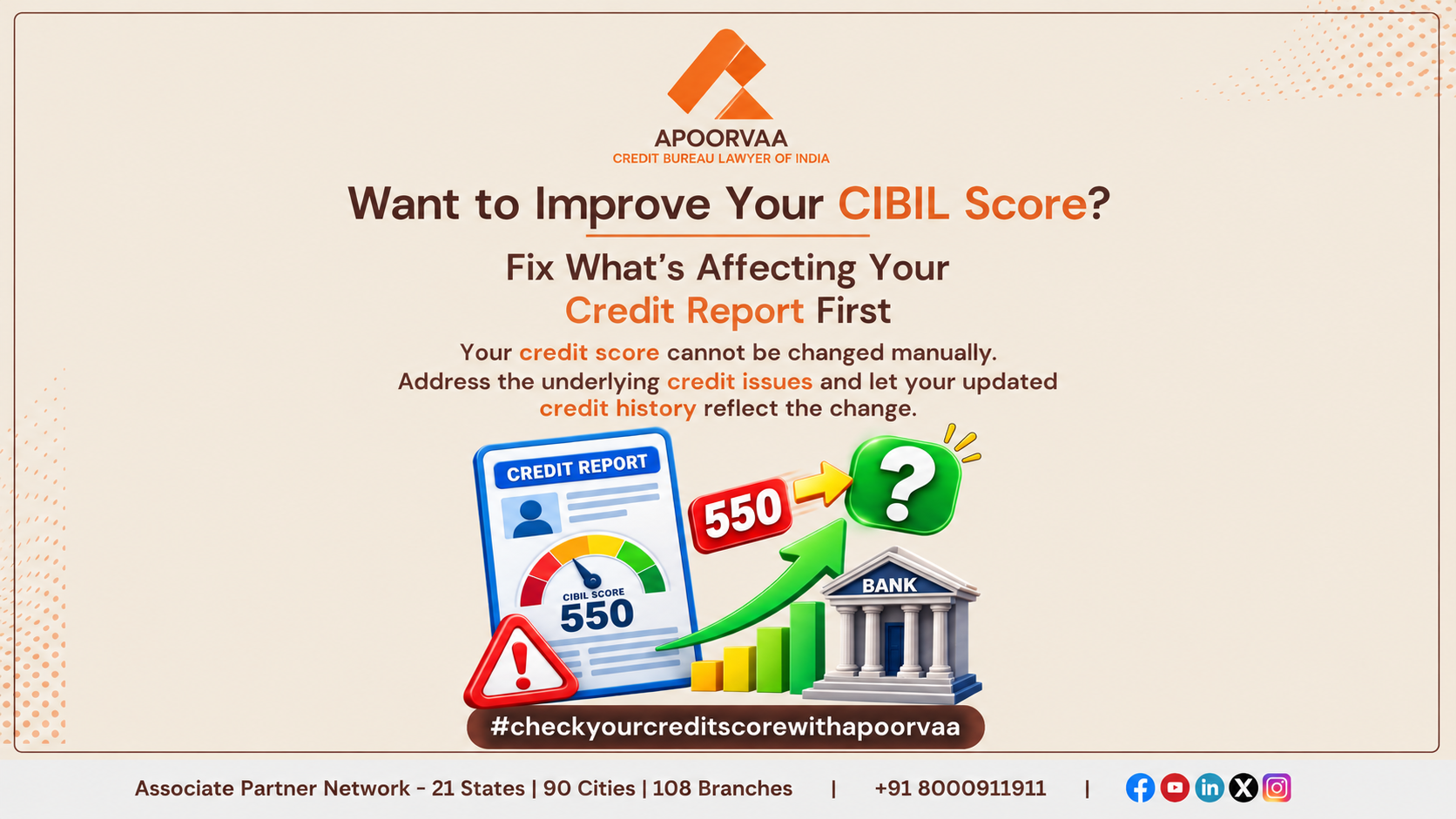
How to improve CIBIL Score is one of the most common questions asked by customers who are planning to apply for a loan.
The conversation often begins like this:
“My CIBIL Score is 600. The bank says I need a better score for my loan. Can you make it 700?”
The customer is understandably focused on the number.
But the number is not where the analysis should begin.
If a credit profile contains genuine overdue obligations, repayment irregularities, old delinquent accounts or other adverse credit information, simply deciding that the score should move from 600 to 700 does not address the underlying problem.
Similarly, if the credit report contains information that is actually inaccurate, paying an amount merely to increase the score would also be the wrong approach.
The first question should therefore be:
Why is the CIBIL Score low?
Only after understanding that can we determine what kind of action may actually be required.
Your CIBIL Score Is the Result, Not the Starting Point
A CIBIL Score should not be understood as an independently editable number.
TransUnion CIBIL explains that factors including payment history, credit utilisation, age of credit and credit enquiries can influence a person’s credit profile. It advises consumers seeking to improve their score to pay obligations on time, maintain lower utilisation, avoid multiple loan applications and regularly review their reports for errors.
This is why the idea of:
“600 hai, 700 kar do”
is fundamentally incomplete.
Think of it this way:
Credit behaviour + Account information + Repayment history + Other credit factors
↓
Overall Credit Profile
↓
CIBIL Score
Therefore, the score should be viewed as an outcome of the credit profile.
The objective should not be to manipulate the final number.
The objective should be to understand and appropriately address what is happening underneath it.
Why Can Two People With the Same CIBIL Score Need Completely Different Solutions?
Suppose two customers both have a CIBIL Score of 590.
At first glance, their problem appears identical.
It is not.
Customer A
The credit report contains an old loan with genuine unpaid dues.
Customer B
The report contains an account the customer does not recognise.
Both customers may have the same score.
But clearly, the same solution cannot be applied to both.
Customer A has an underlying financial/account-resolution issue.
Customer B may have an ownership or credit-reporting issue requiring verification.
CIBIL itself recognises account ownership and inaccurate account details as types of report discrepancies that can be disputed. It also states that it cannot directly modify lender-reported information without confirmation from the concerned credit institution.
This is why professional Credit Rectification cannot begin with:
“What score do you want?”
It has to begin with:
“What is affecting your credit profile?”
Genuine Negative Information and Incorrect Information Are Not the Same
This distinction is one of the most important principles in Credit Rectification.
A customer may see something negative in the credit report and immediately think:
“Remove this and my score will increase.”
But something being negative does not mean it is inaccurate.
For example, suppose a borrower genuinely stopped making payments on a loan and an outstanding obligation remains.
The information may be damaging to the credit profile.
But if it accurately represents the account history, it cannot simply be treated as a reporting error because the borrower now needs a new loan.
Compare this with another situation:
The report contains an account that the customer never took.
That is a fundamentally different problem.
So:
Negative information ≠ Incorrect information
And:
Credit Rectification ≠ Deleting everything that negatively affects a score
A genuine Credit Rectification approach has to understand the nature of the underlying issue before determining what can appropriately be done.
Why Genuine Old Bank Dues Cannot Simply Be Ignored
One of the most difficult conversations arises when a customer says:
“I have old bank dues, but I don’t want to pay anything. Just improve my CIBIL Score.”
If genuine outstanding obligations are materially affecting the credit profile, ignoring those obligations while focusing only on a higher score does not address the underlying problem.
This is particularly relevant in older delinquent accounts.
The credit report may contain information relating to:
Outstanding balance
Overdue amount
Write-Off
Settled-related status
Repayment history
or other lender-reported account information.
The appropriate approach depends on the nature and history of that particular account.
That is why there should be caution around anyone who promises:
“No need to deal with the bank. We will directly increase your CIBIL Score.”
The score cannot legitimately be separated from the underlying credit history.
But Don’t Assume Every Low Score Requires Payment
The opposite mistake is equally important to avoid.
A low CIBIL Score does not automatically mean that you need to pay someone or clear an old loan.
First understand the cause.
The issue could involve:
Recent repayment delays
High credit utilisation
Genuine old outstanding obligations
Multiple recent credit applications
An account that does not belong to you
Incorrect account information
or a combination of different factors.
CIBIL specifically advises consumers to review their reports to identify errors rather than assuming every low score has the same cause.
Therefore, the correct approach is neither:
“Every negative entry can be removed.”
nor:
“Every low score means you need to make a payment.”
The correct approach is:
Understand the cause first.
Why Old Write-Off and Settled Accounts Need Proper Assessment
Write-Off and Settled-related accounts are frequently misunderstood.
Customers sometimes believe:
“This account is many years old, so it should not matter anymore.”
Others believe:
“Just tell me how much I have to pay and my CIBIL will become clear.”
Neither assumption should be made without understanding the particular account.
An old delinquent account can involve a longer history between the borrower and lender.
Its current position cannot always be understood merely from one number appearing in the credit report.
This is precisely where experience in credit-report analysis and Credit Rectification becomes important.
The relevant question is not simply:
“How old is this account?”
or:
“How much is showing in CIBIL?”
It is:
“What is the actual issue with this account, and what is the appropriate way to address it?”
Payment Does Not Mean Someone Manually Adds CIBIL Points
Another misconception needs to be addressed.
Suppose an old genuine obligation is appropriately resolved.
That does not mean somebody at CIBIL then decides:
“Customer paid the bank—add 80 points.”
Credit information is furnished by credit institutions to credit information companies, and the score subsequently reflects the information available in the credit profile.
RBI’s credit-information framework requires credit institutions to keep credit information updated regularly; since January 1, 2025, the prescribed reporting cycle is at least fortnightly, subject to the applicable directions.
CIBIL also makes clear that it cannot independently alter lender-reported information; changes require confirmation from the concerned credit institution.
Conceptually, therefore, the journey is:
Underlying Credit Issue
↓
Appropriate Resolution / Rectification
↓
Updated Credit Information
↓
Updated Credit Profile
↓
Score Generated From That Profile
This is very different from:
₹X Payment = +100 CIBIL Points
Why Nobody Should Guarantee Your Exact Future CIBIL Score
Customers often have a specific target because a lender has told them:
“Improve your score and then come back.”
So naturally they ask:
“If I resolve this account, what will my score become?”
An exact future score should not be promised.
Why?
Because the credit profile can contain multiple variables.
Even if one significant account issue is appropriately addressed, the overall profile may still contain:
- Other repayment history
- Existing credit-card utilisation
- Other outstanding accounts
- Recent enquiries
- Length of credit history
- Current borrowing behaviour
- Additional account-level information
Therefore, resolving one account may change the underlying credit profile, but it does not justify promising:
“Your score will definitely become 750.”
A professional Credit Rectification service should be able to explain the problem and the appropriate course of action.
It should not sell a predetermined number.
Beware of “Guaranteed CIBIL Score Increase” Promises
This brings us to an important customer-awareness issue.
Be cautious if someone tells you:
“100 points guaranteed.”
“550 to 750 guaranteed.”
“All negative entries will be deleted.”
“You don’t need to address old genuine dues.”
“We will simply email CIBIL and increase your score.”
CIBIL states that it does not maintain a separate “defaulters list”; rather, it maintains credit history based on information reported by member credit institutions. It also cannot directly modify lender-reported records without the concerned institution’s confirmation.
That makes an important principle clear:
Credit Rectification is about addressing the underlying credit information—not manipulating a number.
Credit Improvement and Credit Rectification Are Different
These two concepts are closely connected, but they should not be confused.
Credit Improvement
Credit improvement generally comes from healthier credit behaviour over time.
That can include:
Timely repayments
Responsible credit utilisation
Controlled borrowing
Avoiding unnecessary loan applications
Maintaining consistent financial discipline
Credit Rectification
Credit Rectification becomes relevant when a specific credit-report issue requires professional assessment, verification or appropriate resolution.
That may involve:
Old unresolved bank accounts
Write-Off or Settled-related issues
Incorrect balances
Unknown accounts
Reporting discrepancies
Information that has not been appropriately updated
or another account-level issue.
This distinction changes the customer’s question from:
“Who can increase my CIBIL Score?”
to:
“Why is my credit profile affected, and does this require credit improvement, Credit Rectification—or both?”
That is a much more meaningful starting point.
Why the Credit Report Matters More Than the Target Number
Imagine you need a home loan and your lender wants a stronger credit profile.
Naturally, the score becomes important.
But simply knowing:
“My CIBIL Score is 610”
does not tell you what should happen next.
You need to understand what is behind that 610.
This is where the credit report becomes important.
It can help identify whether the profile contains genuine repayment problems, unresolved historical accounts or information that may require verification.
The target score tells you where you want to go.
The credit report helps explain what may be preventing you from getting there.
And that is why genuine CIBIL Score improvement begins with understanding the credit profile—not chasing points.
When Does Credit Rectification Become Relevant?
Not every low CIBIL Score requires Credit Rectification.
This distinction is important.
If your credit profile is being affected mainly because of recent payment delays, high credit utilisation or frequent applications for new credit, improving your ongoing credit behaviour may be an important part of building a healthier profile.
But the situation can become more complex when the credit report contains issues such as:
- Old unresolved loan accounts
- Write-Off or Settled-related information
- Genuine outstanding dues where the present account position is unclear
- An old Current Balance or Amount Overdue
- An account you do not recognise
- Information that appears inconsistent with your records
- An account that has been addressed but is not reflecting as expected
- Multiple credit-report issues affecting the same customer
In such situations, the question is no longer simply:
“How do I increase my CIBIL Score?”
The better question becomes:
“What exactly is affecting my credit profile, and what can legitimately be done about it?”
This is where proper Credit Rectification assessment becomes relevant.
Why Credit Rectification Requires Proper Analysis
A credit report can look simple to a customer.
There is a score.
There are loan accounts.
There are balances.
There are account statuses.
But behind an old problematic account there may be years of financial and reporting history.
Consider three customers:
Customer A: Has an old Write-Off account with genuine unpaid dues.
Customer B: Has already dealt with an old account, but the information currently appearing in the credit report requires examination.
Customer C: Does not recognise the loan account appearing in the report.
All three customers may approach a Credit Rectification service saying:
“My CIBIL is bad. Please fix it.”
But these are three fundamentally different cases.
The appropriate course of action cannot be decided simply by looking at the score.
This is why experience in understanding credit reports, lender-reported information, account history and the nature of different credit problems matters.
An Old Write-Off or Settled Account Is Not Just a Score Problem
Customers frequently approach us because an old Write-Off or Settled-related account is affecting their credit profile.
Their immediate concern is usually the score.
But the score is only the visible result.
The underlying account is the real issue that needs to be understood.
Questions may arise such as:
How old is the account?
What is presently being reported?
What was the historical position of the account?
Is there still an underlying financial obligation?
What information needs to be examined with the lender?
What outcome is realistically possible in this particular case?
The answers can differ from one account to another.
This is why Credit Rectification should not be approached with a universal promise such as:
“Every Write-Off can be removed.”
or:
“Every Settled account can be converted in the same way.”
Each case needs to be understood on its own facts.
Why Professional Assessment Matters Before Taking Action
When a customer urgently needs a loan, there is often pressure to act immediately.
That can lead to mistakes.
For example, a customer may:
Make a payment without properly understanding the account
Raise repeated disputes without understanding whether the information is actually incorrect
Approach multiple agencies looking for someone who guarantees a score
Assume that an old account will disappear automatically
or
Focus only on the CIBIL Score while ignoring the account information behind it
A proper assessment helps identify what type of problem actually exists before deciding what course of action may be appropriate.
This is particularly important with older or complicated credit accounts.
The objective should not be to take the fastest-looking action.
It should be to take the appropriate action for the actual credit issue.
Why Credit Rectification Is Not About Deleting Negative History
This is another misconception that needs to be addressed.
A customer may ask:
“Can you remove all the negative entries from my CIBIL Report?”
That should not be the objective of legitimate Credit Rectification.
If information is genuine and accurately reflects the account history, the fact that it negatively affects the score does not automatically make it removable.
On the other hand, if information is inaccurate, inconsistent or requires verification, it should be examined through the appropriate process.
Therefore, Credit Rectification is not:
Negative information → Delete everything → Higher score
It is:
Understand the information → Determine its nature → Address the legitimate issue → Work toward appropriate reporting
That distinction protects customers from unrealistic promises.
How Apoorvaa Approaches a Credit-Report Problem
At Apoorvaa – Credit Bureau Lawyer of India, we do not begin a Credit Rectification case by asking:
“What CIBIL Score do you want?”
We begin by trying to understand:
Why is the customer’s credit profile affected?
The broad approach is based on four principles:
- Understand the Credit Report
The score alone does not explain the complete problem.
The underlying account information needs to be understood in the context of the customer’s issue.
- Identify the Nature of the Problem
A genuine outstanding obligation, an old Write-Off, a Settled-related account, an unknown account and a potential reporting discrepancy cannot all be treated in the same manner.
- Determine an Appropriate Course of Action
The course of action depends on the particular account and the issue identified.
We do not believe in applying one standard solution to every low CIBIL Score.
- Verify the Outcome
Credit Rectification should ultimately have a result that the customer can verify.
The objective is not simply to tell a customer:
“Your work is completed.”
The relevant outcome should ultimately be reflected in the updated credit information.
This approach allows Credit Rectification to remain case-specific, evidence-based and verifiable without reducing the service to a promise of a particular number.
We Do Not Treat CIBIL Score as a Product
There is an important difference between saying:
“We work on credit-report issues.”
and saying:
“We sell a 100-point CIBIL increase.”
At Apoorvaa, the second approach would contradict the way credit scoring actually works.
We cannot responsibly promise:
600 → 700
or
550 → 750
because the score is determined from the customer’s broader credit profile.
What can be professionally examined is the underlying issue affecting that profile.
If a genuine bank obligation needs to be addressed, that needs an appropriate approach.
If information appears incorrect, that requires a different assessment.
If several issues exist simultaneously, the overall case needs to be understood accordingly.
The score is the result. The credit profile is where the work begins.
What Happens When a Customer Has Multiple Credit Issues?
This is particularly relevant in Credit Rectification.
A customer may not have just one problematic account.
For example, a credit report may simultaneously contain:
One old Write-Off account
One Settled account
An outstanding balance on another facility
An account the customer does not recognise
Recent repayment delays on an active loan
In such a situation, saying:
“We will increase your CIBIL by 100 points”
does not meaningfully explain the work required.
Each issue may have a different history and may require a different assessment.
This is why the credit report needs to be viewed as a complete credit profile, rather than treating one negative flag or one score as the entire problem.
Credit Rectification Should Produce a Verifiable Outcome
One principle is especially important to us:
The customer should be able to verify the outcome independently.
At Apoorvaa, when work relating to a credit-report issue progresses, we believe the customer should remain informed about what is happening.
Where multiple issues are being worked upon, relevant progress can be demonstrated as individual issues are updated.
After completion, the customer should be able to compare the earlier credit report with the updated report and understand what has changed.
Most importantly, we encourage customers to access their own latest credit report through the official credit bureau platform and verify the information themselves.
The purpose is simple:
Credit Rectification should not end with:
“Trust us, your work is done.”
It should end with:
“Check your updated credit report and verify the result yourself.”
Why Verification Matters More Than a Verbal Promise
Suppose somebody tells you:
“Your Write-Off has been resolved.”
How do you know?
Or:
“Your account has been updated.”
Where is the evidence?
The latest credit report provides an important means of verifying what is currently being reported.
This is why customers should preserve earlier reports where possible and compare the relevant information after the rectification process.
The same principle applies to Apoorvaa’s own work.
Our customer should not have to depend only on our verbal confirmation.
The updated credit information should help demonstrate the outcome.
This builds transparency into the Credit Rectification process.
When Should You Seek Professional Help?
Professional Credit Rectification assistance may be worth considering when:
You do not understand why your CIBIL Score is low
Your report contains old Write-Off or Settled-related accounts
You have old bank dues but do not understand the present account position
An unknown account appears in your report
The credit report contains information that appears inconsistent
An earlier account resolution is not reflecting as expected
Several credit issues exist simultaneously
or
An important loan requirement is approaching and you need to understand your credit profile
The objective of seeking professional assistance should not be to purchase a guaranteed score.
It should be to obtain a better understanding of the underlying credit problem and determine what legitimate resolution may be possible.
Don’t Wait for a Loan Rejection to Understand Your Credit Profile
Many customers approach Credit Rectification services only after a problem has already affected an important financial requirement.
The home loan is pending.
Business funding is required.
A balance transfer is being considered.
Additional finance is needed.
Then the customer discovers an old credit issue.
At that stage, the natural question becomes:
“How quickly can this be fixed?”
But old and complicated credit issues may require proper assessment and cannot always be resolved instantly.
A better approach is to review your credit profile periodically—particularly before an important borrowing requirement is expected.
If there is a problem, you have time to understand it properly rather than searching for an overnight solution.
Frequently Asked Questions
Can Apoorvaa guarantee that my CIBIL Score will increase from 600 to 700?
No exact future CIBIL Score should be guaranteed. Our focus is on understanding and appropriately addressing the underlying credit-report issue. The resulting score depends on the overall credit profile.
Can CIBIL Score increase without clearing genuine old dues?
If genuine outstanding obligations are materially affecting the credit profile, simply targeting a higher score without addressing the underlying account does not resolve the issue. The particular case first needs to be understood.
Can every Write-Off or Settled account be removed?
No universal promise should be made. The history and present position of each account need to be assessed individually.
I have already paid the bank. Why is my credit report still showing a problem?
Payment and credit-report reporting are related but distinct matters. If the latest report does not reflect what you believe should be the current position, the specific account and supporting information may need to be examined.
What if a loan in my report does not belong to me?
An unknown account should be properly verified. It should not automatically be accepted as your liability merely because it appears in the report.
Can a Credit Rectification company manually increase my score?
A Credit Rectification service should not represent the score as an editable number. Professional work should focus on the underlying credit-report issue.
How will I know whether my Credit Rectification is actually complete?
The updated credit report is important evidence. Compare the relevant information with the earlier report and verify what is currently reflecting.
Should I approach Apoorvaa only after my loan is rejected?
No. If you already know that your report contains an old or complicated issue, understanding it before an urgent loan requirement arises can provide more time to determine the appropriate course of action.
Final Takeaway
If your CIBIL Score is 550, 600 or 650 and you want it to increase, do not begin by searching for someone who promises a particular number.
Start by understanding:
Why is the score low?
A genuine unpaid obligation requires one type of approach.
A Write-Off or Settled-related account may require another.
An unknown loan requires verification.
Incorrect information requires appropriate examination.
And genuine repayment behaviour cannot simply be treated as a reporting error.
This is why professional Credit Rectification begins with the credit profile—not the target score.
The objective should be:
Understand the problem.
Address what can legitimately be addressed.
Work toward accurate reporting.
Verify the result.
The score should follow the credit profile—not the other way around.
Related Credit Education
- Importance of Good Credit Score: 7 Key Benefits
- Low CIBIL Score: 5 Reasons You Should Check
- Good Credit Score: 5 Benefits for Borrowers
Need Professional Help With a Credit-Report Issue?
If your credit report contains an old Write-Off, Settled account, outstanding bank dues, incorrect information, unknown account or another unresolved credit-report issue, focusing only on the score may not tell you what actually needs to be addressed.
Apoorvaa – Credit Bureau Lawyer of India works on Credit Rectification and credit-report-related issues by first understanding the underlying problem and determining an appropriate course of action based on the individual case.
We do not position Credit Rectification as a promise to manually change a CIBIL Score.
Our objective is to work toward an appropriate, accurate and verifiable credit-report outcome—and encourage customers to verify that outcome through their own updated credit report.