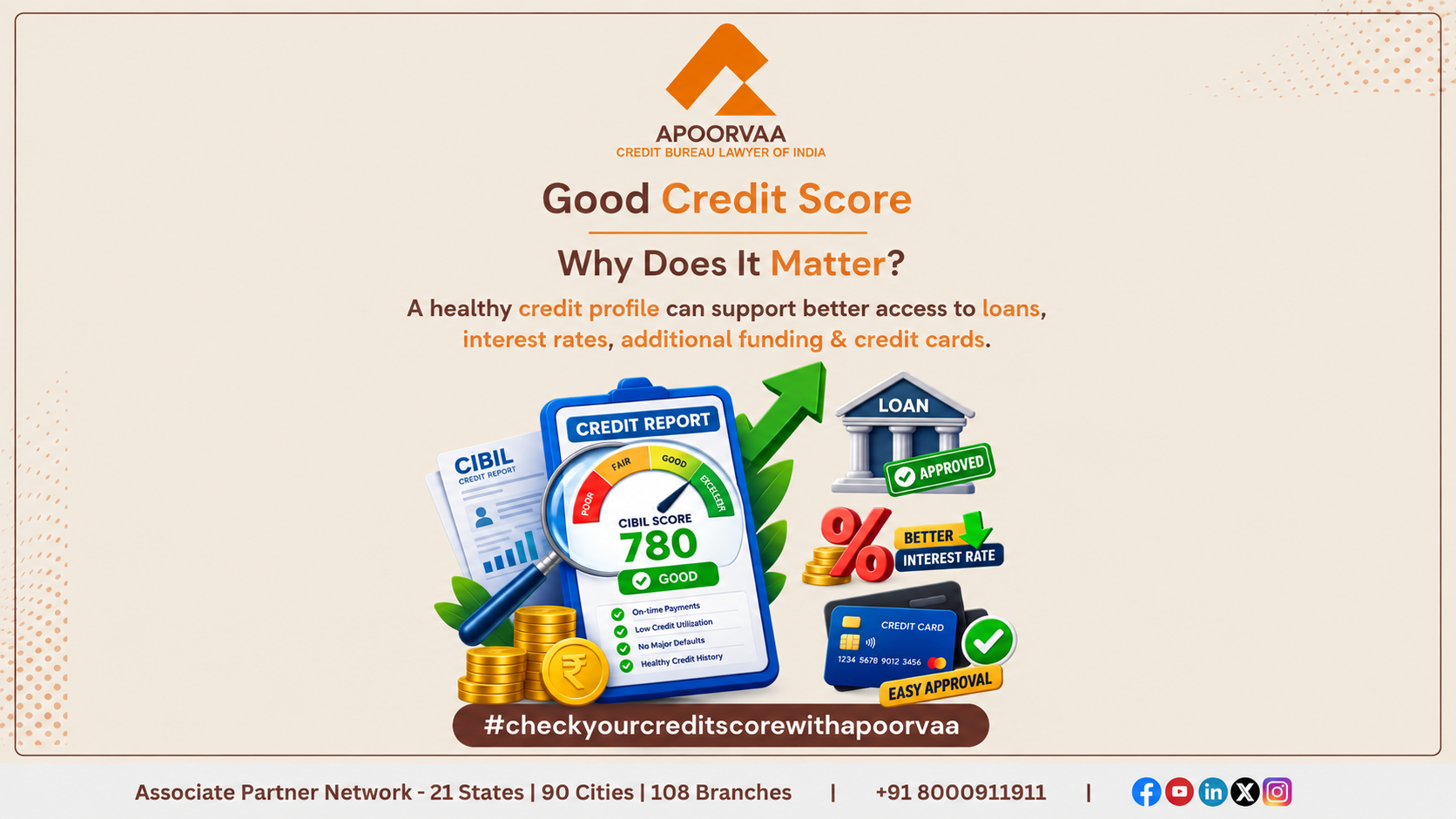
The importance of good credit score becomes obvious when you apply for a loan, but its relevance does not begin and end with loan approval.
Your credit profile develops over time through your borrowing and repayment behaviour. It can contain details of your active and closed credit accounts, repayment history, outstanding balances and credit enquiries. Your credit score is then derived from the information in your credit history.
When you approach a lender for fresh credit, this information can become an important part of its assessment.
But there is a broader point that borrowers often overlook:
A healthy credit profile can help preserve your financial options before you actually need them.
You may not need a home loan today.
You may not need business funding today.
You may not be considering a balance transfer today.
But when that requirement arises, your existing credit history cannot necessarily be rebuilt overnight.
That is why credit health should be maintained continuously rather than examined only after a financial opportunity has already arisen.
Here are 7 important reasons why maintaining a healthy credit score and credit report matters.
- A Good Credit Profile Can Support Loan Eligibility
One of the primary uses of a credit score and credit report is in the lending process.
When you apply for a:
- Home loan
- Personal loan
- Business loan
- Vehicle loan
- Loan against property
- Credit card
- Other credit facility
the lender assesses whether it is comfortable extending credit to you.
CIBIL itself explains that lenders check the CIBIL Score and Report when evaluating loan applications and that a higher score generally improves the chances of approval. The ultimate decision, however, remains with the lender.
The lender’s assessment can also involve several other factors, including:
Income and repayment capacity
Existing financial obligations
Employment or business profile
Nature and amount of the proposed loan
Security or collateral, where applicable
Internal lender policies
Therefore:
Good CIBIL Score ≠ Guaranteed Loan Approval
But the opposite also matters.
A weak credit profile containing serious repayment irregularities, overdue obligations or adverse account information can make obtaining new credit more difficult.
Why Waiting Until Loan Rejection Can Be a Mistake
A common pattern is:
Need loan → Apply → Loan faces difficulty/rejection → Check detailed credit report → Discover old problem
At this stage, the borrower may already be under time pressure.
The loan may be required for a property transaction, business opportunity, education requirement or another important purpose.
If an old credit-report issue is discovered only then, resolving it may require time.
A better sequence is:
Monitor credit health → Identify problems early → Address legitimate issues → Remain credit-ready
This is one of the strongest practical reasons to understand your credit report even when you are not currently applying for a loan.
- Your Credit Profile Can Affect the Cost of Borrowing
Many borrowers think of loan approval as a simple yes-or-no question.
But another question can be equally important:
At what cost will the lender give me the loan?
Credit risk can influence lending terms.
CIBIL’s current consumer guidance notes that borrowers with lower scores may still receive loans from some lenders, but potentially at higher interest rates or stricter terms.
This matters because the interest rate determines the cost of borrowing.
Consider two borrowers taking similar long-term loans.
Even if both receive approval, a difference in the interest rate can lead to a substantial difference in total interest paid over the loan tenure.
Therefore, credit health can potentially affect not only:
Whether credit is available
but also:
On what terms credit is available.
A Good Score Does Not Automatically Guarantee the Lowest Interest Rate
This qualification is important.
It would be misleading to say:
“750+ CIBIL means the bank must give you the lowest interest rate.”
Interest-rate decisions can depend on many variables, including:
- Lender policy
- Loan product
- Borrower’s income
- Loan-to-value ratio
- Security
- Employment or business profile
- Existing obligations
- Market conditions
- Overall risk assessment
Credit score is an important input, but not the only input.
The correct conclusion is:
A stronger credit profile can improve your position when seeking competitive credit terms, but it does not create an automatic right to a particular interest rate.
- Credit Health Can Matter for a Balance Transfer
Suppose you already have a home loan at a relatively high interest rate.
Later, another lender offers a more competitive product.
Naturally, you may consider transferring the outstanding loan.
However, the incoming lender is still taking on a credit exposure.
It therefore has to assess your current eligibility.
Your repayment behaviour since taking the original loan, your existing liabilities and your current credit profile can become relevant to that assessment.
This creates an important situation:
You may have qualified for the original loan several years ago when your credit profile was healthy.
But if your credit position has deteriorated since then, your ability to access a better refinancing opportunity may also be affected.
This is why credit health should be maintained throughout the life of your loans, not merely until the day the original loan is sanctioned.
- A Healthy Credit Profile Can Support Future Additional Funding
Financial requirements change.
A business owner who does not need additional capital today may need funds for expansion next year.
A property owner may later explore additional funding against an existing facility.
An individual may require finance for another major requirement.
Depending on the product and lender policy, additional funding or a top-up facility may involve a fresh assessment of the borrower’s eligibility.
The lender may examine:
Existing repayment behaviour
Current obligations
Income and repayment capacity
Overall credit profile
among other factors.
Therefore, maintaining credit discipline can help preserve access to future borrowing opportunities.
This is especially relevant for entrepreneurs and business owners whose funding requirements can change quickly.
A credit problem that appears manageable today can become a major obstacle when a time-sensitive business opportunity arises tomorrow.
- Your Credit Profile Can Affect Credit-Card Opportunities
Credit cards are another form of credit.
When you apply for a new card, the issuer may evaluate your credit history along with income, existing liabilities and its internal eligibility criteria.
Therefore, repayment behaviour on existing loans and credit cards can become relevant when you seek additional revolving credit.
A borrower should not assume:
“Personal loan EMI important hai, credit-card payment itna important nahi hai.”
Both are credit obligations.
Late or missed credit-card payments can form part of the repayment history appearing in the credit report.
CIBIL identifies payment history, credit utilisation, age of credit and enquiries among the major factors affecting the Score and Report.
What About Credit-Card Limit Increases?
A good score does not guarantee that an existing credit-card issuer will increase your limit.
Credit-limit decisions depend on the issuer’s policies and assessment.
Nevertheless, maintaining a healthy credit profile can support your broader creditworthiness when institutions evaluate you for additional credit.
The Bigger Point: Credit Score and Credit Report Must Be Read Together
This is where many borrowers make a mistake.
They focus entirely on one number:
“My CIBIL Score is 780, so everything is fine.”
or:
“My score is 650, so I only need to increase the number.”
Credit health should not be understood this way.
Your credit score is an indicator.
Your credit report contains the underlying credit information.
A CIBIL Report can include credit enquiries, open and closed accounts, payment history and other lender-reported information.
Therefore, when evaluating your credit health, ask two separate questions:
What is my credit score?
and
What exactly is appearing in my credit report?
This distinction becomes particularly important when a report contains:
Write-Off
Settled
Overdue amount
Old Current Balance
Repayment delays
Unknown loan account
Incorrect account information
or another credit-report issue.
Simply watching the score may not tell you the complete story.
A High Score Should Not Stop You From Reviewing Your Credit Report
Suppose your CIBIL Score is reasonably good.
Does that mean you never need to review the report?
No.
A credit report should also be reviewed for the accuracy and relevance of the underlying information.
For example, you may want to check:
- Do you recognise all reported accounts?
- Are closed accounts reflecting appropriately?
- Is an old outstanding balance still appearing?
- Are repayment details consistent with your records?
- Are there credit enquiries you do not recognise?
- Is an account appearing that does not belong to you?
Regular review can help identify potential issues before the next important credit application.
Credit Health Is Becoming a Form of Financial Preparedness
The real benefit of a healthy credit profile is not simply being able to say:
“My CIBIL Score is good.”
It is the financial flexibility that credit health may help preserve.
When a genuine need arises, you want to approach the financial system from a stronger position.
That may involve:
A home purchase
Business expansion
Additional working capital
A balance transfer
A new credit card
An emergency financial requirement
or another legitimate credit need.
This is why credit health should be treated similarly to other forms of financial preparedness.
You maintain it before you need it.
- Can Your Credit Profile Matter in Certain Employment Situations?
For most people, the first association with a credit score is borrowing.
However, credit information can also become relevant in certain employment and background-verification situations, particularly for roles involving financial responsibility, access to sensitive financial information, banking operations, risk management or positions of trust.
This point needs to be presented carefully.
It would be incorrect to say:
“Every employer checks your CIBIL Score before giving you a job.”
That is not the case.
Employment practices vary depending on the organisation, industry, position and applicable legal and consent requirements.
The broader point is that as organisations strengthen background-verification and risk-management processes, financial conduct may become relevant in specific employment contexts.
For someone moving into a financially sensitive position or certain roles within banking and financial services, maintaining a responsible financial profile can therefore have relevance beyond simply applying for a loan.
But a credit report should never be treated as a complete assessment of someone’s professional ability, honesty or suitability for employment.
- Credit Awareness Is Entering Personal and Marriage-Related Financial Discussions
This is perhaps the most unusual of today’s seven reasons.
Over the last few years, we have observed cases where financially aware families have started discussing loans, existing debts, repayment obligations and credit history before marriage.
In some instances, families may voluntarily ask to understand the credit position of the prospective bride or groom, or broader financial liabilities within the family.
This appears to be more relevant in certain financially aware and higher-income households, but it should not be presented as a universal trend.
There is no general requirement that a person must have a particular CIBIL Score to get married.
Nor is exchanging credit reports a standard part of every marriage discussion.
The underlying development is about something broader:
Financial transparency.
Marriage can bring together not only two individuals but also future financial responsibilities.
Existing home loans, personal loans, business borrowings, credit-card liabilities or significant repayment obligations can affect future household finances.
Therefore, some individuals and families are becoming more comfortable asking:
What are the existing financial liabilities?
Are the loans being repaid regularly?
Are there substantial outstanding debts?
Are there financial commitments that should be understood before marriage?
A credit report can provide useful information about reported credit facilities and repayment behaviour.
However, it should not be used as a complete measure of a person’s financial standing or character.
A credit report does not provide the full picture of a person’s assets, savings, investments, income or reasons behind a past financial difficulty.
The useful takeaway is therefore not:
“Good CIBIL is necessary for marriage.”
It is:
Financial awareness and transparency are becoming increasingly relevant in important personal decisions as well.
What Actually Makes a Credit Profile Healthy?
A healthy credit profile is not created simply by reaching a particular score.
Someone may ask:
“What should my CIBIL Score be?”
That is a useful question, but it should be accompanied by another:
“What does my complete credit report look like?”
A healthy credit profile generally develops through responsible credit behaviour over time.
Timely Repayment
Loan EMIs and credit-card obligations should be paid according to their due dates.
Repeated delays can become part of the repayment history and affect the overall credit profile.
Responsible Credit Utilisation
Having access to a large credit-card limit does not mean that it should continuously be used close to its maximum.
Credit should be managed according to genuine financial requirements and repayment capacity.
Controlled Credit Applications
Applying for multiple loans or credit cards unnecessarily can result in multiple credit enquiries.
Credit applications should therefore be purposeful rather than made repeatedly simply to see which lender will approve them.
Sustainable Borrowing
Borrowing should remain proportionate to the person’s repayment capacity.
A good score should not be interpreted as permission to continuously take additional debt.
Long-Term Credit Discipline
Credit history develops over time.
Consistent repayment behaviour provides a more meaningful financial record than attempting to change a score immediately before applying for an important loan.
Good Credit Score and Accurate Credit Report Are Not the Same Thing
This distinction is extremely important from a Credit Rectification perspective.
Imagine a person has a relatively healthy score but discovers an account in the credit report that he or she does not recognise.
Should that person ignore the account because the score is still good?
No.
Now consider another person whose score is low because of genuine repayment delays.
Can those genuine delays simply be deleted because they are reducing the score?
Again, no.
The objective should be to maintain both:
Healthy Credit Behaviour + Accurate Credit Information
A credit score tells you something about your credit profile.
But accuracy has to be examined at the underlying account level.
What If the Negative Information in Your Credit Report Is Genuine?
Suppose you actually missed several EMIs.
Or an old loan genuinely remains unpaid.
Or you entered into a settlement with a lender.
The fact that this information is affecting your credit profile does not automatically make the information incorrect.
This is where customers should be cautious about promises such as:
“Every negative entry can be deleted.”
or:
“We can remove everything and increase your score.”
Genuine financial obligations and accurately reported repayment history cannot simply be treated as reporting errors because they are inconvenient.
Depending on the issue, the underlying account may first need to be appropriately addressed with the lender.
For example, an outstanding loan requires a different approach from an incorrectly reported loan.
Negative information and incorrect information are not the same thing.
What If the Information Is Incorrect?
Now consider a different situation.
Your credit report contains:
An account you do not recognise
An incorrect outstanding balance
A payment update that does not correspond with the lender’s records
An account that should have been updated after the applicable lender-side process
or another information discrepancy.
That situation should be examined differently.
First understand exactly what is being reported.
Then compare it with the relevant lender records and supporting documentation.
Where there is a genuine discrepancy, the appropriate lender and credit-bureau rectification or dispute process can be followed.
The objective should be:
Correct inaccurate credit information—not artificially manufacture a higher score.
Credit Improvement and Credit Rectification Are Different
These two terms are often used interchangeably, but they should be distinguished.
Credit Improvement
Credit improvement generally comes from developing healthier credit behaviour over time.
That may involve:
Paying obligations on time
Managing utilisation responsibly
Avoiding unnecessary credit applications
Maintaining sustainable debt
Building a consistent repayment history
Credit Rectification
Credit Rectification becomes relevant when the underlying credit information needs to be analysed, verified, appropriately addressed or corrected through the relevant process.
For example, the issue may involve:
Incorrect account information
Unknown loan account
Old balance requiring examination
Incorrect reporting after account resolution
Write-Off or Settled-related account issues
Another lender-reported discrepancy
The appropriate action depends on the nature of the problem.
Therefore, simply asking:
“How can I increase my CIBIL Score?”
may be the wrong starting point.
A better starting point is:
“Why is my credit profile in its present condition?”
Once the reason is understood, the appropriate action becomes clearer.
How Apoorvaa Approaches Credit Rectification
At Apoorvaa – Credit Bureau Lawyer of India, our approach begins with the underlying credit report rather than with a promise about a particular score.
The first objective is to understand:
What exactly is appearing in the report?
Which account or information is creating the issue?
Is the information genuine, inaccurate or in need of further verification?
Does an underlying lender-side issue first need to be addressed?
The course of action then depends on the individual case.
Where lender communication, documentation, account resolution or credit-bureau follow-up is required, the process should be supported by evidence.
And after the relevant work is completed, the result should ultimately be visible in the updated credit report.
We believe the customer should be able to understand:
What was appearing before?
What action was taken?
What is appearing now?
Where relevant, we preserve the earlier report, keep the customer informed during the process and provide progress updates as individual issues move forward.
Once the relevant information has been updated, the latest report can be compared with the earlier report.
Most importantly, we encourage customers to access their own report through the official credit bureau website and independently verify the result.
The purpose of Credit Rectification should therefore not be:
“Give me a higher number somehow.”
It should be:
“Help me understand and appropriately address the information affecting my credit profile.”
Don’t Wait Until an Important Loan Is Rejected
One of the most practical lessons from today’s discussion is timing.
Many people start thinking about credit health only when:
A home loan is required urgently
A business opportunity needs funding
A balance transfer is planned
A credit-card application is rejected
or
Additional finance is suddenly required.
At that point, there may not be enough time to address an old credit issue properly.
Credit-report problems can sometimes involve lender communication, document retrieval, account analysis, dispute processes or subsequent reporting cycles.
They may not disappear overnight.
This is why periodically reviewing your credit profile can be useful even when you have no immediate borrowing requirement.
A Practical Credit-Health Checklist
You do not need to check your score every day.
Instead, periodically review your complete credit profile and ask:
- Do I recognise all the credit accounts?
- Are my active accounts being reported correctly?
- Are closed accounts reflecting appropriately?
- Are my loan and credit-card payments being made on time?
- Is any old Current Balance still appearing unexpectedly?
- Is there an overdue amount that requires attention?
- Is any Write-Off or Settled-related information appearing?
- Are there enquiries that I do not recognise?
- Have recently resolved accounts been appropriately updated?
- Is there anything in the report that needs further verification?
This provides a much more useful understanding of credit health than simply checking whether the score increased or decreased by a few points.
Frequently Asked Questions
Why is a good credit score important?
A healthy credit profile can support loan eligibility, competitive borrowing opportunities, balance transfers, additional funding and credit-card applications, subject to the lender’s individual assessment.
Does a good CIBIL Score guarantee a loan?
No. Lenders also consider income, repayment capacity, existing obligations, security where applicable and their own eligibility and risk policies.
Can a low credit score mean a higher interest rate?
Credit profile can form part of a lender’s risk and pricing assessment. Depending on the lender and product, a weaker credit profile may affect the terms offered.
Can a poor credit profile affect a balance transfer?
Yes, potentially. The incoming lender generally evaluates the borrower’s current eligibility before accepting a loan transfer.
Can credit history affect additional funding?
It can. A lender considering a top-up or additional credit may reassess repayment behaviour, obligations and overall eligibility.
Does a good CIBIL Score guarantee a higher credit-card limit?
No. Credit limits remain subject to the card issuer’s assessment and policies.
Do employers check CIBIL Scores?
Not universally. Credit-related background verification may be relevant in certain roles or organisations and remains subject to applicable requirements.
Do families check CIBIL Reports before marriage?
This is not a general requirement or universal practice. Some financially aware individuals or families may voluntarily discuss debts, liabilities or credit information as part of broader financial transparency.
Can every negative entry be removed from a credit report?
No. Genuine and accurately reported information cannot simply be deleted because it negatively affects the score. Incorrect information should be examined through the appropriate rectification process.
Should I focus on increasing my score or correcting my report?
First understand why the score is where it is. If the report contains inaccurate information, rectification may be required. If the information is accurate, healthier credit behaviour or appropriate resolution of underlying obligations may be necessary.
Final Takeaway
The importance of good credit score extends well beyond getting one loan approved.
Your credit profile can influence:
Loan eligibility
Cost of borrowing
Balance-transfer opportunities
Additional funding
Credit-card opportunities
and, in certain circumstances, may also become relevant in broader financial background or personal financial discussions.
But the real objective should not be to chase the highest possible number.
It should be to maintain:
Responsible borrowing + Timely repayment + Sustainable debt + Accurate credit information
A healthy credit profile creates something extremely valuable:
Financial flexibility.
You may not need credit today.
But when an important opportunity or requirement arises tomorrow, your past credit behaviour will already form part of your financial record.
That is why credit health should be maintained before you need it—not after a financial opportunity is already at risk.
Related Credit Education
- CIBIL Enquiries: Can Loan Enquiries Be Removed?
- Improving Your CIBIL Score Begins with Understanding Your Credit Report
- Low CIBIL Score: 5 Reasons You Should Check
Need Help Understanding an Issue in Your Credit Report?
If your credit report contains an unknown account, incorrect information, old outstanding balance, Write-Off, Settled status or another credit-reporting issue, the first step should be to understand the underlying problem rather than simply trying to increase the score.
At Apoorvaa – Credit Bureau Lawyer of India, our Credit Rectification process focuses on analysing the credit-report issue, understanding the relevant lender information, following the appropriate rectification process and helping customers verify the subsequent reporting outcome.
The goal is not an artificially higher score. The goal is an accurate, healthy and verifiable credit profile.