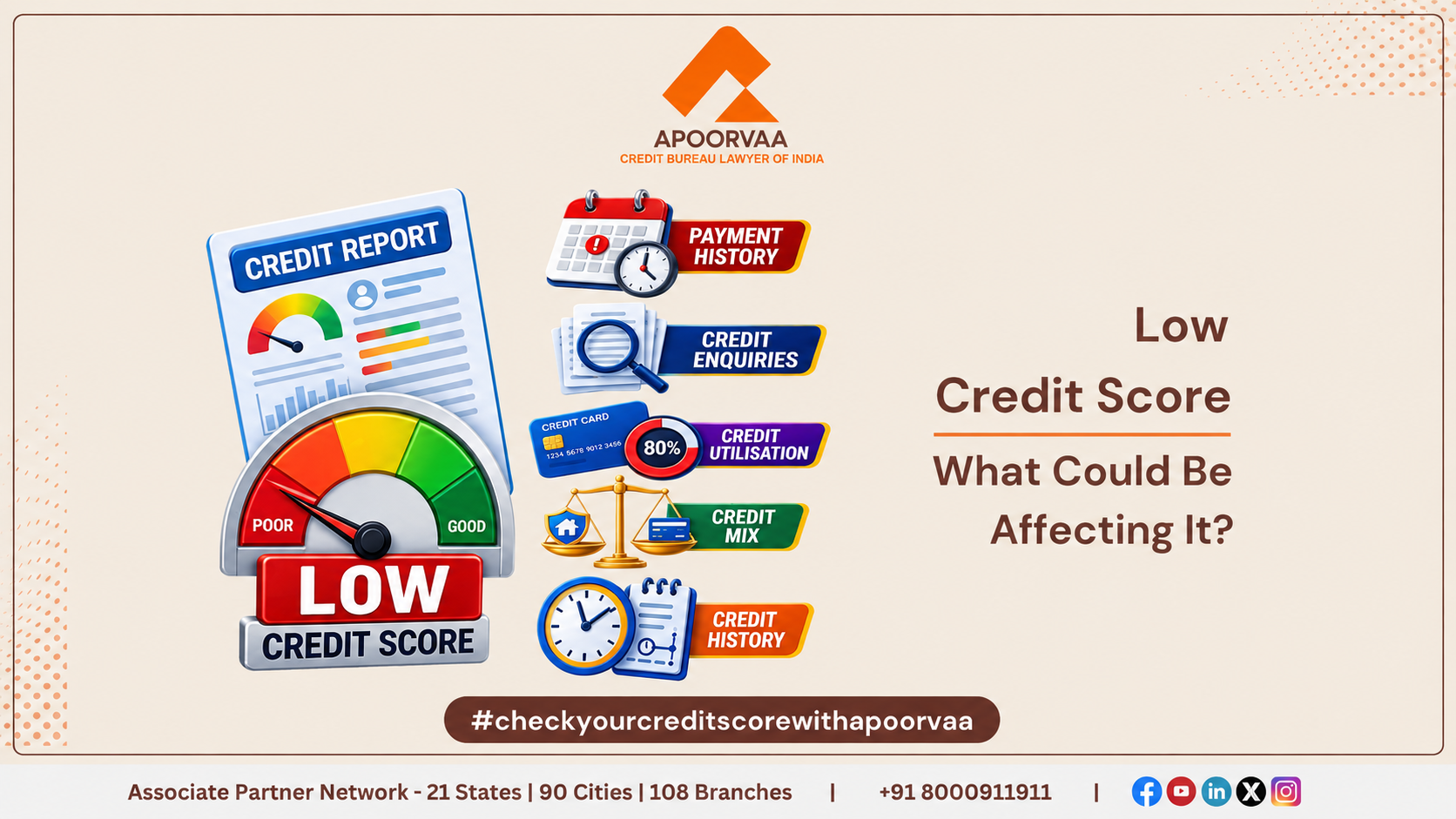
A Low CIBIL Score can result from different aspects of your credit behaviour, including delayed loan or credit card payments, frequent credit enquiries, high credit utilisation, the nature of your credit mix and a relatively short credit history. If your score is lower than expected, the right approach is to understand the information behind the score before trying to improve it.
Many borrowers make one fundamental mistake.
They check their CIBIL Score and immediately search:
“How can I increase my CIBIL Score?”
But the better first question is:
“Why is my CIBIL Score low?”
The difference is important.
A credit score is calculated from information contained in your credit profile. CIBIL itself explains that payment history, credit utilisation, age of credit and enquiries are among the major factors affecting the score.
Therefore, there is no single solution that applies to every person with a Low CIBIL Score.
First identify the reason.
Then determine what actually requires attention.
- Delayed Loan or Credit Card Payments
Repayment behaviour is one of the first areas to examine when your credit score is lower than expected.
Every loan comes with an agreed repayment schedule.
Every credit card also comes with payment obligations.
When payments are repeatedly delayed, missed or remain overdue, that repayment behaviour becomes part of your credit history.
CIBIL specifically identifies late payments, missed payments and delinquencies as factors that can negatively affect the score.
For example, suppose you have:
- Home loan
- Vehicle loan
- Personal loan
- Two credit cards
Your home loan and vehicle loan are completely regular.
But one credit card has experienced repeated payment delays during the last several months.
You may think:
“Sirf ek account mein delay hai. Baaki sab toh regular hai.”
But your credit profile reflects information across the credit facilities reported against you.
Therefore, repayment irregularities on one account can still become relevant to the overall profile.
Check DPD, Not Just the Score
When analysing repayment history, review the DPD – Days Past Due information in the report.
DPD helps indicate payment delays during particular reporting periods.
Depending on the information reported against an account, you may encounter entries such as:
000 – generally indicates no days past due for the relevant reporting period.
30 – indicates approximately 30 days past due.
60 – indicates a longer delay.
90 – indicates a still more serious delinquency.
CIBIL’s Accounts section includes repayment history, and lenders may evaluate repayment consistency through information such as DPD and account status.
This is why looking only at the three-digit score provides an incomplete picture.
The credit report explains the credit behaviour behind that number.
Recent Repayment Behaviour Deserves Attention
Suppose someone delayed a credit-card payment many years ago but subsequently maintained years of regular repayment behaviour.
Now compare that with someone whose current home-loan EMI has bounced repeatedly during the last three months.
These are very different credit situations.
A lender evaluating a fresh application can examine the applicant’s overall and current credit profile according to its credit policy.
Therefore, if your score has recently changed, review whether any active facility has recently developed:
- EMI delays
- Credit-card payment delays
- Overdue balances
- DPD
- Other repayment irregularities
Addressing the underlying financial issue is more important than simply searching for an instant method to increase the score.
- Frequent Credit Enquiries
The second factor is frequent applications for new credit.
Whenever you apply for a loan or credit card, the lender may access your CIBIL Report while assessing the application.
That lender enquiry becomes part of the Enquiries section of your report. CIBIL explains that repeated applications within a short period can result in multiple enquiries and may negatively affect the score.
Consider a common situation.
You apply for a personal loan with Bank A.
The application does not proceed.
Immediately, you apply with Bank B.
Then Bank C.
Then an NBFC.
Then another digital lender.
The borrower thinks:
“Kahin na kahin se loan approve ho jayega.”
But meanwhile, several credit enquiries may be added to the credit profile.
This is why repeatedly applying for loans without understanding the reason behind the previous rejection may create an additional credit concern.
Loan Rejected? Don’t Immediately Apply Everywhere
If a lender rejects or does not proceed with your application, first understand your financial and credit position.
Review:
- CIBIL Score
- Complete CIBIL Report
- Existing loan obligations
- Recent repayment history
- Current overdue amounts
- Recent enquiries
- Account status
- Income and eligibility
Only after understanding these factors should you decide whether another credit application makes sense.
Applying repeatedly is not a substitute for understanding the original problem.
Checking Your Own CIBIL Report Is Not the Same as Applying for Credit
This distinction is important.
Some consumers avoid checking their own CIBIL Report because they believe:
“Main CIBIL check karunga toh enquiry lagegi aur score kam ho jayega.”
The concern about enquiries relates to lenders accessing your report in connection with credit applications.
CIBIL itself encourages consumers to regularly monitor their Score and Report, and provides one free CIBIL Score and Report each calendar year.
Therefore, don’t confuse responsible self-monitoring with repeatedly applying for new loans or credit cards.
Checking your own report can help you detect issues before an important credit application.
- High Credit Utilisation
The third factor behind a Low CIBIL Score can be high credit utilisation.
Credit utilisation broadly refers to how much of your available revolving credit you are currently using.
Consider a credit card with a limit of:
₹1,00,000
If your reported usage is ₹20,000, you are using a relatively smaller portion of the available limit.
But if your outstanding regularly remains around ₹85,000 or ₹90,000, you are consistently using a substantial portion of the available credit.
CIBIL explains that higher credit utilisation can indicate greater credit risk because the consumer may appear financially overextended.
Therefore, someone can have regular payment behaviour but still need to examine how heavily available credit is being utilised.
High Credit Utilisation Is Not the Same as Having Unsecured Loans
This distinction is important for accurate credit education.
Credit utilisation generally refers to how much available revolving credit you are using, particularly credit-card limits.
Unsecured borrowing, on the other hand, refers to credit facilities that are not backed by specific collateral.
Examples can include:
- Personal loans
- Credit cards
- Certain business loans
Therefore, a person may have:
High credit-card utilisation without several unsecured loans.
Or:
Several unsecured loans without extremely high card utilisation.
Or both.
These should not be treated as exactly the same credit factor.
Should You Increase Your Credit Limit to Reduce Utilisation?
Do not look for mechanical shortcuts.
If your credit utilisation is high because you are regularly dependent on almost the entire available limit, the first question should be:
“Why am I using so much revolving credit?”
Increasing the available limit may mathematically change the utilisation ratio, but it does not automatically address the underlying financial behaviour.
Similarly, taking another credit card merely to create more available credit may expose you to additional borrowing.
A healthier approach is to understand:
- Monthly spending
- Outstanding balances
- Repayment capacity
- Dependence on revolving credit
- Overall debt obligations
Credit health should be built through sustainable financial behaviour, not temporary manipulation of a ratio.
Your CIBIL Report Matters More Than One Isolated Number
A CIBIL Report contains much more than the score.
It can include information relating to:
- Active and closed credit accounts
- Current balances
- Repayment history
- Account ownership
- Credit enquiries
- Loan and credit-card information
CIBIL describes its report as a record of credit history compiled from information received from banks and financial institutions.
This is why professional credit analysis should never begin and end with:
“Your score is 650.”
The more useful questions are:
Why is it 650?
Which accounts require attention?
Is the information accurate?
Are there current repayment problems?
Is utilisation high?
Have there been too many recent applications?
Is the credit history relatively new?
Once these questions are answered, the credit profile becomes much easier to understand.
- An Imbalanced Credit Mix
The fourth factor that can contribute to a Low CIBIL Score is your overall credit mix.
A credit profile may contain different types of borrowing, broadly including secured and unsecured credit facilities.
Secured credit is generally backed by an asset or security. Examples may include:
- Home loans
- Certain vehicle loans
- Loans against property
Unsecured credit generally does not have specific collateral attached to the facility. Examples may include:
- Personal loans
- Credit cards
- Certain unsecured business loans
CIBIL identifies credit mix as one of the factors considered in a credit profile and notes that a balanced mix of secured and unsecured credit may be viewed more favourably than excessive dependence on unsecured borrowing.
However, this needs to be understood correctly.
Should You Take a Secured Loan Just to Improve Credit Mix?
No.
If your credit profile consists primarily of unsecured credit, this does not mean you should immediately take a home loan, vehicle loan or another secured facility simply to create a different credit mix.
Every loan comes with:
- Interest cost
- EMI responsibility
- Repayment obligation
- Additional financial exposure
Borrowing should primarily be based on a genuine financial requirement and your ability to repay.
A healthy credit profile should develop through responsible credit behaviour, not unnecessary borrowing undertaken merely to influence the score.
- Short Credit History
The fifth factor behind a Low CIBIL Score can be the length of your credit history.
Consider two borrowers.
The first borrower received their first credit card six months ago and has never previously taken a loan.
The second borrower has maintained different credit facilities responsibly for several years.
Even if the first borrower has not missed any payments, their credit profile has a relatively limited history.
CIBIL identifies the age of credit as one of the factors that can influence the score. A longer history of responsibly managed credit provides more information about a person’s credit behaviour.
But there is an important distinction:
A short credit history does not automatically mean poor credit behaviour.
It may simply mean that sufficient historical credit information has not yet developed.
Don’t Take Multiple Loans Just to Build Credit History
Someone with a relatively new credit profile may think:
“Agar credit history short hai toh main do-three loans le leta hoon. History jaldi ban jayegi.”
That is not a sensible approach.
Taking unnecessary credit creates additional financial obligations and can also generate new enquiries.
Credit history naturally develops over time.
If you have a credit facility, use it responsibly, make payments according to schedule and allow your credit profile to mature.
There is no need to create unnecessary debt merely to accelerate the process.
Understanding the Complete Credit Profile
These five factors provide an important framework for understanding a Low CIBIL Score, but every credit profile needs to be evaluated according to its own information.
One borrower may have recent payment delays.
Another may have high credit-card utilisation.
A third may have several recent enquiries.
Someone else may simply have a relatively short credit history.
A credit report can also contain other observations requiring attention, such as:
- Overdue balances
- DPD
- Settlement-related reporting
- Written-off account status
- Guarantor-related exposure
- Unknown credit accounts
- Incorrect balances or account status
- Other reporting discrepancies
Therefore, the objective should not be to assume the reason from the score alone.
The complete credit report needs to be analysed.
How Does Apoorvaa Analyse a Low CIBIL Score?
When someone approaches us with a Low CIBIL Score, the first step should not be a promise that:
“We will increase your score to X within a fixed number of days.”
That is not how a proper credit analysis should begin.
At Apoorvaa – Credit Bureau Lawyer of India, the approach starts with understanding the complete credit profile.
Step 1: Review All Credit Accounts
Every reported loan and credit card should be reviewed.
The objective is to understand:
- Which accounts are active
- Which accounts are closed
- Outstanding balances
- Overdue amounts
- Repayment history
- DPD
- Account status
- Ownership of the accounts
An issue cannot be properly addressed until it is first identified.
Step 2: Identify Negative Observations
Next, identify which reported information may be affecting the credit profile.
For example:
- Recent EMI delays
- Credit-card payment delays
- High utilisation
- Multiple enquiries
- Settlement
- Write-off related reporting
- Other adverse account information
Each observation needs to be understood separately.
Step 3: Separate Genuine Information from Incorrect Information
This is one of the most important stages of Credit Rectification.
Suppose the report shows 90 DPD because the borrower genuinely delayed that payment.
That should not automatically be treated as an error simply because it negatively affects the score.
Now consider a different situation.
A loan that the person never took appears in the report.
Or the balance is incorrect.
Or an account continues to show an inaccurate status despite the lender’s records indicating otherwise.
That may require verification and appropriate correction.
These are fundamentally different situations.
Genuine negative information and inaccurate negative information should never be treated as the same problem.
Step 4: Determine the Appropriate Course of Action
Once the issue has been identified, the next step depends on its nature.
It may involve:
- Addressing genuine outstanding dues
- Communicating with the concerned lender
- Obtaining relevant account documentation
- Raising an appropriate dispute where information is inaccurate
- Following the lender’s grievance process where necessary
- Monitoring subsequent reporting cycles
- Maintaining responsible repayment behaviour
There is no single process that should be blindly applied to every Low CIBIL Score case.
The appropriate action depends on why the credit profile is weak in the first place.
Credit Rectification Does Not Mean Deleting Every Negative Entry
This distinction deserves particular attention.
People often understand “CIBIL rectification” to mean:
“Whatever is negative in my report should be removed.”
That is not the correct approach.
If negative information is genuinely and accurately reported, a credit-bureau dispute should not be used simply to erase legitimate credit history.
Credit Rectification becomes relevant where information needs to be:
- Verified
- Corrected
- Updated appropriately
- Properly associated with the correct borrower
The objective is accuracy of the credit report.
This is why a proper analysis must happen before any rectification process begins.
Common Mistakes People Make with a Low CIBIL Score
- Applying for Loans Everywhere
If one lender rejects an application, immediately approaching multiple other lenders can create additional enquiries.
Understand the problem first.
- Looking Only at the Three-Digit Score
The score gives you a summary.
The detailed report helps you understand the underlying credit profile.
- Believing in Instant CIBIL Improvement
Be cautious about promises of guaranteed score improvement within unrealistic timelines.
Credit information and repayment behaviour develop through reporting cycles and over time.
- Disputing Genuine Payment History
A genuine payment delay should not be disputed simply because it is negatively affecting the score.
- Ignoring Current Payment Problems
If your current EMIs are bouncing, addressing the ongoing financial issue is more important than focusing only on an old credit-report entry.
- Taking Unnecessary Credit
Do not take additional loans or credit cards simply to manipulate credit mix, utilisation or history.
Low CIBIL Score: Practical Credit Health Checklist
If your score is lower than expected, follow a structured approach:
✔ Obtain your latest complete credit report.
✔ Review every reported loan and credit card.
✔ Check repayment history and DPD.
✔ Identify overdue and outstanding balances.
✔ Review credit-card utilisation.
✔ Check recent credit enquiries.
✔ Understand your secured and unsecured credit exposure.
✔ Review the age of your credit history.
✔ Identify settlement, write-off or other adverse account statuses.
✔ Verify that every account actually belongs to you.
✔ Separate genuine negative information from inaccurate information.
✔ Address genuine financial obligations appropriately.
✔ Raise disputes only where information genuinely requires verification or correction.
✔ Continue responsible repayment behaviour.
The sequence matters:
Analyse → Identify → Verify → Rectify where required → Maintain healthy credit behaviour.
Frequently Asked Questions
Why is my CIBIL Score low even though I pay my EMIs on time?
Repayment behaviour is important, but it is not the only aspect of a credit profile. High credit utilisation, frequent enquiries, credit mix, length of credit history and other account information may also be relevant.
Can frequent loan applications lower my CIBIL Score?
Multiple applications within a short period can result in multiple lender enquiries. It is therefore better to understand your credit profile and eligibility before repeatedly applying for new credit.
Can high credit-card usage affect my score even if I pay on time?
High utilisation of available revolving credit can influence the overall credit profile. Timely payment remains important, but utilisation is a separate consideration.
Is having unsecured credit automatically bad?
No. Having an unsecured loan or credit card is not automatically negative. The complete borrowing pattern, repayment behaviour and overall credit profile need to be considered.
Can a short credit history cause a lower score?
A relatively new credit profile provides less historical information about borrowing and repayment behaviour. Credit history develops naturally over time through responsible use of credit.
Can incorrect information cause credit problems?
Yes. If an account, balance, status or other information is genuinely inaccurate, it should be identified and taken up through the appropriate verification and correction process.
Can every negative entry in a CIBIL Report be removed?
No. Genuine and accurately reported credit history should not be treated as an error merely because it is negative. Rectification should focus on information that is genuinely inaccurate or requires appropriate updating.
Final Thoughts
A Low CIBIL Score is not the problem you should analyse in isolation.
It is an indication that you need to understand the credit profile behind the number.
Start with these five areas:
- Payment history
2. Credit enquiries
3. Credit utilisation
4. Credit mix
5. Length of credit history
Then examine the complete report for other relevant observations.
Most importantly, distinguish between:
a genuine credit-behaviour problem
and
a genuine credit-reporting error.
The first may require better repayment and financial management.
The second may require Credit Rectification through the appropriate lender and credit-bureau process.
There is no responsible shortcut that replaces this analysis.
Is Your CIBIL Score Lower Than Expected?
If your CIBIL Score is low, don’t begin by asking:
“How many points can my score increase?”
Begin by asking:
“What exactly is affecting my credit report?”
At Apoorvaa – Credit Bureau Lawyer of India, we work on Credit Rectification and detailed Credit Report analysis for individuals and businesses.
Our approach begins with understanding the complete credit profile, identifying negative observations and distinguishing between genuine credit history and information that may require verification or correction.
Where the information is accurate, responsible financial action may be required.
Where the information is genuinely incorrect, the appropriate rectification process can be followed with the concerned lender and credit bureau.
A healthier credit profile begins with understanding the report—not chasing the score.