
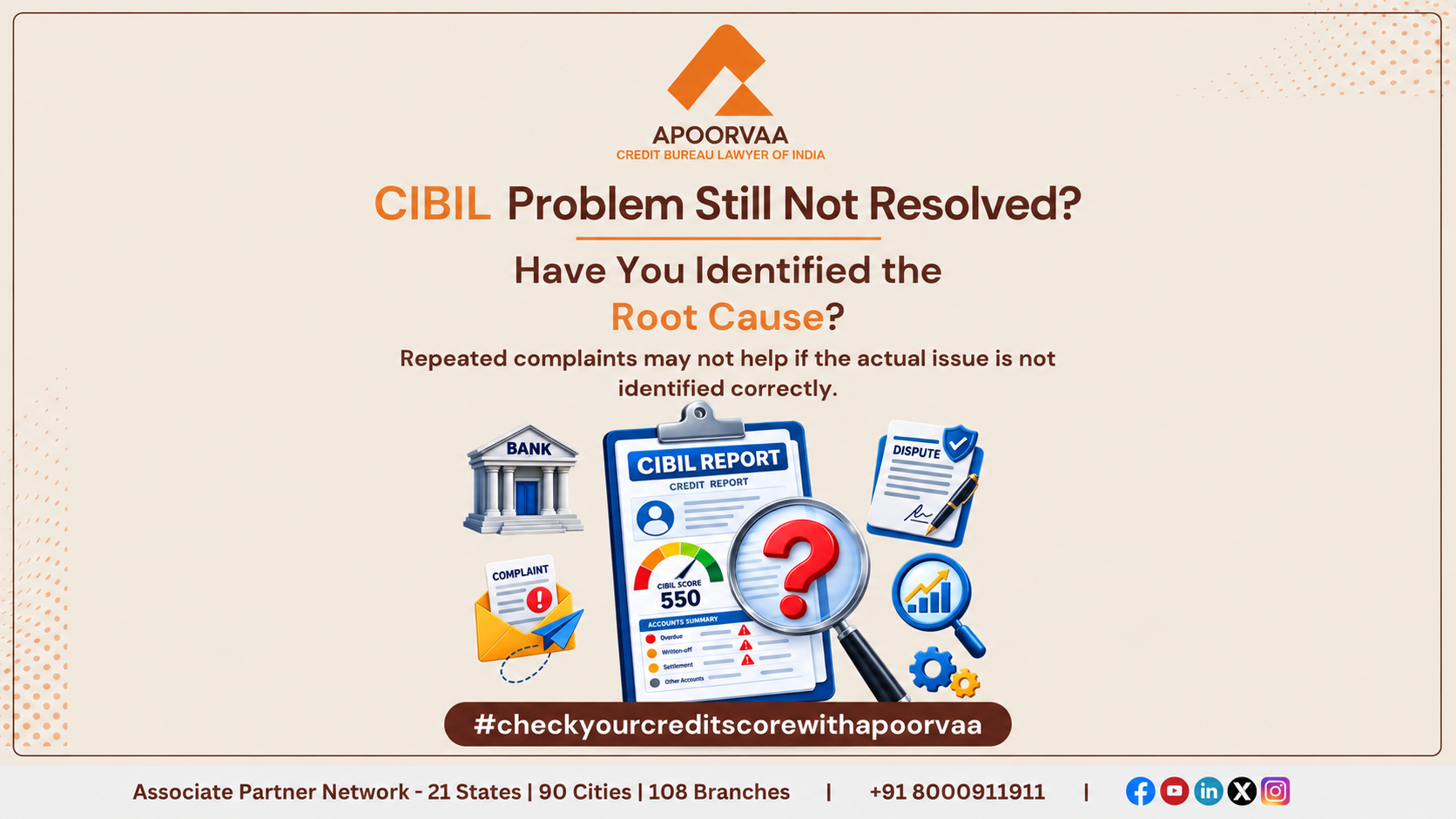
Some customers approach Apoorvaa – Credit Bureau Lawyer of India with a new credit-report problem.
Others approach us after spending six months, a year or even longer trying to resolve the same issue.
Their conversation often begins like this:
“We already contacted the bank.”
“We raised a CIBIL dispute.”
“We sent emails.”
“We escalated the complaint.”
“We approached another professional.”
“We spent money, but the problem is still there.”
By this stage, the customer is understandably frustrated.
Their loan requirement may be affected.
Business funding may be delayed.
Their CIBIL Report may still contain problematic information.
Or, in the case of a business, the company’s credit profile or CIBIL Rank may continue to create difficulties.
The natural reaction is:
“What else can I do?”
But after repeated attempts have failed, we believe there is another question that deserves attention first:
Has the actual root cause of the credit problem been identified correctly?
Because sometimes the problem is not a lack of complaints.
It is a lack of correct diagnosis.
Credit Rectification Should Start With Diagnosis, Not a Complaint
Complaints and disputes are legitimate mechanisms.
If information in a credit report is inaccurate, the customer has the right to seek verification and correction.
CIBIL itself permits disputes across areas such as personal information, account details, enquiries, account ownership and duplicate information.
But this does not mean that every credit-report problem can be resolved simply by raising a standard dispute.
Consider the difference between these situations:
Customer A: An unknown loan appears in the report.
Customer B: Personal identification information appears inconsistent.
Customer C: An old loan contains an account-level reporting issue.
Customer D: The customer has genuine historical dues but believes the information should simply be removed.
Customer E: An earlier account resolution is not reflecting as expected.
All five customers may say:
“My CIBIL is wrong.”
But they do not necessarily have the same problem.
And therefore, they should not automatically receive the same solution.
This is why effective Credit Rectification begins with:
Identify the problem → Understand its nature → Determine the appropriate direction
rather than:
Problem → Immediately raise another complaint
Why Repeated CIBIL Disputes May Not Resolve the Problem
Suppose a customer has already raised a dispute once.
The expected correction does not happen.
So another dispute is raised.
Then another email.
Then another escalation.
Eventually, the customer concludes:
“CIBIL is not correcting my report.”
But before reaching that conclusion, it is important to understand how lender-reported information works.
CIBIL states that information appearing in the report is reported by credit institutions. CIBIL cannot independently delete or modify those records without confirmation from the relevant credit institution.
Therefore, the outcome of a dispute depends heavily on what information is being challenged and what the concerned credit institution verifies.
This makes the original diagnosis extremely important.
If the wrong issue is being challenged repeatedly, increasing the number of disputes may not solve the underlying problem.
The Visible Credit Problem May Not Be the Root Cause
This is where complicated Credit Rectification cases become interesting.
Imagine a customer says:
“There are 20 loans appearing in my CIBIL Report that I never took.”
The visible problem is obvious:
20 Unknown Loans
So the natural response may be:
“Dispute those 20 accounts.”
But what if there is something deeper within the customer’s credit profile that has not been properly examined?
Then the more important question becomes:
“Why are these accounts appearing against this particular credit profile?”
That question can change the entire direction of the assessment.
This is the difference between treating the symptom and understanding the root cause.
A Case That Demonstrates Why Root-Cause Analysis Matters
We encountered a situation where a customer was repeatedly facing problems with loan accounts appearing in the credit profile.
The customer maintained that several of those accounts did not belong to him.
He had already explored different avenues for assistance.
Complaints had been raised.
Professional assistance had been sought.
But the underlying problem continued.
When the credit profile was examined more closely, inconsistencies were also observed in fundamental identifying information—including details relating to the PAN, date of birth and name.
This changed the questions that needed to be asked.
Instead of focusing only on:
“Which loans need to be removed?”
it became important to understand:
“Why is unrelated credit information becoming associated with this profile?”
This distinction is important because CIBIL itself recognises incorrect personal details and account ownership as separate categories of potential inaccuracies. It notes that lenders submit information such as name, date of birth and PAN along with credit-account information, and that incorrect details can contribute to an incorrect credit report being generated.
That does not mean every PAN, name or date-of-birth discrepancy automatically causes another person’s account to appear.
But it does demonstrate why the complete credit profile sometimes needs to be examined rather than treating each visible account as an isolated problem.
Unknown Loan Accounts Require More Than an Assumption
When a customer sees an unknown loan, the reaction is understandably serious.
But the analysis should distinguish between different possibilities.
The account may genuinely not belong to the customer.
There may be an ownership issue.
There may be incorrect identifying information.
There may be duplicate information.
There may be another credit-data inconsistency requiring verification.
CIBIL specifically allows disputes relating to account ownership and duplicate information, in addition to inaccuracies in personal and account details.
Therefore, professional Credit Rectification should not begin by assuming the answer.
It should begin by asking:
What does the available credit information actually indicate?
Symptom-Based Rectification vs Root-Cause-Based Rectification
Consider this simple comparison.
Symptom
“My CIBIL Score is low.”
Possible underlying issues could involve repayment history, outstanding obligations, utilisation or other credit-profile factors.
Symptom
“An unknown loan is appearing.”
The underlying issue may require examination of ownership and associated credit information.
Symptom
“My Current Balance is incorrect.”
The relevant question becomes why the account is currently being reported that way and what the lender’s position is.
Symptom
“My Write-Off is still showing.”
The history and current position of that particular account become relevant.
The visible problem tells us where the customer is experiencing difficulty.
The root cause tells us what may actually need to be addressed.
This is why Credit Rectification expertise is not simply about knowing where to send a complaint.
It is about understanding what problem the complaint, verification or rectification effort should actually address.
Why Customers Can Lose Months Following the Wrong Direction
The financial cost of an unresolved CIBIL problem is not always limited to professional fees.
Time itself can become expensive.
Imagine a business owner whose funding requirement has been delayed for six months.
Or a homebuyer whose loan application is affected by an unresolved credit-report issue.
During those months, the customer may repeatedly:
Raise complaints.
Send emails.
Visit the bank.
Contact different professionals.
Escalate the issue.
Check the report again.
Yet the same underlying problem remains.
At this point, taking more action may not necessarily be the answer.
A better decision may be to reassess:
Are we working on the correct problem?
More Escalation Is Not Always Better Escalation
Today, customers have several grievance and escalation mechanisms available to them.
This is positive.
In fact, RBI has a framework under which complaints involving delayed updation or rectification of credit information are expected to be resolved within 30 calendar days, with compensation provisions applicable for qualifying delays.
But even a strong grievance mechanism works best when the underlying grievance has been identified correctly.
There is a major difference between:
A correctly diagnosed problem that requires escalation
and
An incorrectly understood problem being escalated repeatedly.
The first may require persistence.
The second may require reassessment.
This is why Credit Rectification cannot be reduced to:
“If the first complaint doesn’t work, complain at a higher level.”
Sometimes the better question is:
“Are we complaining about the right thing?”
Why Another Professional Opinion Can Be Valuable
Suppose you have already approached:
A bank official.
An advocate.
A Chartered Accountant.
A financial professional.
Another Credit Rectification service.
Or several of them.
And the issue still remains unresolved.
This does not automatically mean those professionals were wrong.
They may have acted appropriately based on the information available to them and their professional understanding.
But complicated cases can sometimes benefit from a fresh interpretation.
A second opinion allows someone else to ask:
Has anything been overlooked?
Does the credit report suggest another possible issue?
Are we treating the symptom rather than the root cause?
Is the existing course of action actually appropriate?
A good second opinion may even conclude:
“The earlier professional’s direction appears correct.”
That is still valuable.
Because the purpose of a second opinion should be clarity, not criticism of whoever handled the case earlier.
Don’t Search for Someone Who Simply Agrees With You
There is also a responsibility on the customer.
A second opinion should not mean:
Professional 1 says this cannot legitimately be removed → find Professional 2.
Professional 2 says the same → find Professional 3.
until someone finally promises:
“Yes, everything can be deleted.”
That is not the purpose of professional consultation.
A useful second opinion should help determine:
What is actually wrong?
What appears genuine?
What requires verification?
What may realistically be rectified?
and
What may not have the outcome the customer originally expected?
Expertise sometimes means telling the customer what they need to understand, not simply what they want to hear.
When the Problem Has Continued for Months, Stop and Reassess
If your CIBIL problem has continued despite repeated efforts, consider whether you are now in this cycle:
Problem → Complaint → No Result → Another Complaint → No Result → Another Professional → Same Problem
At some point, it can be sensible to interrupt that cycle.
Not by giving up.
But by returning to the beginning:
What is the root cause?
Because once the problem is understood correctly, the appropriate direction can become much clearer.
hen Professional Credit Rectification Becomes Relevant
Not every credit-report problem requires professional Credit Rectification.
Some customers may identify a straightforward issue, approach the concerned institution through the appropriate channel and get the information clarified or updated.
But professional assistance can become particularly relevant when the situation is no longer straightforward.
For example:
- The problem has remained unresolved for months despite repeated attempts.
- Multiple disputes or complaints have already been raised.
- Several accounts or different types of issues exist in the same credit report.
- Unknown accounts continue to appear.
- Personal information and account information appear inconsistent.
- An old Write-Off, Settled account or other historical credit issue is involved.
- Different professionals have given different explanations.
- The customer does not understand why earlier attempts have failed.
- An important loan or business-funding requirement is being affected.
At this stage, the value of professional assistance is not simply:
“We know where to complain.”
The greater value lies in understanding:
What exactly is affecting the credit profile, and what direction is appropriate for that particular issue?
What Apoorvaa Looks at When a Credit Problem Has Already Been Worked On
At Apoorvaa – Credit Bureau Lawyer of India, unresolved cases require a different mindset from a completely new credit-report query.
When a customer approaches us after already spending months on the problem, we do not believe the right starting point is:
“Forget everything that has happened. Let us start again.”
What has already happened can itself provide important context.
We first try to understand the overall situation.
What is currently appearing in the credit report?
What does the customer believe is incorrect?
How long has the issue existed?
What action has already been taken?
What response has been received?
Has the information changed at any stage?
Is the customer’s understanding of the problem consistent with what is actually appearing in the report?
This does not mean every case requires the same analysis.
The objective is to understand the history and present position of the problem before deciding what may need attention next.
Previous Attempts Can Provide Important Clues
Customers sometimes feel that the six months they have already spent on the issue have been completely wasted.
That is not necessarily true.
Earlier disputes, lender communications, complaint responses, previous credit reports and subsequent reports can sometimes help explain how the issue has developed.
For example, they may help establish:
What was originally reported
What was challenged
What response was received
Whether anything changed
and
What remains unresolved today
Therefore, when a customer seeks a second opinion, previous work should not automatically be ignored.
It can become part of understanding the case.
The purpose is not to repeat everything.
It is to determine whether the earlier efforts were directed toward the actual underlying problem.
A Second Opinion Is Different From Restarting Credit Rectification
This distinction is important.
Suppose you have already worked with another professional for several months.
Taking a second opinion from Apoorvaa does not automatically mean:
“Stop working with them and transfer the case to us.”
The first purpose of a second opinion should be clarity.
We may find that:
The existing direction appears appropriate.
Or:
Another aspect of the credit report deserves examination.
Or:
The customer’s expectation about what can be changed may need clarification.
Or:
The visible problem may not fully explain the underlying credit issue.
Only after understanding the situation should the customer decide what to do next.
This makes the second opinion useful even when no further Credit Rectification service is required.
Sometimes Our Opinion May Be: Continue With the Existing Process
This point matters to us.
A professional second opinion should not automatically result in:
“Your existing service provider is wrong. Give the case to us.”
That would defeat the purpose of an independent assessment.
If the information available indicates that the customer’s existing professional or grievance process is already moving in an appropriate direction, the customer should know that.
Similarly, if an existing dispute is still under consideration through the relevant process, immediately starting multiple parallel actions may not necessarily be useful.
The objective of an expert opinion should be to provide clarity about the credit problem, not simply to acquire another case.
Why We Don’t Assume Every Unresolved CIBIL Problem Can Be “Fixed”
Customers sometimes approach us with an expectation:
“I have already tried everywhere. You are my last option, so please remove this information.”
We understand the frustration behind that statement.
But professional Credit Rectification requires realistic expectations.
The fact that information is negatively affecting a CIBIL Score does not automatically mean that the information is inaccurate.
A genuine unpaid obligation cannot simply be treated as an error because the customer now requires another loan.
Similarly, genuine historical repayment behaviour does not become incorrect merely because it is creating difficulty today.
On the other hand, if there is inaccurate information, an unknown account, inconsistent data or another legitimate reporting issue, the nature of that problem deserves proper examination.
Therefore, we do not begin with:
“Can this negative entry be removed?”
We begin with:
“What is the actual issue, and what outcome can legitimately be pursued?”
That distinction is fundamental to professional Credit Rectification.
The Customer’s Expectation Is Also Part of the Diagnosis
Sometimes the credit report is not the only thing that needs clarification.
The customer’s expectation may also need to be understood.
A customer may believe:
“If I raise a dispute, the negative account must disappear.”
Another may believe:
“If I hire an advocate, CIBIL must delete the account.”
Another may expect:
“If I pay someone for Credit Rectification, they should guarantee my score.”
These expectations can lead to disappointment even when the underlying credit information is genuine.
This is why a proper consultation should also help the customer distinguish between:
What is negative
What may be inaccurate
What requires verification
and
What may realistically be addressed.
Sometimes giving the customer this clarity is itself an important part of professional assistance.
Why Root-Cause Analysis Matters Even More in Multiple-Issue Cases
A credit report may contain more than one problem.
For example, one customer may simultaneously have:
An old Write-Off account
An unfamiliar loan account
A Current Balance issue
A personal-information discrepancy
and
A low CIBIL Score
If everything is treated as one generic:
“CIBIL problem”
the case can become confusing.
Different issues may have different causes.
Different institutions may be involved.
And different outcomes may be possible.
This is why complicated Credit Rectification should not be reduced to one standard complaint template.
The first objective is to understand the individual issues within the overall credit profile.
Why Apoorvaa Encourages Customers to Understand Their Own Case
Credit Rectification should not be a black box.
A customer should not spend months hearing only:
“Work is going on.”
without understanding what the actual issue is.
At Apoorvaa, we believe customers should have reasonable clarity about:
What problem has been identified
What is being worked upon
and
What progress is taking place
particularly when several issues exist in the same credit profile.
This becomes even more important for customers who have previously spent months moving between different solutions without understanding why the problem remained unresolved.
Our objective is not simply to take over the problem.
It is to help the customer understand the problem first.
Progress Should Be Verifiable
The same principle applies after Credit Rectification work begins.
A verbal statement such as:
“Your issue has been resolved.”
should not be the only basis on which the customer understands the outcome.
Where a credit-report issue is being worked upon, the customer should ultimately be able to examine the relevant updated credit information.
At Apoorvaa, we preserve the earlier report used for the case so that the relevant information can be compared with subsequent updates.
When multiple issues are being handled, customers are kept informed as individual issues progress. Relevant updated screenshots can be shared as changes become visible, and an updated credit report can also be provided as appropriate or on request.
Most importantly, we genuinely encourage customers to access their own latest report through the official credit bureau platform and verify the outcome independently.
The principle is simple:
Don’t depend only on our word. Verify what your latest credit report actually shows.
This makes Credit Rectification more transparent and gives the customer a clearer understanding of the result.
Free Second Opinion Before You Spend More Time and Money
If you have already spent months trying to resolve a CIBIL or credit-report problem, another paid service should not automatically be your next step.
First, understand whether you are working on the right problem.
At Apoorvaa – Credit Bureau Lawyer of India, customers with an unresolved credit-report issue can seek an initial second opinion without consultation fees.
This can be particularly useful if you have already:
Raised multiple disputes
Contacted the lender
Sent repeated emails or complaints
Approached another professional
Spent several months on the issue
or
Still do not understand why your credit report remains unresolved.
The purpose of the initial opinion is to understand the situation and provide a professional perspective on the apparent credit-report issue.
It does not mean every case will require Apoorvaa’s paid Credit Rectification service.
If further professional work appears relevant, the customer can understand the proposed scope before deciding whether to proceed.
Helpline: +91 8000 911 911
Before Taking a Second Opinion, Keep These Records Available
If you have already worked on the problem, preserve whatever documentation is available.
Useful information may include:
- Latest detailed credit report
- Earlier credit report showing the original issue
- Relevant lender communications
- Previous dispute responses
- Relevant complaint responses
- Payment or closure documentation, where applicable
- Information about what has already been attempted
You do not need to determine the technical solution yourself.
These records simply help provide context so that the issue can be understood more accurately.
Don’t Lose Another Six Months Repeating the Same Action
There is a practical lesson in all of this.
If you have already:
Raised the same dispute repeatedly
Sent the same complaint through different channels
Approached multiple people
and
Still cannot explain why the problem exists,
consider whether another round of the same action is really the best next step.
A second opinion can help answer a much more fundamental question:
“Are we working on the correct problem?”
If the answer is yes, you gain confidence that the existing direction may be appropriate.
If the answer is no, identifying a different underlying issue may change what needs to happen next.
Either way, you gain something extremely valuable:
Clarity.
Frequently Asked Questions
My CIBIL problem has not been resolved even after several complaints. What should I do?
If repeated attempts have not resolved the issue, consider reassessing whether the underlying credit-report problem has been identified correctly rather than automatically repeating the same complaint.
I have already hired another Credit Rectification company. Can I still take a second opinion?
Yes. A second opinion does not automatically mean changing your existing service provider. Its purpose is to obtain another professional assessment of the problem.
Will Apoorvaa tell me whether my previous professional was wrong?
That is not the objective. The purpose is to understand the credit-report issue based on the information available. The existing direction may be appropriate, or another aspect of the case may deserve examination.
Can every negative CIBIL entry be removed?
No. Negative information should not automatically be treated as inaccurate. Genuine credit history and potentially incorrect credit information need to be distinguished.
Several unknown loans are appearing in my CIBIL Report. What should I do?
Unknown accounts require proper examination. The broader credit profile, including relevant identification and account information, may also need to be considered to understand the nature of the issue.
My PAN, name or date of birth appears incorrect. Does that mean another person’s loan has been merged with mine?
Not automatically. Personal-information inconsistencies can be relevant when assessing an unusual credit profile, but the actual cause should be determined from the available credit information rather than assumed.
Does Apoorvaa guarantee that an unresolved CIBIL problem will be corrected?
No professional assessment should begin with a guarantee that every problem can be corrected. The nature of the information, underlying account history and actual issue first need to be understood.
Does Apoorvaa provide a free second opinion?
For the initial second-opinion consultation discussed here, there is no consultation fee. If the case requires further professional Credit Rectification work, the scope can be discussed separately.
How will I know whether the work is actually completed?
The relevant outcome should be verifiable through updated credit information. We encourage customers to review their own latest credit report and compare the relevant information with the earlier report.
Final Takeaway
When a CIBIL problem remains unresolved after months of effort, the answer is not always:
Another complaint.
Another dispute.
Another escalation.
Sometimes the more important step is to return to the beginning and ask:
What is actually causing the problem?
Credit Rectification should not be a race to send the maximum number of complaints.
It should begin with understanding the credit profile, identifying the actual issue and determining an appropriate direction.
And when a customer has already spent considerable time and money without gaining clarity, a second expert opinion can be valuable.
Not because everyone who worked on the case earlier was necessarily wrong.
But because a fresh assessment may:
Confirm the existing direction,
identify something that deserves another look,
or simply help the customer finally understand why the problem remains unresolved.
At Apoorvaa – Credit Bureau Lawyer of India, that is the purpose of our second-opinion approach:
Understand first. Act appropriately. Keep the customer informed. Verify the outcome.
Related Credit Education
- Low CIBIL Score: 5 Reasons You Should Check
- How to Improve CIBIL Score: Fix the Real Problem First
- CIBIL Rectification: How to Verify Your Report Is Corrected
Need a Second Opinion on an Unresolved Credit-Report Issue?
If you have already contacted the bank, raised disputes, approached professionals or spent months trying to resolve your credit-report problem—but still do not understand why it remains unresolved—you can seek an initial second opinion from Apoorvaa – Credit Bureau Lawyer of India.
Initial second opinion: No consultation fee
The objective is not to promise that every negative entry can be removed. It is to understand your credit-report issue and determine whether the existing direction appears appropriate or whether another aspect requires examination.
Helpline: +91 8000 911 911