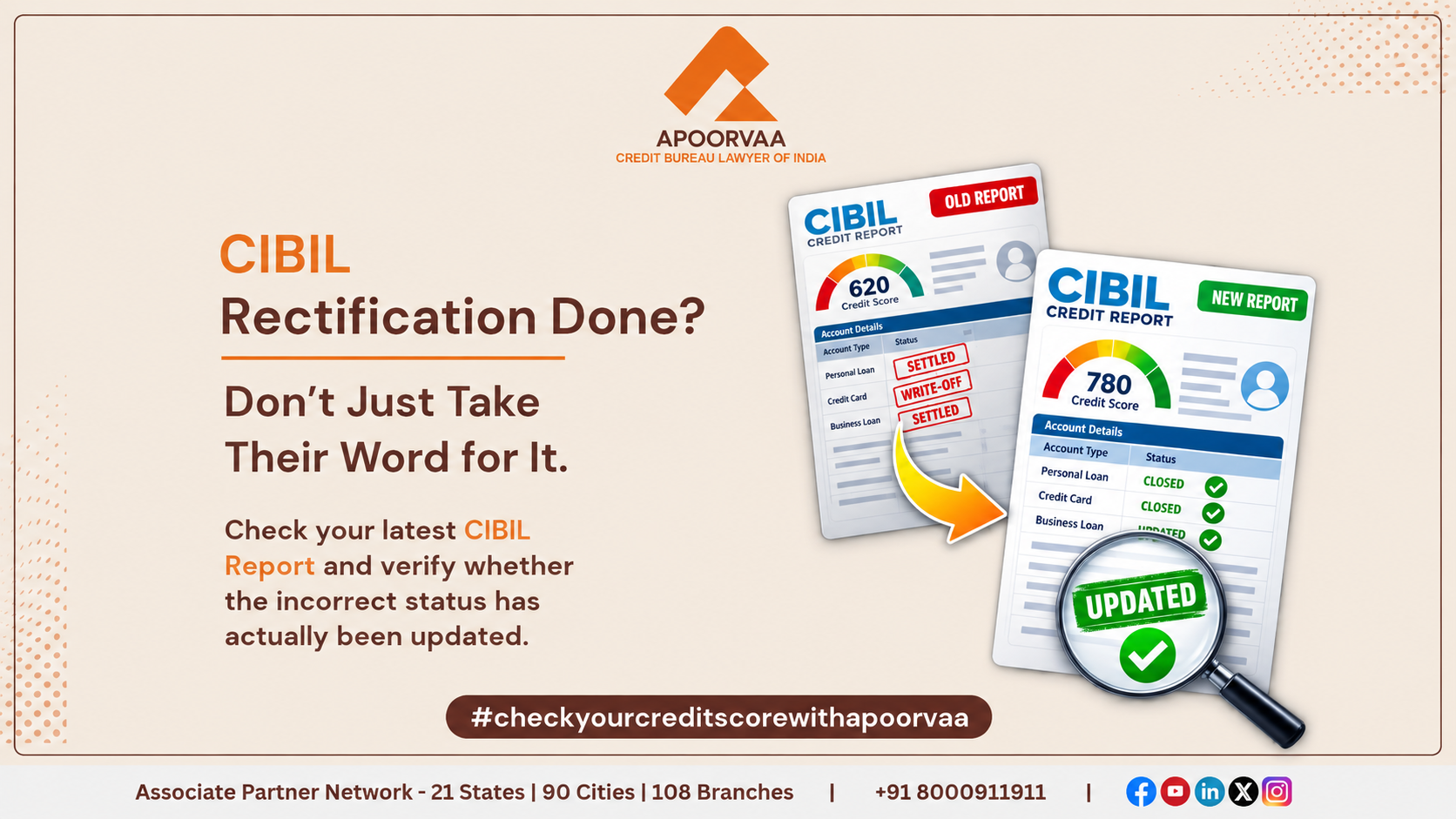
CIBIL Rectification should not be considered complete merely because a consultant, professional, lender or service provider tells you that the work has been done. If the process was started to correct inaccurate information in your CIBIL Report, the actual result should be verified through your latest credit report.
This is particularly important when the original issue involved information such as a Write-Off, Settled status, incorrect outstanding balance, incorrect overdue amount, DPD, account ownership or another credit-reporting discrepancy.
A common question we receive is:
“Mujhe kaise pata chalega ki mera CIBIL ka kaam actually ho gaya hai?”
The answer is straightforward:
Know what was incorrect in your earlier report, obtain the latest report, and verify whether that specific information has actually been corrected.
A verbal confirmation saying “Your CIBIL is fixed” is not enough.
The result should be visible and verifiable in the credit report.
What Does Successful CIBIL Rectification Actually Mean?
Before deciding whether CIBIL Rectification has been successful, you need to know what you were trying to rectify in the first place.
For example, perhaps your earlier CIBIL Report showed:
Account Status: Settled
Or:
Written-Off / Write-Off related status
Or an incorrect:
- Current balance
- Amount overdue
- DPD
- Payment history
- Account ownership
- Closure status
- Account information
If one of these specific pieces of information was inaccurate and the rectification process was undertaken to correct it, the final verification should focus on that information.
Suppose an incorrect outstanding balance of ₹2 lakh was the issue.
The question after rectification should not simply be:
“Mera CIBIL Score badha ya nahi?”
The first question should be:
“Is the incorrect ₹2 lakh outstanding balance now appropriately updated?”
That is how rectification should be measured.
Your Latest CIBIL Report Is the Verification Point
Consider this situation.
Your previous CIBIL Report contained an incorrect Settled status against a particular loan account.
You completed the required process.
Later, you receive a call:
“Sir/Ma’am, your work has been completed.”
What should you do?
Obtain your latest CIBIL Report.
Locate the same lender and loan account.
Check the specific field that was under rectification.
If the information now corresponds with the verified updated position, you have evidence that the change is reflecting in the report.
If the same disputed information continues to appear, the matter may still require examination depending on the reporting timeline and the lender’s records.
The principle is:
Don’t verify CIBIL Rectification through a conversation. Verify it through the reported information.
Keep Your Old CIBIL Report Before Starting Rectification
One of the most useful things a consumer can do is preserve the credit report that originally contained the problem.
Do not rely only on memory.
Do not keep only a screenshot of your CIBIL Score.
Keep the relevant complete report.
Why?
Because the old report establishes the original reporting position.
Suppose the issue was:
Bank: XYZ Bank
Account: Personal Loan
Reported Issue: Settled status
When you later obtain a fresh report, you know exactly which account and information you need to verify.
This creates a clear process:
Old Report → Identify the Issue → Rectification → Latest Report → Verify the Update
Without identifying the original issue properly, the consumer may end up judging the entire process only by whether the score increased.
That can be misleading.
Don’t Use CIBIL Score Alone to Verify Rectification
A very common mistake is checking only the CIBIL Score after rectification.
For example:
Before Rectification: 620
After Rectification: 690
The consumer sees the increase and assumes:
“My entire CIBIL problem has been corrected.”
That conclusion should not be made from the score alone.
If the original rectification concerned a specific inaccurate account status, balance, DPD or ownership issue, check that particular information.
The reverse situation is equally important.
Suppose the incorrect information has genuinely been corrected, but the score does not increase as much as the consumer expected.
That does not automatically mean the correction failed.
The credit score is calculated from the broader credit information in the consumer’s profile.
Other information may still influence the score.
Therefore:
CIBIL Rectification = Verify the corrected information.
Credit Score = Evaluate the broader credit profile.
The two are connected, but they should not be treated as identical.
What Should You Check After CIBIL Rectification?
What you check depends entirely on the issue that was being rectified.
If the Issue Was a Settled Status
Locate the relevant loan account and check what status is now being reported.
The objective should be to verify whether the latest reporting corresponds with the actual updated position confirmed through the appropriate process.
If the Issue Was a Write-Off Status
Check the relevant account information in the latest report.
Do not rely solely on someone saying:
“Write-Off remove ho gaya hai.”
Verify what is actually reflecting.
If the Issue Was an Incorrect Outstanding Amount
Check the current balance and overdue information against the relevant lender records.
If payment has already been made but an incorrect balance continues to appear, that may require further verification.
If the Issue Was Incorrect DPD
Review the relevant payment-history information.
Do not assume that clearing an account automatically removes genuine historical DPD. The question is whether the DPD itself was inaccurately reported.
If the Issue Was an Unknown Loan
If a loan that you genuinely never took was appearing in your report, check whether that account is still being attributed to your credit profile.
This is an ownership issue and should be verified separately from ordinary repayment-related rectification.
“Our Portal Shows Corrected” — Should You Accept That?
A consumer may sometimes be told:
“Hamare portal se update ho gaya.”
“Bank ke system mein change ho gaya.”
“Correction request processed hai.”
These statements can indicate that a particular stage of the process has been completed.
But they should not replace final verification.
There is a difference between:
The lender processing an update
and
the updated information reflecting in your latest credit report.
If the lender has recently processed the correction, there may be a reporting interval before the change becomes visible in the report.
Therefore, the consumer should understand the timing rather than immediately assuming either:
“Nothing has happened.”
or
“Everything is completed.”
The latest credit report, after the relevant reporting process, provides the clearest verification.
Understand the Credit Reporting Timeline
Credit information does not necessarily change in your report the moment a lender processes a correction.
Under RBI’s current credit-information framework, credit institutions are required to submit credit information to Credit Information Companies on a fortnightly basis, as of the 15th and last day of every month, within the prescribed timelines.
Therefore, if a correction was processed very recently, the updated information may require the relevant reporting cycle before it becomes visible.
This is why you should check:
- Date the lender processed the update
- Date of the latest credit report
- Date Reported for the concerned account
- Whether the subsequent reporting cycle has occurred
- Whether the relevant information is now updated
However, reporting timelines should not become an excuse for indefinite assurances.
If sufficient time has passed and the information remains genuinely inconsistent with the lender’s records, the matter should be examined further.
Dispute Resolution and Actual Correction Are Not Always the Same
Suppose you raised a CIBIL dispute regarding inaccurate information.
Later, the dispute status shows that the matter has been resolved.
Does that automatically mean the information was changed exactly as you requested?
Not necessarily.
A dispute involves verification of the reported information with the concerned credit institution.
Therefore, the outcome may be:
Information updated following verification
or
Information retained following verification.
That is why a consumer should not stop at:
“My dispute is closed.”
The next step is:
“What does my latest CIBIL Report show?”
This distinction is important because dispute closure is a process outcome; accurate reporting is the objective.
What If the Same Write-Off or Settled Status Is Still Showing?
Suppose you started CIBIL Rectification specifically because of an incorrect status.
You complete the required process.
You are told that the work has been done.
After the appropriate reporting period, you obtain your latest report—and the same disputed information is still appearing.
Do not rely indefinitely on:
“Ho jayega.”
Instead, check:
- What did the lender agree or confirm?
- Was the required update actually processed?
- What supporting documentation is available?
- What is the latest Date Reported?
- Has the relevant reporting period passed?
- Does the latest information correspond with the lender’s current records?
If a genuine discrepancy continues, further follow-up may be required.
The objective throughout should remain the same:
Establish the correct information and verify that it is being reported accurately.
CIBIL Rectification Should Have a Verifiable Outcome
A professional Credit Rectification process should not be vague.
The starting point should be:
What exactly is wrong?
The finishing point should be:
Has that specific information actually been corrected?
For example:
An incorrect account status was identified.
Supporting information was obtained.
The appropriate rectification process was followed.
A fresh report was obtained.
The concerned account was checked.
The updated information was verified.
That is a measurable process.
Compare this with:
“Your CIBIL was bad. Now your CIBIL is good.”
That statement provides very little information about what was actually corrected.
A consumer should understand the issue, the action and the result.
CIBIL Rectification should be transparent, evidence-based and verifiable.
How Apoorvaa Verifies Whether CIBIL Rectification Is Actually Complete
At Apoorvaa – Credit Bureau Lawyer of India, we believe CIBIL Rectification should have a result that the customer can verify.
The process should not end with:
“Your work is done.”
It should end with a clear understanding of:
What was incorrect?
What was supposed to be corrected?
What is reflecting in the latest credit report?
For this reason, verification is an important part of our Credit Rectification process.
When a customer starts working with us, we preserve the earlier credit report containing the identified issues. This gives both our team and the customer a reference point for understanding what was appearing before the rectification process began.
Once the work is completed, we provide an updated credit report, enabling the customer to compare the earlier and latest reports and verify the result independently.
The customer does not have to depend only on our statement that:
“Your CIBIL work is completed.”
They can see the result themselves.
We Keep the Customer Informed Throughout the Rectification Process
Transparency should not begin only after the work is completed.
During the CIBIL Rectification process, we keep the customer informed about the progress of the identified issues so that they understand what is happening with their case.
A credit report may contain one issue or multiple issues.
For example, one customer’s report may involve:
- Incorrect Settled status
- Write-Off related reporting
- Incorrect outstanding balance
- Incorrect overdue amount
- DPD-related discrepancy
- Account ownership issue
- Incorrect closure information
- Another reporting discrepancy
When multiple issues are being handled, they may not necessarily be resolved at the same time.
Therefore, we do not wait until the entire case is completed before giving the customer visibility into the progress.
As an individual issue gets resolved and the updated information becomes available, we share the relevant updated screenshot with the customer.
This allows the customer to understand:
Which issue was being handled?
What progress has been made?
What information is now reflecting?
And where required or requested, an updated credit report can also be provided during the process.
This makes the customer part of the verification process rather than leaving them unaware of what is happening behind the scenes.
Before and After Verification Is Important
We preserve the customer’s earlier credit report because it provides an important reference for the rectification work.
Suppose the original report contained an incorrect status against a particular loan account.
That report establishes the position before rectification.
Once the relevant information is updated, the latest report establishes the position after rectification.
The customer can therefore independently see:
What was appearing earlier?
What is appearing now?
This before-and-after verification is much more meaningful than simply telling the customer that the work has been completed.
Our team also helps the customer understand the relevant changes between the earlier and updated reports, particularly where credit-report terminology or account information may be difficult to interpret.
We Encourage Customers to Verify Their Own CIBIL Report
Customers should not feel that they must depend entirely on a Credit Rectification company to know what is appearing in their own credit report.
At Apoorvaa, we genuinely encourage customers to check their latest credit report themselves through the official credit bureau website.
This gives the customer an additional layer of independent verification.
If we inform a customer that a particular issue has been updated, the customer can also access the latest available report through the bureau’s official platform and check the relevant account.
This is particularly important because the customer’s own credit report is ultimately the place where the updated information should be visible.
Our approach is therefore not:
“Trust us because we say the work is completed.”
It is:
“Here is the update. Understand it, compare it and verify it yourself as well.”
That transparency is an important part of how we approach Credit Rectification.
Updated Screenshots Help Track Multiple Issues
Some Credit Rectification cases involve more than one reporting issue.
For example, a customer’s report may contain problems involving different accounts or different reported fields.
If five separate issues are identified, all five may not be resolved simultaneously.
In such cases, progress should be visible issue by issue.
At Apoorvaa, when an individual issue is cleared and the updated information becomes available, we provide the customer with the relevant updated screenshot.
This helps the customer track the case progressively rather than waiting until the end without knowing what has happened.
For example:
Issue 1 → Updated → Customer informed
Issue 2 → Updated → Customer informed
Issue 3 → Process continuing
This gives the customer a clearer understanding of the status of the overall rectification work.
Where the customer wants further verification, an updated credit report can also be provided on request during the process.
And once the work is completed, the updated report enables the customer to verify the final position against the original report.
What Documents Should Be Preserved During CIBIL Rectification?
Proper documentation remains important throughout the process.
Depending on the nature of the case, relevant records may include:
- Original credit report
- Updated credit report
- Loan account statements
- Payment receipts
- Closure documents
- No Due Certificate/NOC, where applicable
- Settlement-related documents, where relevant
- Lender correspondence
- Complaint or dispute references
- Written responses received during the process
At Apoorvaa, preserving the earlier report is particularly important because it establishes the starting point of the case.
Without knowing what was originally appearing, it becomes more difficult to demonstrate what subsequently changed.
The objective should always be to maintain a clear record of:
Original issue → Action taken → Updated information → Verification
Don’t Verify CIBIL Rectification Only Through Screenshots
Although we use updated screenshots to keep customers informed as individual issues are resolved, screenshots should not be confused with the final verification of the complete credit profile.
A screenshot is useful because it allows the customer to quickly see the particular account or information that has changed.
However, once the rectification work is completed, the updated credit report provides broader verification.
That is why both have a role in our process.
Updated screenshot → Progress visibility
Updated credit report → Comprehensive verification
And customers can independently access their own latest available report through the official bureau website as an additional verification step.
What If CIBIL Is Updated but Another Credit Bureau Is Not?
India has multiple Credit Information Companies, including TransUnion CIBIL, Experian, Equifax and CRIF High Mark.
An update visible in the CIBIL Report establishes the position currently appearing in that report.
It does not automatically establish that the same information is already reflecting identically across every other credit bureau.
Therefore, if a customer’s rectification work involves information appearing across multiple credit bureaus, the relevant reports may need to be verified separately.
This is why the starting analysis should identify:
Which bureau has the issue?
Which account is involved?
What information requires rectification?
The final verification should then correspond with that original scope.
Credit Rectification Does Not Mean Deleting Every Negative Entry
Transparency also means being clear about what CIBIL Rectification can and cannot legitimately address.
Not every negative item appearing in a credit report is necessarily incorrect.
Suppose a customer genuinely delayed several EMI payments and those delays were accurately reported.
The customer later clears the loan.
That does not automatically make the historical repayment information inaccurate.
Similarly, negative information should not be treated as an error merely because it affects the customer’s credit score.
The fundamental question remains:
“Is the information being reported accurate?”
If information is genuinely inaccurate, there may be a basis for rectification.
If it is accurate, Credit Rectification should not be represented as artificial deletion of genuine credit history.
What If Incorrect Information Still Appears?
If an issue was expected to be corrected but the latest report continues to show the same information, the next step should be to understand why.
Relevant questions include:
- Has the lender processed the required update?
- What is the latest Date Reported?
- Has the relevant reporting cycle occurred?
- What does the lender’s documentation show?
- What was the outcome of the dispute or complaint?
- Is the information actually inaccurate?
- Does further follow-up remain necessary?
This is another reason continuous customer communication matters.
Instead of leaving the customer with only:
“Work is in process,”
they should understand what stage the matter has reached and what remains pending.
Understand the 30-Day Credit Information Complaint Framework
RBI has prescribed a framework for complaints relating to updation or rectification of credit information.
Under the applicable framework, there is an overall 30-calendar-day period for resolution of such complaints.
The framework also provides compensation of ₹100 per calendar day for eligible delays beyond the prescribed period, subject to the applicable conditions.
However, this provision should be understood correctly.
It does not mean:
“Every negative entry must be deleted within 30 days.”
It means that qualifying complaints relating to updation or rectification of credit information are subject to the prescribed resolution framework.
The information itself still needs to be verified.
If the lender confirms that particular information is accurate, the fact that the information negatively affects the credit profile does not automatically create a basis for deletion.
What If a Dispute Is Closed but the Report Has Not Changed?
A customer should not assume that the words “dispute resolved” automatically mean that the requested information has been changed.
The actual outcome needs to be checked.
After the dispute process, review the latest report and verify what is now appearing against the concerned account.
If the information remains unchanged, understand:
Why was it retained?
What did the lender verify?
Does the available documentation support a different position?
Repeatedly raising the same dispute without understanding the underlying reason may not resolve the issue.
The focus should remain on establishing whether a genuine reporting discrepancy exists.
CIBIL Rectification and Credit Score Improvement Are Different
Another important point customers should understand is that correcting inaccurate information and achieving a particular credit score are not the same thing.
Suppose an incorrect account status is successfully rectified.
That correction can be verified through the updated report.
However, the customer’s credit profile may contain other factors that influence the score.
Therefore, an exact score increase should not be treated as the only measure of successful rectification.
The better question is:
“Has the information that was genuinely incorrect been corrected?”
If yes, that specific rectification outcome can be verified.
Common Mistakes Customers Should Avoid
- Accepting Only Verbal Confirmation
Ask to see the actual updated information.
- Checking Only the CIBIL Score
Check the particular account or field that was under rectification.
- Not Preserving the Original Report
The original report provides the baseline for verification.
- Depending Entirely on the Service Provider
Customers should also verify their own report through the official bureau platform.
- Assuming Every Issue Will Be Resolved Together
Where multiple issues exist, progress may occur issue by issue.
- Assuming a Screenshot Is the Complete Report
Screenshots are useful for progress updates, but the latest report provides broader verification.
- Treating Dispute Closure as Automatic Correction
Always check the actual reported outcome.
- Expecting Accurate Negative Information to Be Deleted
Rectification should focus on genuine inaccuracies.
The Apoorvaa CIBIL Rectification Verification Process
Our approach can be summarized simply:
- Analyse the original credit report
We identify the specific issues requiring attention.
- Preserve the original report
This establishes the position before the work begins.
- Work on the identified issues
Each issue is handled according to its nature and available supporting information.
- Keep the customer informed
The customer receives progress updates during the process.
- Share issue-wise updates
When an issue is cleared and the updated information becomes available, the relevant screenshot is shared.
- Provide updated reports
Updated reports can be provided during the process where required or requested, and after completion the customer receives the updated report for verification.
- Help the customer compare and understand
Our team helps explain the relevant changes between the earlier and updated reports.
- Encourage independent verification
Customers are encouraged to check their own latest report through the official credit bureau website.
The objective is straightforward:
The customer should not merely be told that the work is complete. The customer should be able to verify it.
Frequently Asked Questions
How does Apoorvaa show me that my CIBIL Rectification is completed?
After completion of the rectification work, we provide the updated credit report so that the customer can compare it with the earlier report and verify the relevant changes.
Will I know what is happening while my case is in process?
Yes. Customers are kept informed about the progress of the identified issues during the rectification process.
What happens if my credit report has multiple issues?
Multiple issues may be resolved at different stages. When an individual issue is cleared and the updated information becomes available, we share the relevant updated screenshot with the customer.
Can I ask for an updated credit report during the process?
Where required, an updated credit report can also be provided on request so that the customer can verify the current position.
Can I check the result myself?
Yes. In fact, we encourage customers to independently check their latest available credit report through the official credit bureau website.
Why does Apoorvaa preserve my earlier credit report?
The earlier report establishes what was appearing before rectification. It provides a reference for understanding and verifying what has subsequently changed.
Does an updated screenshot mean the entire case is completed?
Not necessarily. If multiple issues are being handled, a screenshot may confirm the progress of a particular issue while other issues remain under process.
Is a higher CIBIL Score proof that all my issues are resolved?
No. Each identified issue should be verified individually. Credit score movement and correction of a specific reporting discrepancy should not be treated as exactly the same thing.
Final Takeaway
CIBIL Rectification should be transparent from beginning to end.
A customer should not have to wait until the end of the process and simply accept:
“Your work is done.”
At Apoorvaa, we believe the customer should understand what is happening throughout the process.
We preserve the original report.
We identify the issues.
We keep the customer updated.
When individual issues are cleared, we share the relevant updated screenshots.
Where required or requested, updated reports can be provided during the process.
After completion, we provide the updated credit report so the customer can verify the result against the earlier report.
And importantly, we encourage customers to independently access their latest credit report through the official credit bureau website and verify the result themselves.
Because the objective of professional Credit Rectification should not be to ask the customer to blindly trust a claim.
It should be to give the customer enough transparency and evidence to say:
“I have checked my report myself. I can see what has changed.”
Related Credit Education
Keep these three titles and hyperlink them to the respective published articles when uploading the blog:
- Outstanding Bank Dues: Can CIBIL Be Fixed Without Payment?
- CIBIL Enquiries: Can Loan Enquiries Be Removed?
- Low CIBIL Score: 5 Reasons You Should Check
Need Help With CIBIL Rectification?
If your CIBIL Report contains an incorrect Write-Off, Settled status, outstanding amount, DPD, account ownership issue or another reporting discrepancy, the first step is to identify exactly what is wrong.
At Apoorvaa – Credit Bureau Lawyer of India, our approach focuses on analysis, transparency, regular customer updates and verifiable outcomes.
We don’t believe the customer should simply hear that the work has been completed.
The customer should be able to see and verify the result.